24 October 2012

Aerocaps for pick-up trucks
Aerocaps for pick-up trucks

by Bakari Kafele on October 24, 2012
AerolidWhen people think about fuel economy, they usually think about small cars, perhaps a mid-size hybrid.  If they think about trucks, its usually to contrast them with a more efficient vehicle (and perhaps chastise truck owners for their wasteful choice).
But while cars are great if you need to get yourself and maybe a few other people from one place to another, they don’t excel in moving large amounts of stuff, and can’t tow very much.
If you regularly need to move lots of big, bulky, or heavy stuff, or tow something large and heavy, but rarely need to move more than a couple people, a truck makes a lot of sense.
Of course there is a reason that trucks are seen as inefficient: they are.  They are heavy, overpowered (although cars are even more so these days), and not at all aerodynamic.
Then again, because trucks get such low mileage to begin with, improvements in their mileage have a relatively bigger impact.  For example, an increase of 15mpg for a 45mpg car is a 33% increase and will save 55 gallons of fuel over 10,000 miles.  Not bad, but that same 15mpg improvement to a 15mpg truck is a 100% increase, saving 333 gallons over the same distance.
So what is a mpg-conscious person who needs to move a lot of stuff to do?


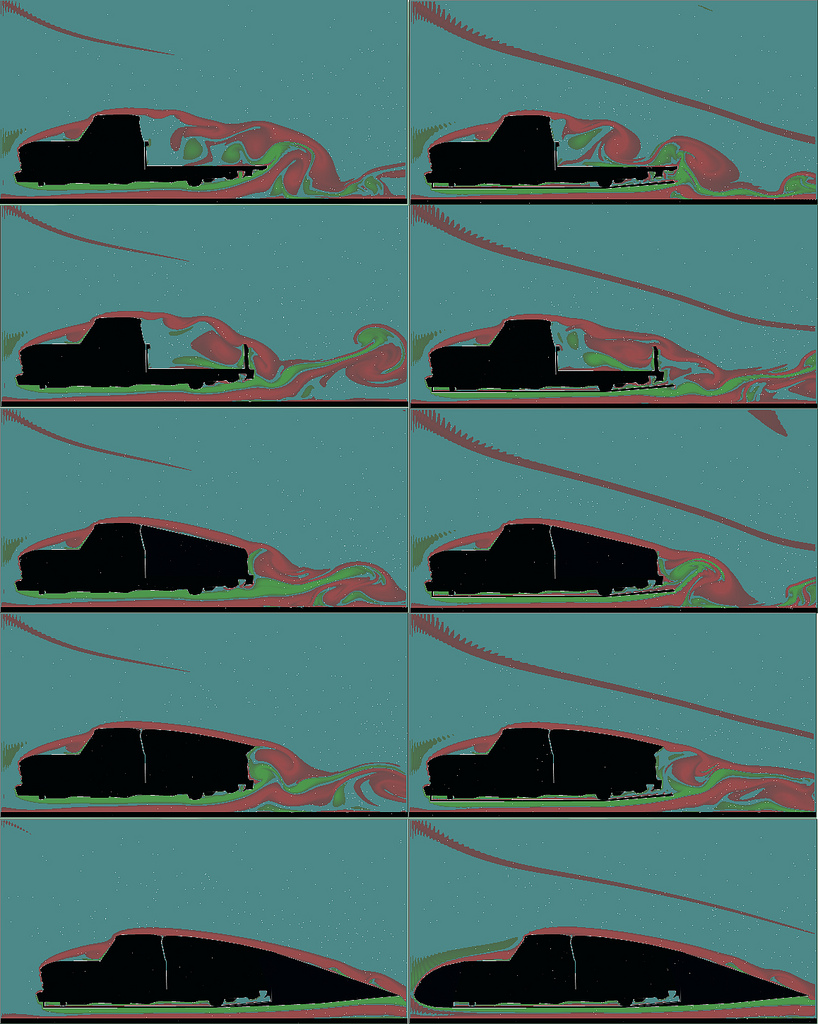
The classic question was whether its better to drive with the tailgate up or down – the reasoning being that the tailgate might be catching the air coming off the roof like a parachute, being a flat vertical surface and all.  It turns out though that (at least for most trucks) that at speeds an air bubble naturally forms in the truck bed of an open bed pick-up with the tailgate up, and that creates a virtual tonneau which deflects the air current over the gate.  With the tailgate open, that bubble can’t form, and aerodynamics is actually decreased overall, reducing MPGs along with it.
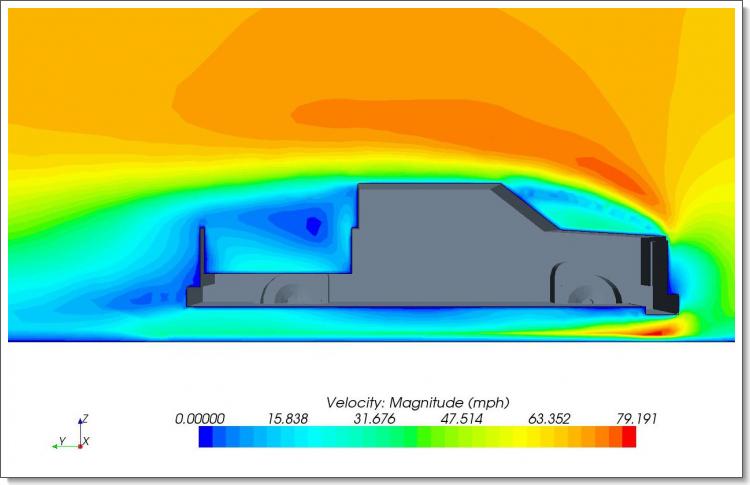

(image from: http://johnversteeg.com/projects/2 )
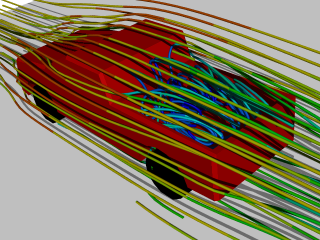
(image from: http://www.symscape.com/blog/tailgate-up-or-down )
It’s important to note that this does not seem to be universally true; while the MythBusters and some (better controlled) studies have found better fuel economy with the gate up, other studies have found the opposite: reduced air drag with the gate down.
Which actually shouldn’t be too surprising, given the complexity of fluid dynamics, and the plethora of shapes and sizes and other variables that go into the design of a truck bed, cab, and tailgate, from length of bed and height of cab, to whether edges are sharp or rounded.  In any case, neither shape of truck bed is optimal for aerodynamics, and the potential improvement gained by tailgate position is relatively minimal.
The next step in truck aero evolution is the tonneau.  When installed, it makes the truck bed a solid flat surface at the height of the bed rails and tailgate.
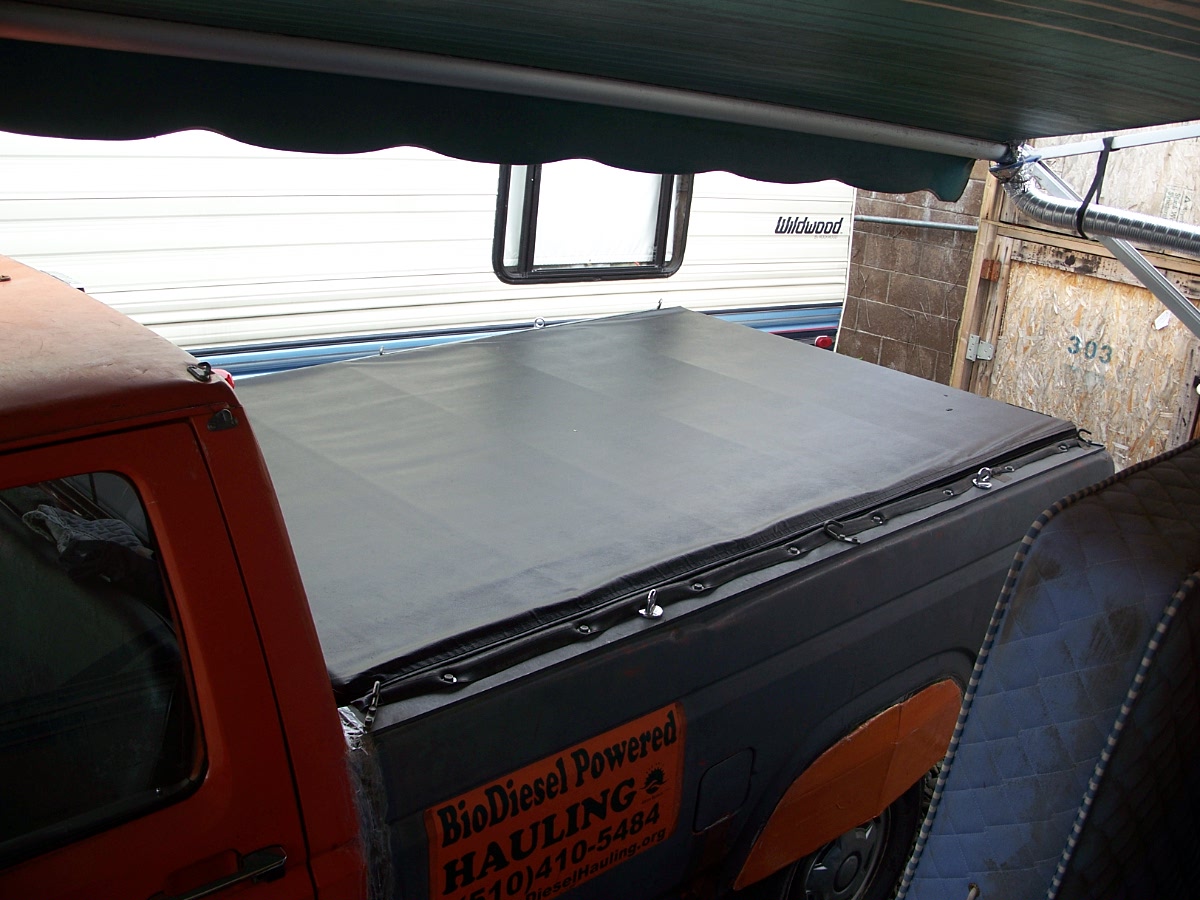

Now instead of a virtual surface closing the truck bed, consisting of a bubble of air, there is an actual surface there, to do the same thing.
Unfortunately, this is still far from the ideal tear-drop shape, and (again, unsurprisingly) while it is frequently seen to improve fuel mileage, it isn’t by terribly much, and it doesn’t consistently show any improvement at all.
The goal is aero-mods is to make a vehicle as close to a teardrop shape as possible.
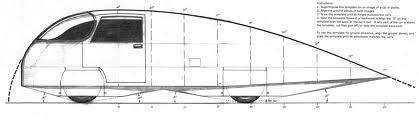

And while many car designs typically match this shape better than an open bed pick-up truck,
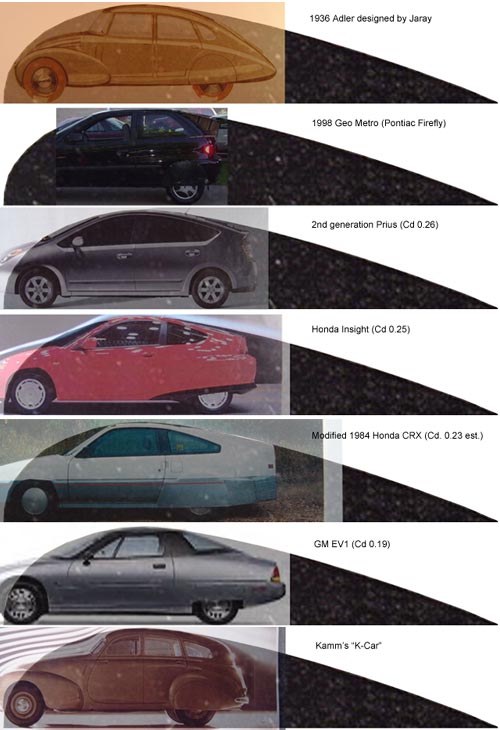
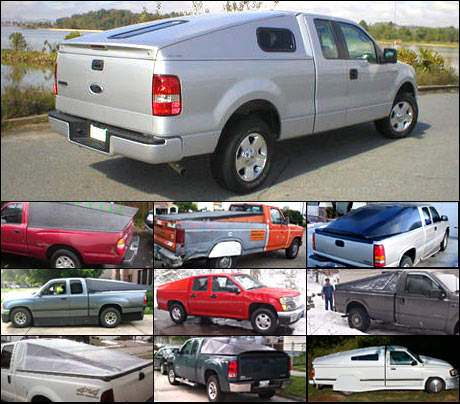
the large bed area (with no particular requirements for headroom) leave a lot of room for modding a cap to make it fit the shape even better:
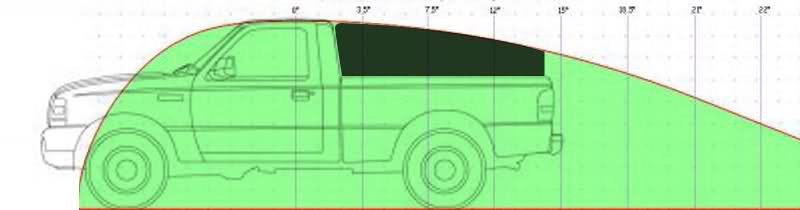

The result is referred to as an “aerocap” or “aeroshell”, and it can potentially give a truck lower air drag than some cars, while providing a covered and secure space to store cargo.
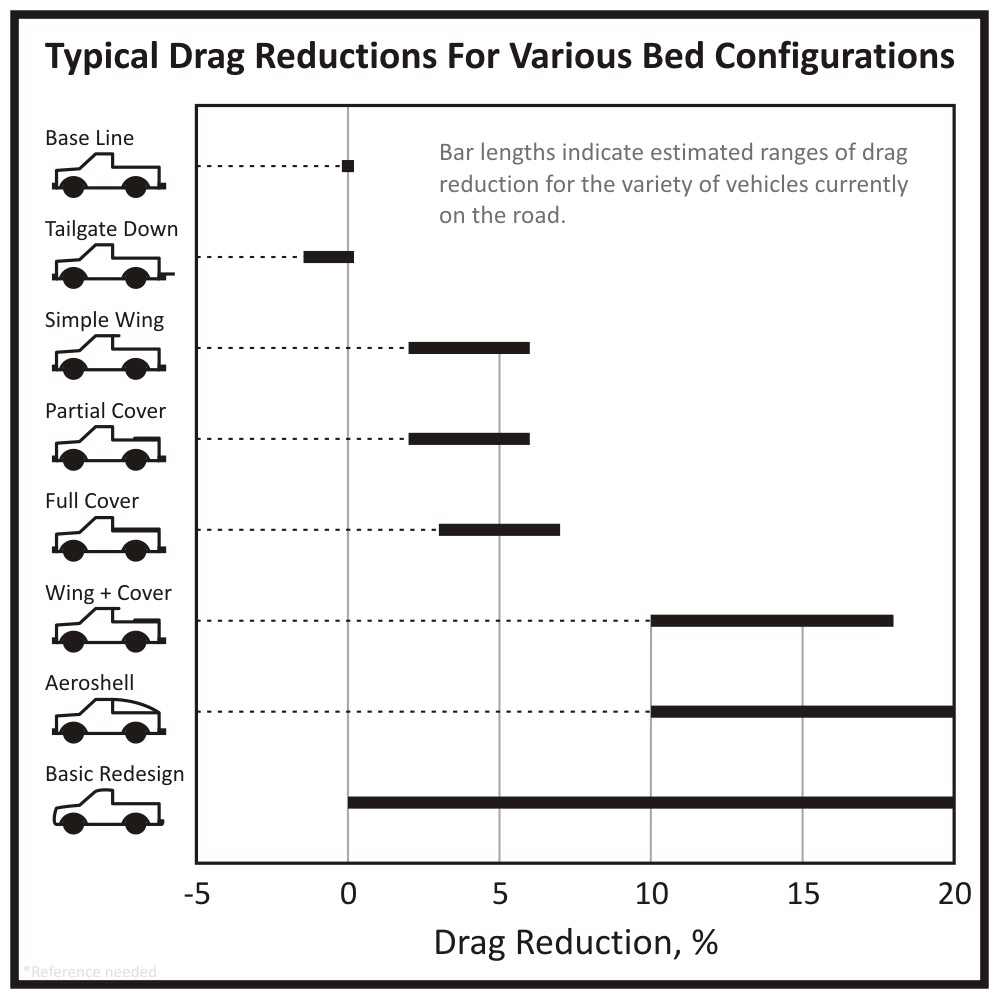
Of course none of this is news to serious ecomodders, and a large number of varying designs have been built, with different solutions to balance the trade-offs of maximum aerodynamics, interior space and accessibility, rear visibility, being securely attached but easily removable (in case on needing to use the truck bed for large items), and looking seamless and integrated.
Here are some of the designs that have been showcased in the ecomodder forums:

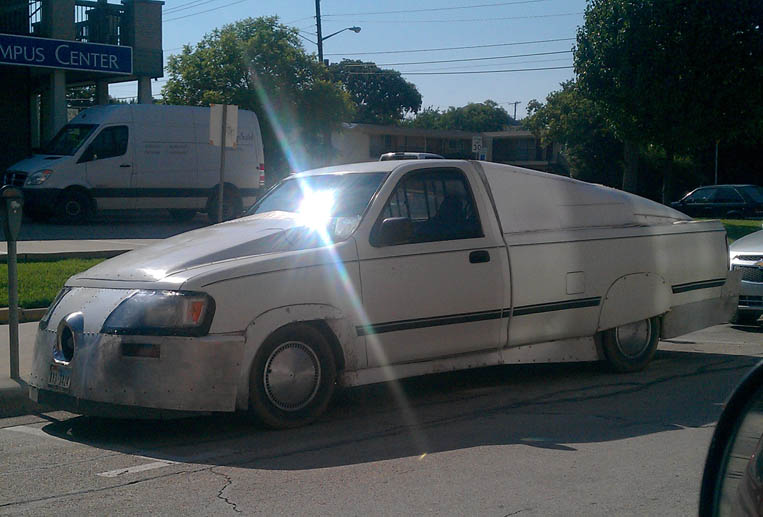
AeroHead / ITworks / Phil Knox’s T-100
Inline image 1
One of the very first.  Phil has been aeromodding since the oil embargo of the 1970′s.  This particular truck was in the form in the picture in 2005.
Measured coefficient of drag on the stock truck, plus aeroshell: 0.325
For reference, an open bed pick up has a cd around 0.40 to 0.45, a typical car 0.30 to 0.35, and the original Honda Insight had a Cd of 0.25, the lowest of any standard production car.
The lower the number, the less air resistance.
With all of the mods shown in the picture, coefficient of drag dropped all the way to: 0.25
The shell alone caused a 13% highway mileage improvement compared to the same truck at the same speed without it, 27.5 miles per gallon (EPA 25), and with all aeromods it got 32mpg at 70mph.
For more on this truck, see: http://www.evworld.com/article.cfm?storyid=870

AeroHead / ITworks / Phil Knox’s T-100: V2
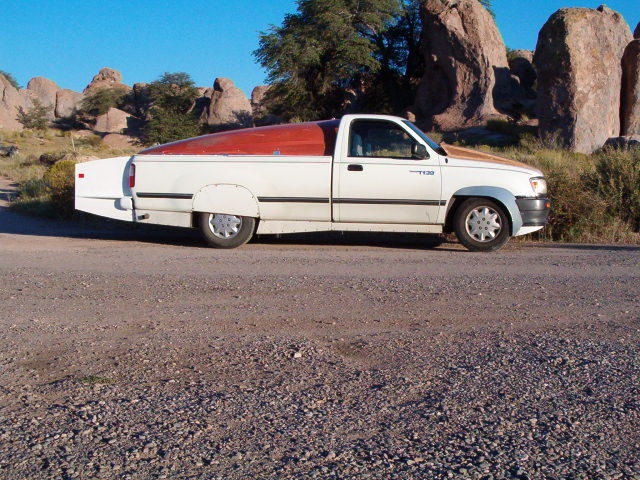
Inline image 7 Inline image 2
Inline image 3 Inline image 4
The original aeroshell was partially eaten by goats (or something like that…)
So he started over, and built another, goat-proof shell, and, as heavily aero-moddified as the first version was, he took the new one even further.
The new shell is made from the hull of a sailboat – you can tell in the first picture, the others are the same, just painted, and later with a window which removes the passenger side blind spot.
Aerohead takes this to Bonneville for racing and setting records and such, so the priority is maximizing aerodynamics over cargo carrying utility (the shell is removable though, so the truck could be used like a truck).
Theoretical Cd of 0.156
almost 80% mpg improvement compared to an original unmodified T-100, at 36mpg highway!
And yet still this was not enough – he has also built a trailer that attaches to the back of the truck just to extend the aerodynamic taper even further!
Inline image 5
Wow.  Just wow.
A labor of love with years and years of labor put into it.
For more on this absolutely magnificent monstrosity, see:
http://ecomodder.com/forum/showthread.php/pickup-truck-streamlining-14884.html
http://ecomodder.com/forum/showthread.php/basjoosing-toyota-t-100-articulated-front-wheel-skirts-22971.html
and
http://ecomodder.com/forum/showthread.php/full-boat-tail-trailer-gap-fillers-toyota-t-7839.html

Bondo / Brett Herndon’s Aerolid
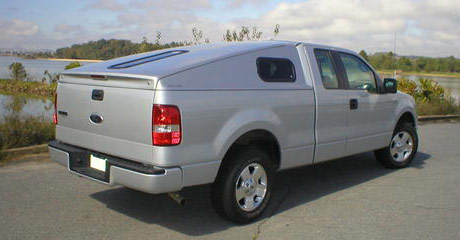
Inline image 8 Inline image 9
Ok, so the ITworks T-100 may be a little too extreme for the average pick-up truck owner.
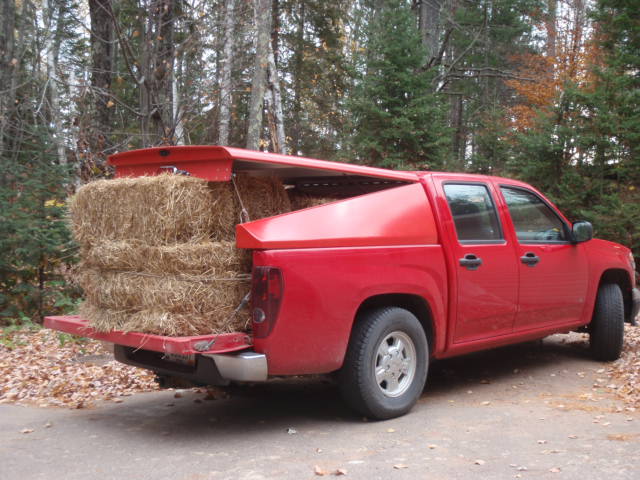
On the other end of the spectrum of customization and labor required by the end user is the very polished and professional looking “Aerolid”.
These are available for purchase.
The long term goal is funding for large scale commercial availability (patent pending), but even without corporate sponsorship, he has already produced several on his own, and has a website up for their sale.
Highway mileage increase (on this truck) of over 20% 18mpg to 22.
For times the truck needs to be used for serious truck stuff, the center section can be removed without removing the entire shell
Inline image 10
If a load is just a little too big to fit under the shell, but not so big it has to be removed entirely, it is hinged and can swing up partially; also making it a potential place to hang out while camping.
Inline image 11 Inline image 12
For more interior space and even better aerodynamics, there is an optional extender kit that is deployed with the tailgate down, which can fold away when not in use
Inline image 13 Inline image 14
Inline image 15 Inline image 16
For more on the Aerolid, see his website:  http://www.aerolid.com/
or the ecomodder thread http://ecomodder.com/forum/showthread.php/commercially-produced-aerodynamic-pickup-bed-cap-583.html


In between those two extremes the DIYers at Ecomodder have come up with plenty of unique designs:


SkyKing’s aeroshell/boat tail for the Dodge truck “Woody”

Inline image 17
Made from laminated plywood sheets on a plywood frame, this design goes further and lower than any other.
26mpg highway from an otherwise unmoddified (except those beautiful wood side boxes) 1-ton.
For more on Woody’s shell, see:  http://ecomodder.com/forum/showthread.php/testing-aeroshell-boat-tail-dodge-22354.html


T Vago’s
compound curve foam board pickup aeroshell
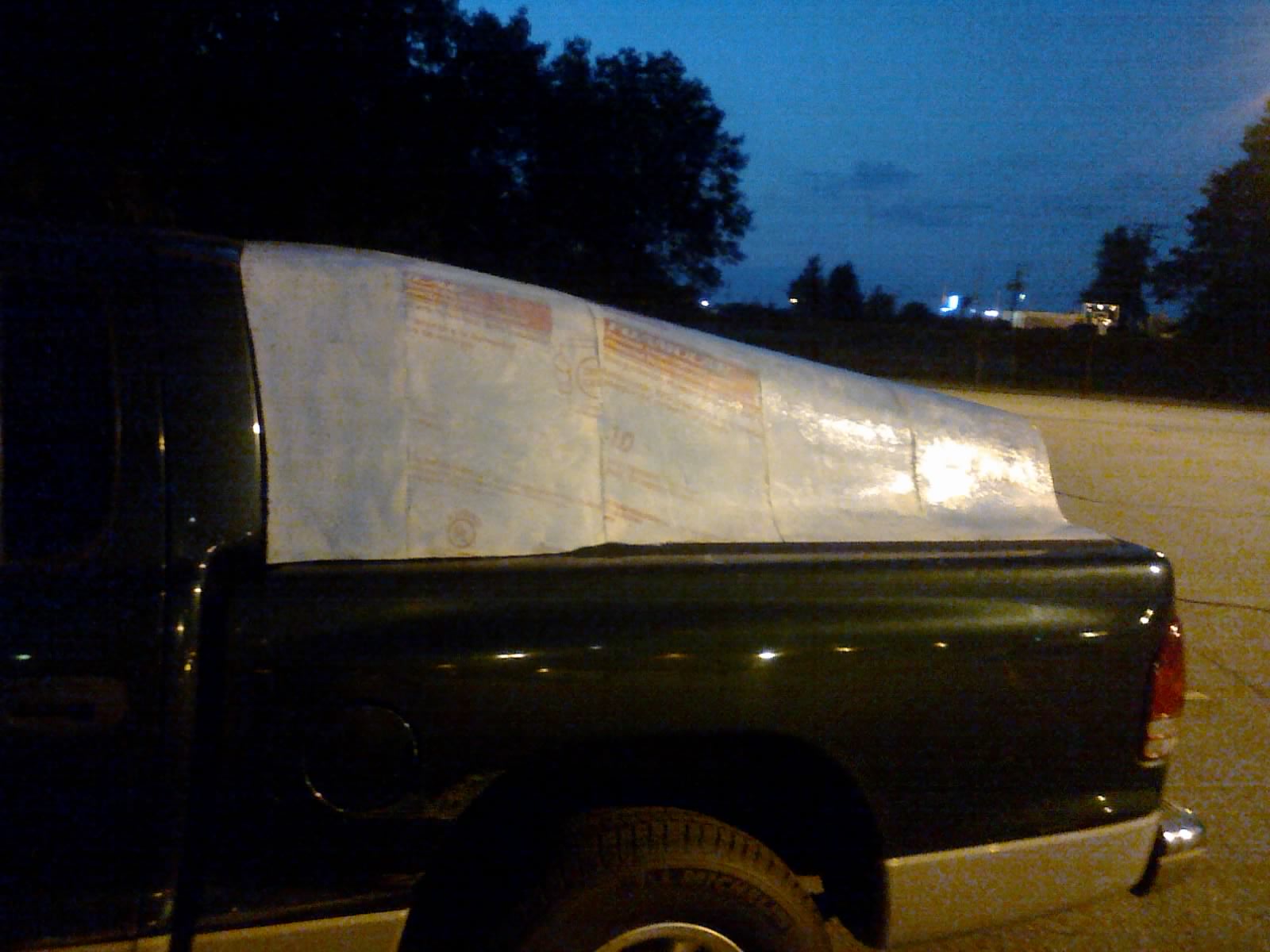

Inline image 18 Inline image 19
10% improvement, from 19mpg to 21mpg with no other mods.
Its made of foam, so its very light; which is good, sense adding weight reduces fuel economy, which would be counter-productive.  Also, it makes it easier to take off when the bed space is needed for big bulky stuff.
You can read much about its design process on a previous blog post:  http://ecomodder.com/blog/makings-pickup-aerocap-vagos-dakota/
as well as the forum thread http://ecomodder.com/forum/showthread.php/t_vagos-compound-curve-foam-board-pickup-aeroshell-15862.html


BamZipPow’s T-100 Aerocap


Inline image 20
Made from coroplast (plastic sheets) over wood and metal frame.
Up to 27mpg highway.
Long thread covering everything from concept to construction to V2 trials:
http://ecomodder.com/forum/showthread.php/another-truck-aero-cap-idea-15137.html


JRMichler’s Nameless’ Canyon topper


Inline image 21 Inline image 22
Along with other mods, improved mileage from 21mpg to 30mpg in winter, and 27 to 35 in summer, with around 2mpg of that increase specifically upon replacement of the original non topper with this one.
Believe it or not, it is constructed of plain old plywood, waterproofed and strengthened with epoxy, and prettied up with some hardware store paint.
Details at http://ecomodder.com/forum/showthread.php/modding-06-gmc-canyon-17070.html


JRMichler’s brother’s Ford F-250
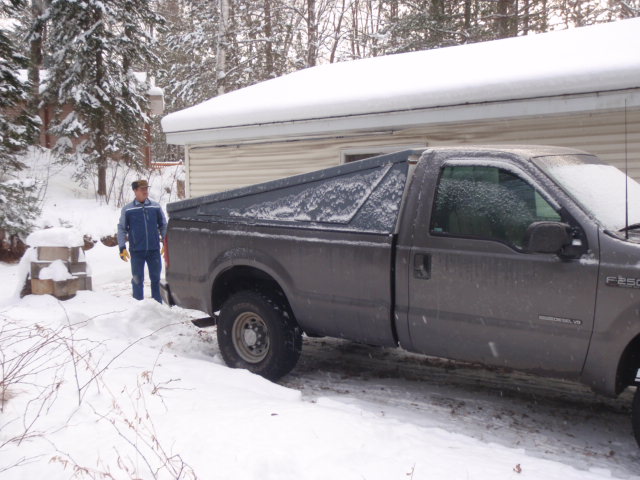

Inline image 23
Mileage of 23.5mpg, up from 19.5
Not a lot of information on it is public, but what there is is here:
http://ecomodder.com/forum/showthread.php/modding-02-ford-f250-16798.html


Bajascoob’s Lightweight Aerocap on BigWhiteWhale


Inline image 24 Inline image 25
In addition to being relatively light, this design neatly solves the issue of reduced visibility created by every single other aerocap design.  The entire thing is completely translucent.
Unfortunately, plastic film isn’t 100% clear, so while he can see headlights behind at night, it isn’t clear enough to allow eliminating outside side mirrors.
Went from 16 to 19mpg.
Made of 1/2″ metal conduit frame wrapped in 4mm film, for a total of roughly $20 material cost.
More here: http://ecomodder.com/forum/showthread.php/f-250-7-3-4wd-light-aerocap-12573.html


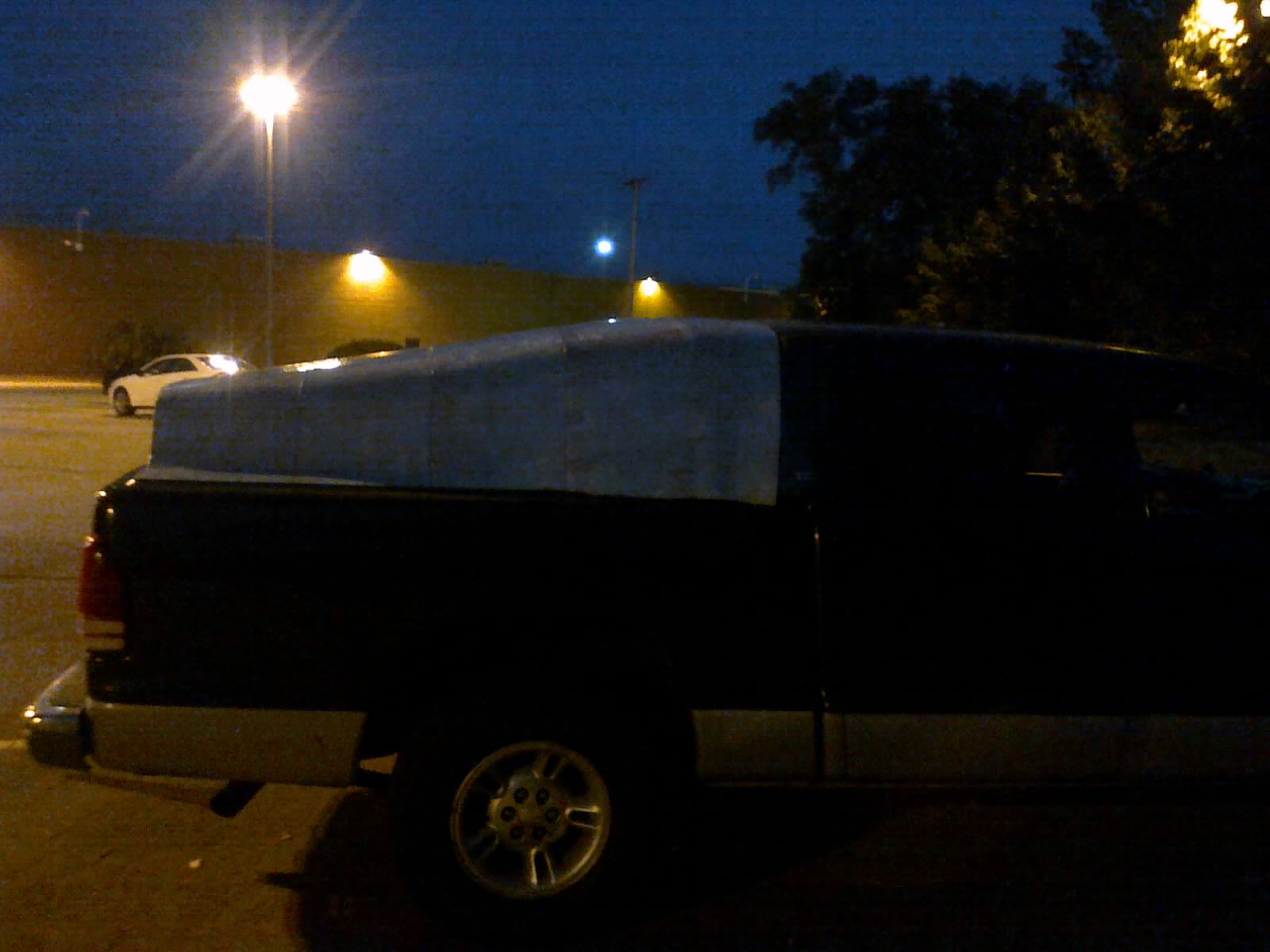
Swede’s Aerolid


Inline image 26
Coroplast over a welded 1/2″ conduit metal frame.
13% improvement, from 20mpg to 23.
Read more:  http://ecomodder.com/forum/showthread.php/swedes-aerolid-build-thread-13092.html


Kevlar’s aero “Toyota truck”
(Apparently in 1992 Toyota didn’t give its trucks model names or numbers?)
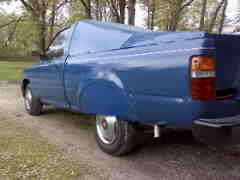
Inline image 27 Inline image 28
Made of fiber-reinforced plastic board panels, the stuff public restroom stalls are made from.
31mpg actual, with an EPA estimate of only 24mpg highway
Since sold – and the new owner is reporting even better mileage, 32-36mpg.
http://ecomodder.com/forum/showthread.php/aero-truck-project-begins-2269.html


Ccrider’s Tacoma Aerocap


Inline image 30 Inline image 29
1/2″ Plywood on a wood frame.
$45 worth of material, including the paint.
30+ mpg in a truck rated for 20.
Simple, inexpensive, yet the numbers speak for themselves.
Build thread at: http://ecomodder.com/forum/showthread.php/aerocap-tacoma-pickup-11271.html


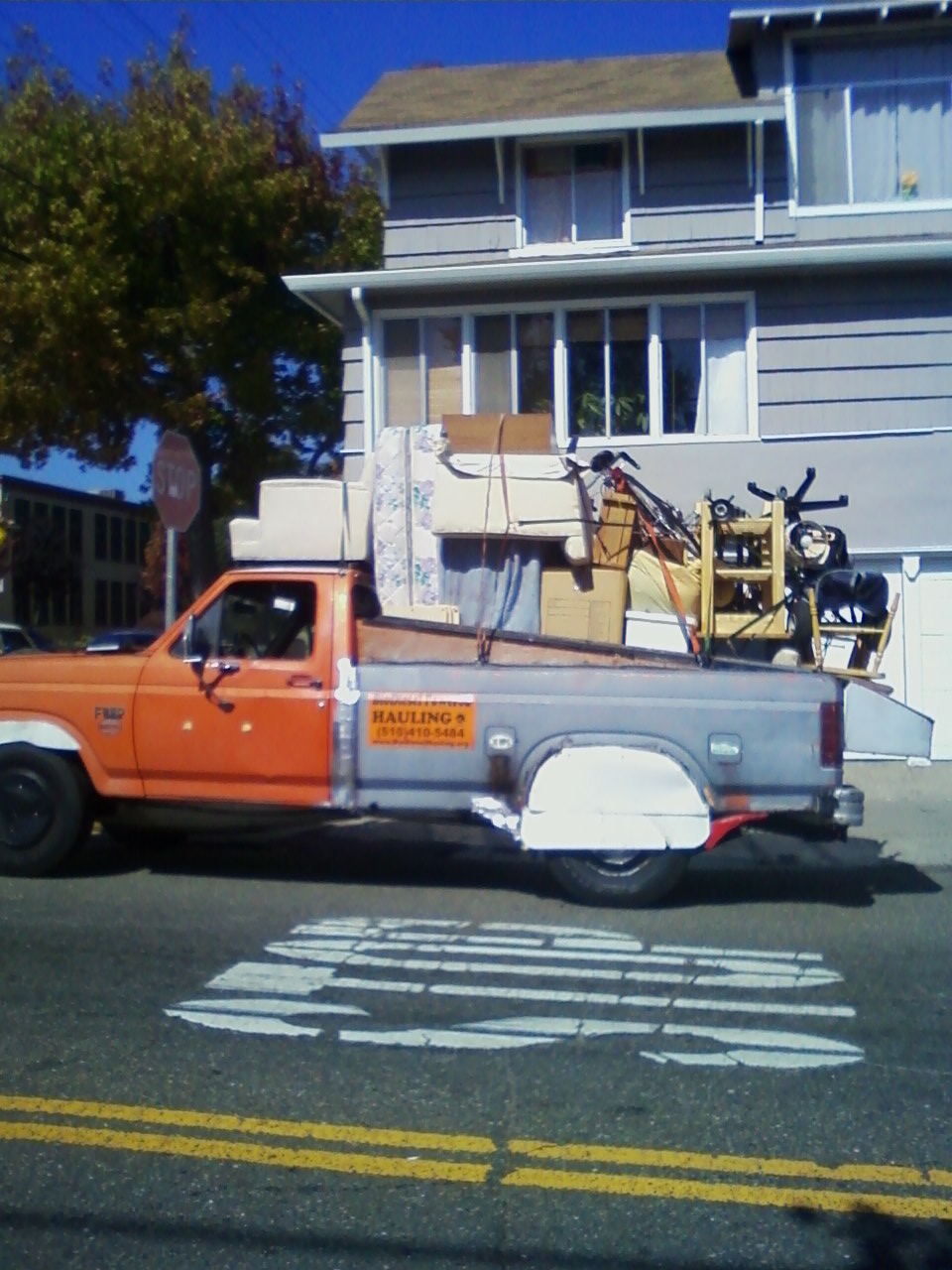
Jacob Aziza’s Big Orange Work Truck’s tilted tonneau

(That’s me, the author)
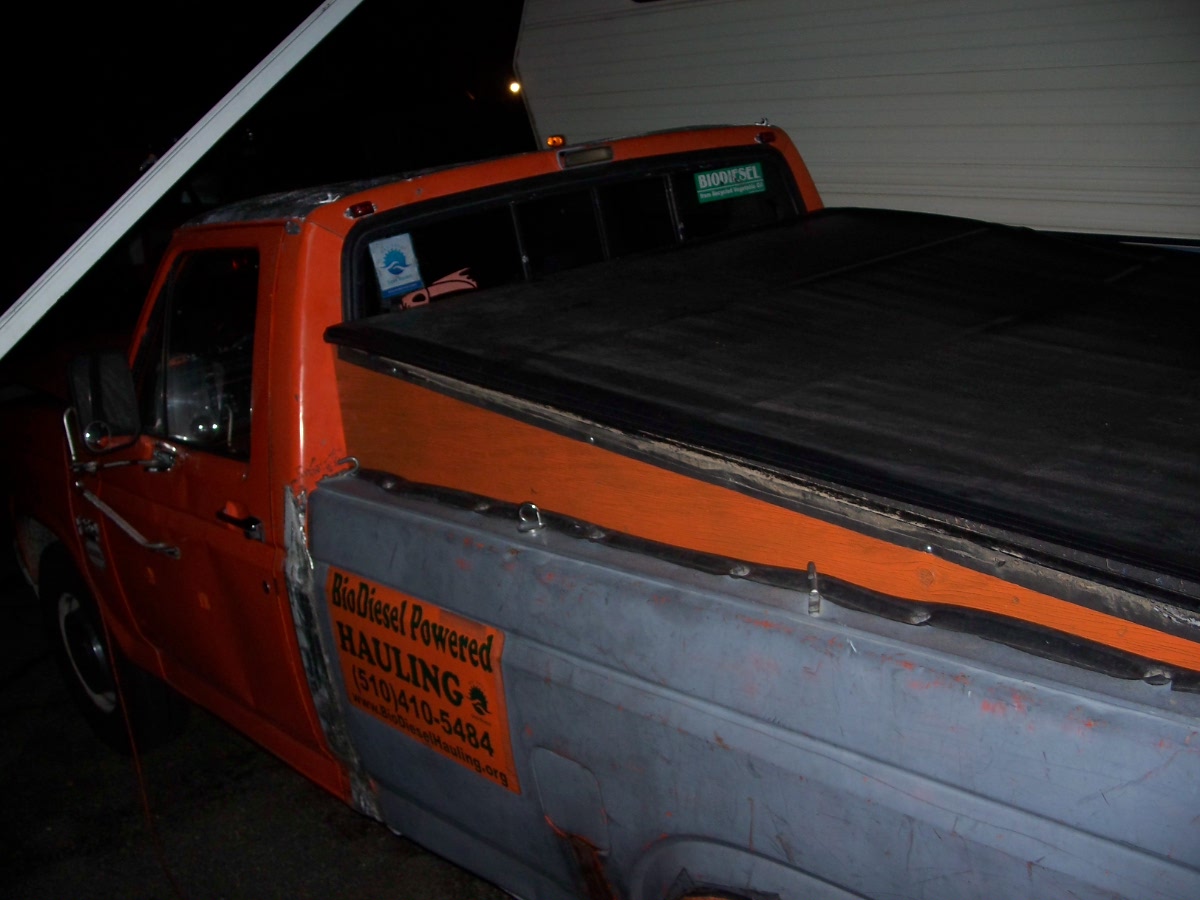
Mine represents the opposite extreme from the first truck in this list, the ITworks T-100 in the trade-off between aerodynamics and the ability to use the truck bed.
Unlike every other design, the cover does not actually start at the roofline.  From an aerodynamic perspective this is a pretty major design flaw – it means that the air flowing off the back of the roof will not continue on smoothly to the cover, but will actually separate, leaving an air space of slower moving and potentially turbulent air right behind the rear window.
I was aware of this when I built it, but I decided it was more important to have a fully unobstructed view to the rear.  I regularly drive this truck in dense city traffic, at lower than normal speeds on major highways, and have to back up down driveways so narrow that I have to fold both side mirrors in.  In other words, I use my rear-view mirror a lot.  And even without a cover, I managed to back-up into a parked motor scooter once.  So I decided to sacrifice optimum aerodynamics and have the bed cover start about midway between the top of the bed and the roof.  I have a rearview mirror mounted just below the ceiling inside, and being higher than the top of the cover means I can see over it right to the edge of the tailgate.  I actually have a better view to the rear than with the stock mirror set up.
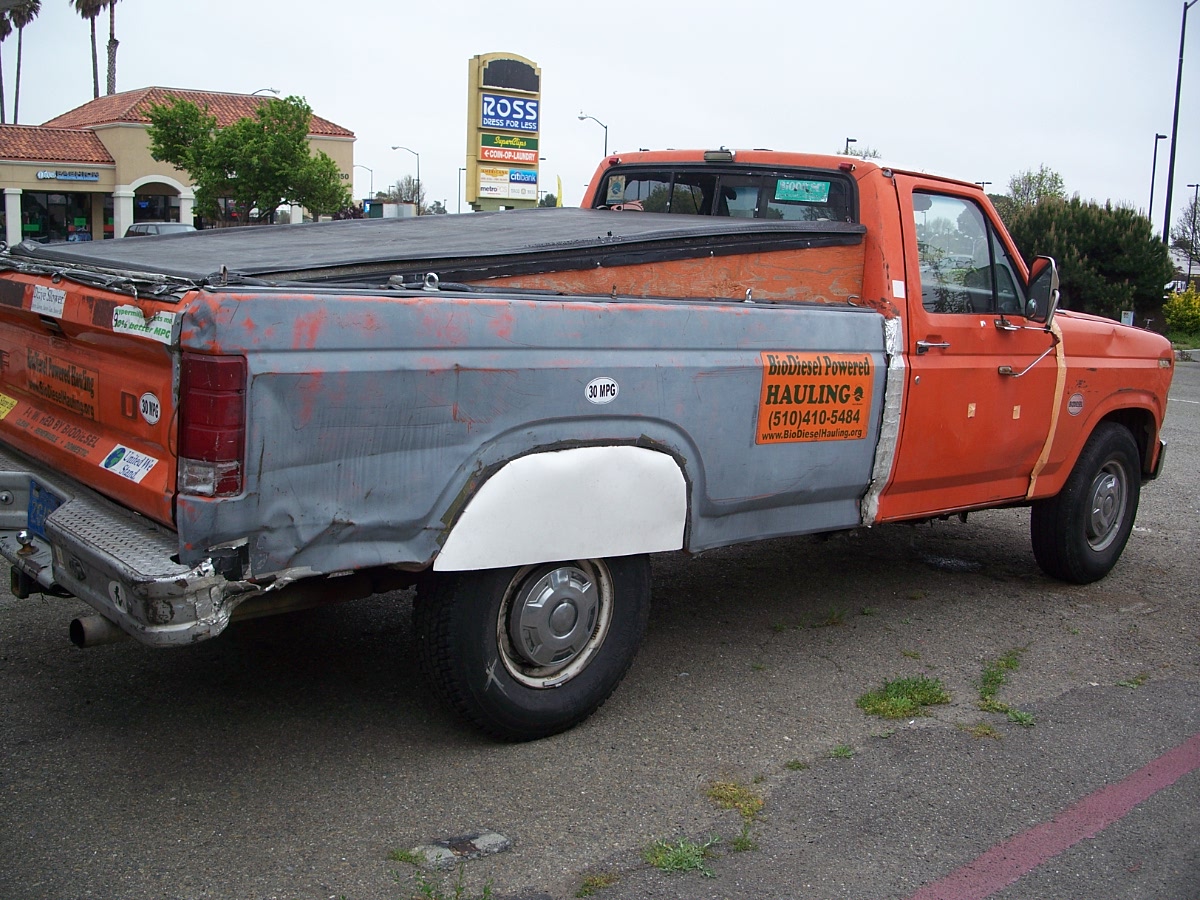
My other consideration that required a major trade off in maximum efficiency for maximum utility is that I regularly use the truck to haul things which would not fit under any of the above aerocaps, even the hinged ones if they were at maximum tilt angle.


Some of the aerocap designs have removable tops, or remove relatively easily for those times, but those times are so frequent for me that it would be extremely inconvenient to have to be constantly removing and replacing a cover. Besides for which, living in an RV, I have nowhere to store a large aeroshell when not in use.
Most of the time my trip goes something like: travel to location with bed empty, pick up bulky stuff, transport it to somewhere else, travel home with bed empty.  So if I was going to do anything to make the truck bed more aerodynamic, it had to be something I could remove completely within seconds while in the field, store it out of the way on the truck, and then deploy it again just as quickly for the trip home.
My solution was to take a standard, commercially available roll-up vinyl tonneau cover, and mount it on triangular plywood sheets.  When I need to access the bed, I just roll it up.  If the bed is empty (or carrying little enough) I roll it down, and the built-in rails keep it locked down.  While not the ideal angle, it still lets the air coming off the roof travel down to the tailgate level more gradually.
Vinyl tonneau with metal stabilizers on metal rails attached to plywood sides.
I already owned the tonneau (originally cost about $180), and used some old plywood and bolts I had lying around, for an additional cost of $0
My overall average mileage (on an already heavily modded truck) increased from 26mpg to 28, and test-run highway mileage from 28mpg to 30.
A lower improvement than many of the other designs – no doubt due to not starting at the top of the roofline – but an improvement none the less, and not too far behind most of the other numbers when reporting an actual before and after (as opposed to comparing with the EPA numbers – after all, the expected mileage for my truck is around 15mpg)


There are surely more that I have missed.  Hopefully there will be plenty more to come.
Its always best to buy the smallest vehicle that will fit your daily needs, (and rent a truck if you only need one every now and then).
But for those few people who legitimately do need a big truck, there is no reason to resign yourself to terrible fuel mileage.  If ecomodders can get hybrid like mileage out of ordinary cars, we should be able to get at least ordinary-car-like mileage out of big trucks.
If you’ve been inspired to improve your own truck, post on the forum with your thoughts and questions.  There are a lot of helpful knowledgeable people who will be more than happy to give you any advice you may need to do a similar project of your own.

Update: Oct. 25, 2012 …
For even more examples of aerocaps in the EcoModder forum, see: http://ecomodder.com/forum/showthread.php/comprehensive-list-aerodynamic-pickup-caps-aeroshells-ecomodder-elsewhere-23775.html

06 September 2012

Advertisements that only work due to ignorance and stupidity

I don't generally see a lot of ads, thanks to AdBlock on the computer and a RePlayTV unit that automatically skips them when I watch an occasional show, but between Hulu, the few that get past the RePlay's filters, and billboards, I can't seem to escape them entirely.
Which is fine, they are paying for me to have free content, some of them are entertaining, and every once in a great while actually informative.

But there are 3 out right now which grate against me so severely that the only way I'm going to be able to stop ranting in my own head about them is to rant on the internet.

They are deliberately relying on consumer's ignorance in order to try to convey a message which simply isn't there - the facts are technically accurate, but the implication is actually the exact opposite of reality.


1) The new milk campaign, attempting to discredit soy milk:


They list a bunch of scary sounding "chemicals" that soy milk contains, to contrast with cow milk, which according to the ingredient list has only one ingredient: "milk".
Never mind that the list of scary sounding chemicals they list consists almost entirely of vitamins and minerals which are actually quite healthy, or neutral at worst.

So, in the interest of fairness, here are some scary sounding chemicals that are present in cow's milk:


  • oligosaccharides
    galactose
    pantothenic acid
    phosphorus
    selenium
    manganese
    lipoprotein lipase
    inactivated alkaline phosphatase
    lactoperoxidase
    C16:0 ß-hydroxy fatty acids
    conjugated linoleic acid*
    α-lactalbumin
    blood serum albumin
    transferrin
    high proline micelle
    methionine
    cholin
    cerebrosides
Golly.  Don't all those chemicals sound unknown, and therefor scary? 


*(which is a TRANSfat omg!!!!!!!! - but wait, aren't transfats all man-made and added by the evil food industry????  What?  Some transfats are naturally occurring? How can that be, when everything natural is good and healthy, and all transfats are devil food??)


2) 5-hour energy:


73% "said they would recommend a low-calorie energy supplements to their healthy patients who used energy supplements. 73%!"
Wow!  That's a C- grade.
Ok, so never mind that 73% is not particularly impressive.

Never mind that if it has no calories it has no actual energy.  It may make you feel energetic, but the human body gets its energy from calories, not stimulants.  (Don't believe it, try going on a fast where you consume nothing but cocaine for a few months)

And never mind that almost 1/2 the doctors they tried to survey refused to participate in the first place...


They worded it pretty carefully.  Sounds like they handed out a survey that said "if you had a patient who was determined to take an energy supplement, would you recommend that it be low calorie?"
Well, sure, given that constraint, of course.
Just like IF you have a patient that smokes, you might recommend that at the very least they smoke light, filtered cigarettes.  That's not exactly an endorsement.
And even with that particular wording, 27% still wouldn't recommend it.
But wait - there's more!
If you read the fine print, even among those who would recommend low calorie energy supplements to patients who are going to take energy supplements anyway, after reviewing the ingredients of the specific 5-Hour Energy brand, 45% of them would NOT recommend it!  45%!

So, assuming that the 1/2 of doctors who refused to dignify their survey with an answer would not have been impressed, you have 50% (number who answered at all) x 73% (number who said yes to low calorie) x 55% (number of those who said yes to the brand) = 20% who actually said they would recommend the product IF a person was dead-set on using an "energy supplement".

We can only assume that the number who would recommend it to a patient who wasn't already on legal stimulants is approximately 0%


3) No On Beverage Tax


This is a local one, but similar measures are being proposed all over.
It isn't even a ballot measure yet, but the soda industry and retailers are fighting it preemptively.  In theory it would tax beverages with added sugar by one penny an ounce.

The ad claims that it would "hit the city’s poorest residents and the elderly the hardest"

Because, you know, poor people and old people are legally mandated to drink nothing but soda. 
Or is it that their unique physiological properties make it that the empty calories in soda are actually a nutritional requirement? 

Ah, I know - some people are SO poor that, not only aren't there supermarkets nearby with real juice, they don't have running water, so their only source of liquid is the soda they buy at the gas station.

Wait... what?  Gas stations and corner stores sell not only 100% juice, but also bottled water? Hmm....

Whoa, whoa, whats that!?  Running water is legally required in all rental units, including the projects and even homeless shelters, and many if not most renters don't actually pay for metered water?  Are you saying all these poor people could actually be drinking water for FREE?

And even if one does pay metered rate for tap water, its cost is between one half to 5 cents a gallon?  Now you are just being silly. 
That would mean that even without the tax, generic brand soda costs roughly 35 times as much as tap water for the exact same nutritional value. 
Gosh, so maybe drinking water would save more money than traveling to a city without a beverage tax to find cheap soda, as the ad campaign suggests is the only possible alternative.


I suppose its good that we have any truth in advertising laws at all, but I really think we need to take the next step and ban "technically accurate but deliberately deceptive and misleading in it's implications" advertising as well.

13 July 2012

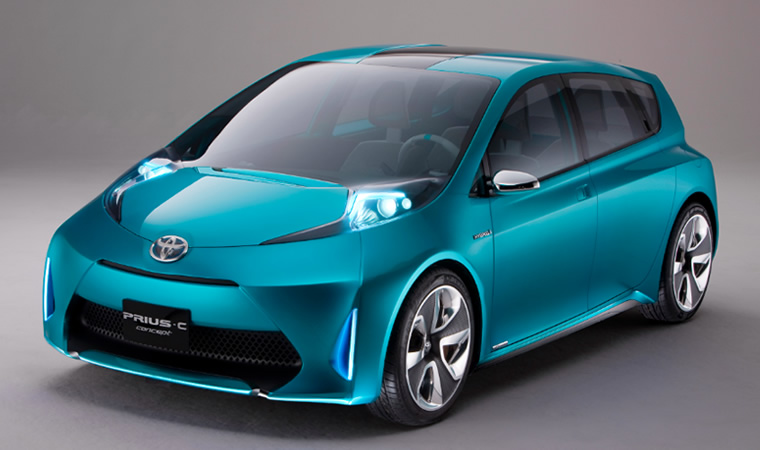
Prius C: A sub-compact hybrid, at a non-hybrid price.

Prius C: A sub-compact hybrid, at a non-hybrid price.

by Bakari Kafele on July 13, 2012

The newest Prius, available for only 2 months now in the US, is a compact fuel-efficient hybrid.
One thing it is not, however, is a Prius.


The car is really a Yaris hybrid.

But, given that “Prius” is basically synonymous with “hybrid” among average Americans, and that the Yaris may seen by some as an “econ-o-box,” it is a smart marketing move on Toyota’s part to label it as a Prius. (In its home country of Japan it isn’t called a Yaris hybrid either, its called the Aqua).
Despite the misnomer, both the pricetag and the size reflect its true roots as a Yaris.
Sticker, at just under $19,000 baseline, is over 20% less expensive – $5000 less – than the standard model. Of 337 different models available for sale in 2012, only 17 cars are cheaper – and none of them are hybrids.

The first time I was in the original Prius, I was shocked at just how large the interior felt. It almost seemed more like a small minivan than the “compact” car it was classified as. I guess this shouldn’t have been surprising given how most long-lasting models have been super-sized over time (the modern Honda Civic, for example, is an entire 3 feet longer than the original Civic) – but it was not that long after the debut of the first US hybrid, the Insight, and I had assumed the Prius would be a 4 passenger version of that tiny car.

Ever since, it has seemed rather odd to me that the vehicle with the best (standard) mileage for sale in the US is one which falls in the 4th highest of the 5 size ratings. Surely, I imagined, something with a Prius like drive-train, but in a mini or compact size, should be able to get even better mileage.
It took them 12 years to do it, but the “Prius” C is just that.

It is over 1 1/2 feet smaller, 2 inches thinner, and almost 2 inches shorter than the original Prius, as well as 500lbs lighter – it’s actually lighter than many non-hybrid compact cars, such as the Fit, the Miata, and the new “Mini” Cooper.

The ‘C’ in the name stands for ‘City,’ where the small size would make parking easier and the lighter weight will help fuel mileage. As it does, at least in city traffic, where its meant to be used. By US EPA standards it gets 53mpg city, the highest rating of any (non-electric/plug-in) mass-produced commercially available highway capable auto in the country. At the same time, the EPA gives it 46mpg highway, slightly worse than the original Prius, and the two average out to a mixed rating of… 50mpg, exactly the same as the original Prius. However, it is very interesting to note that – although the marketing department is limited by law to only advertising the EPA generated numbers – Toyota’s own engineers estimate the mileage at a whopping 82mpg(US) under Japan’s mileage testing system. One tester even got 57mpg on the excessively hilly streets of San Francisco, so the official ratings are clearly conservative. Even a lead-footed car-guy tester with Car and Driver beat EPA with 55mpg on his test run.

Some of the reviews coming from professional car reviewers are pretty much what you would expect before even looking at them: this is a nice car – looks good, comfortable though small inside, handles decently, lots of technology and gadgets – but it doesn’t have enough acceleration. Its 0-60 is around 11 seconds. This apparently feels like driving through syrup to someone who is used to reviewing modern overpowered passenger cars, but for comparisons sake, a semi-tractor-trailer measures its 0-60 time in minutes or miles, and they are apparently capable of merging onto freeway onramps somehow. The more a particular reviewer is able to shift their frame of reference from performance to fuel economy, the more they liked it.

Bonus: everyone agrees that its 25-40mph acceleration of 3.6seconds – more what you’d use in city driving – is plenty.

Apparently consumer’s minds are coming around. Despite its small size and <100hp 10="" 2012.="" 2012="" 337="" 3="" 3rd="" 4="" 5000="" all="" and="" any="" aqua="" are="" as="" at="" award.="" been="" between="" by="" c="" can="" car.="" car="" cars="" combined="" compact="" countries="" deathtraps="" demand="" dying="" earn="" fact="" faster="" fastest="" first="" for="" have="" helped="" higher="" highway="" in="" institute="" insurance="" is="" it="" its="" japanese="" just="" keep="" literally="" minivan="" models="" month="" most="" much="" myth="" new="" of="" one="" only="" op="" original="" out="" over="" p="" part="" perhaps="" pick="" plug-in="" popular="" pre-orders="" prius="" produce="" production.="" projected="" rii="" riuses="" s="" safety="" same="" selling="" slowly="" small="" sold="" than="" that="" the="" them.="" they="" three="" time="" times="" to="" toyota="" two="" units="" up="" v="" was="" with="" world.="">
Then again, even though it is smaller than its predecessor, it isn’t really that tiny. While it is 1.5 feet less in front to back length than the original Prius, it is still a full 3 feet longer than the Scion iQ, another city car made by Toyota, which (unlike the Smart Car) has room for 4 passengers. The last 2 passengers might not be in luxury, but the reality is that most people, most of the time, don’t have 4 adults in the car. They have one, maybe 2, and possibly one or two children. So the iQ would probably be an appropriate size for many, if not most, households – especially if it’s the second of two cars. Of course the iQ gets nowhere near the C’s mileage (36/37), it is also $3,000 less.

I guess I will just have to keep waiting for a car to come out with the size of the iQ but the mileage of the Prius C. They are heading in that direction.

If one was going to get a new car now, the Prius C is the most efficient car out there, at a pretty reasonable price. In a decade or two, when used ones can be found on Craigslist for a few thousand, I might just pick one up myself. In the meantime, hopefully an ecomodder with a bigger bank account than mine will pick one up. I’d love to see what could be done with it in the right hands.

09 July 2012

Adding an overdrive (BW T-19 to ZF-5 transmission swap)

(Just want tips for swapping a BW T-19 for a ZF S5? Skip to tips.  Not swapping a Ford truck transmission?  Skip to the end for the results.  Continue reading for all the gruesome details of my project.  Hopefully my trails and tribulations can at least provide you some entertainment.)


If you’ve never driven a vehicle more than a couple decades old, you probably take overdrive for granted.  You may not even have a clear idea what that term means.That 5th or 6thgear, with a ratio smaller than 1.0 (meaning the driveshaft is turning faster than the engine) lowers the engine RPM speed on the highway, and can make a huge difference in the fuel used to go the same distance at the same speed.Gears on a car are just like gears on a bicycle; imagine trying to ride a bike with only a small chainring and big cog, and having to spin your legs like crazy to get anywhere at a decent speed.  Lower RPMs means less internal friction, less internal reciprocal motion, and therefore less wasted energy.
If, like me, you don’t care to spend the money for a new – or even remotely new-ish – vehicle, you may have noticed that overdrive was once upon a time not always standard equipment, or even available as an option.

The Ford F-Series of trucks has been one of the most popular vehicles world-wide for decades, and though much has changed over the years, many of the internal design factors stayed the same from one generation to the next.  They were rather reliable, so a good many older ones are still on the road.  Those two factors mean that there is much interchangeability of parts among different generations, and those parts are easy to find.
The 7th generation F-series (1980-1986) had a couple of manual transmission options, all of them 4 speed. My own 1983 diesel F-250 ¾ ton truck came with a Borg-Warner T-19, in which the 1st gear was an extra-extra low granny gear (6.32) which is normally not used.  For all practical purposes it is a 3-speed.  No overdrive gear.  In fact, even 4th gear isn’t quite direct drive, at a 1.1 drive ratio.
This means shifting into top gear at 25mph, and 2400 RPMs at 55mph.
2400RPMs means each piston is going up and down 40 times every single second, which means the mass of the piston head has to stop, change direction, move a little, stop, change direction again, 80 times every second (once up, once down, for a full rotation).  This is bad enough is a small engine with light parts and a couple cylinders (like a motorcycle) but in a heavy V8 diesel engine, a lot of inertia is going to waste.
Not a terribly big deal in 1983, when the national speed limit was still 55, but post-embargo gas prices had dropped again; the lack of stock overdrive leaves a lot of potential for increasing highway fuel mileage.
The addition of an overdrive gear reduces engine speed from 40 cycles per second down to only 28, a 30% reduction.


The 8th generation Ford trucks came with a couple of 5-speed transmission options, and although built by a completely unrelated manufacturer, they were made close enough to the old specifications that they were interchangeable.  As such, the transmission swap from gen 8 trucks into gen 7 is a fairly popular and common one.
It is possible to put any transmission from a truck from 1973 all the way to 1996 into any other from that range, provided they have the same engine size, fuel type (gas vs. diesel) and drive type (4x4 vs. 2x4).  This includes going from automatic to manual (or vice versa), although of course then you need additional parts.  With the right adapters one can even cross the engine, fuel type, and driveline compatibilities.

I’m just going to go over one of the simplest and most common transmission swaps, the one which I recently did: starting with a Borg Warner T-19 4-spd (behind a 6.9L International Harvester IDI engine) and swapping it with a ZF S5-42 which I got on ebay (the process from the T-18 or to the ZF S5-47 should be identical).  The information here would likely apply or be useful to someone doing any other 7th/8th gen F-series tranny swap as well, and maybe even 6th or 9th gen swaps - but I haven’t done them, so I can’t say specifically which parts will apply.
------------------------------------------------------------------------------
Before I started the project or purchased anything, I spent a lot of time looking up information on it.  A lot of helpful people who have done it before have taken the time to provide information on it.
Everyone consistently said “it is a bolt-in replacement”.
Well, technically it is.
The actual bolts line up perfectly between any transmission for the 6.9L and 7.3L diesel engines, whenever they were made, whatever size truck they were from.
But “bolt-in replacement” gives the impression that everything will mate up.
No.
Its just literally the bolts.
Almost nothing else is compatible.

I also found there are a lot of helpful people who answer the questions of people who get stuck on various truck enthusiast forums.  Any problem I ran across (and any you are likely to) has probably been experiences by someone else somewhere, asked online, and answered accurately.
The only problem is, you have to know the right questions to ask, (or rather the right keywords to enter into a search engine), to find those answers, and until you run into a particular problem, you don’t necessarily know the right questions to ask.

So, to insure no one else has to go through the same learning process I - and many others – have taken, I’ll list all the potential problems one may come across, if you happen to own an older Ford truck and you want to upgrade to a transmission with overdrive.
Instead of going through the entire process step-by-step, I’m just skipping to the potential problems – the things I wish I had known in advance - because there are plenty of other guides and manuals that can walk you through it - but even more because really, if you have enough confidence and experience with mechanics to even consider removing and installing your own transmission, it is actually a fairly easy and intuitive process.
If, like me, you’ve never changed a transmission, a clutch, or any other drivetrain parts, the following are things to know will make your job a whole lot easier:

  • Set aside several days aside for this project.  It should only take a day.  Should.  If there are no unexpected complications.  But you know how life is.  There are always unexpected complications.  They should be expected.  But then other, even more unexpected ones come up.  You can’t win.  Reading this will make your chances better, but leave extra time anyway.  You don’t want to be under your truck with a clamp on floodlight at midnight trying to have it running in time for the job you have the next morning.  Trust me on that.

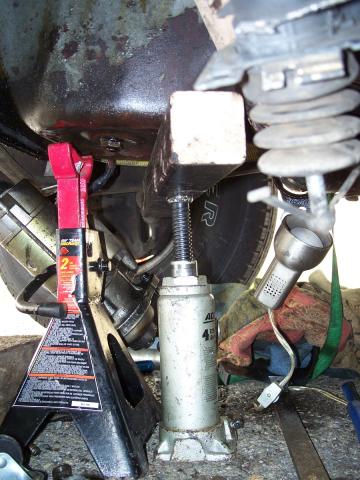
  • You don’t need any special tools other than a wide base jack (a transmission jack if you have one – I used a motorcycle jack I found on Craigslist, because it was both cheaper and more versatile for future projects).  Don’t try to use a regular bottle or scissor jack.  They are strong enough, but they will probably fall over, and then a transmission will fall on your head.

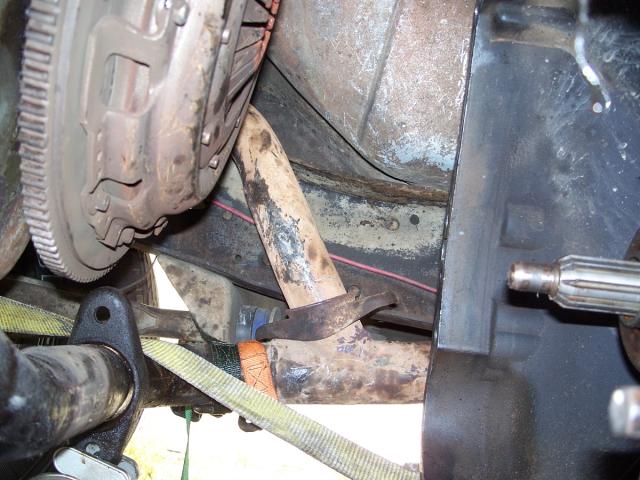
  • What you will want that you won’t necessarily find listed in the shop manual for this process is various crowbars, lengths of pipe, hammers, ratchet straps, and possibly a propane torch.  Luckily I happened to have all that stuff lying around already, and I bet you do too.
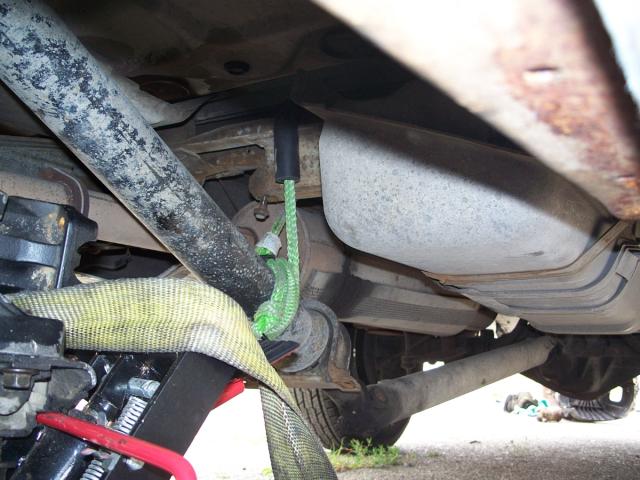
    Crowbars and pipes are for prying parts apart and pressing them together.  Hammer gets the universal joint out.  Ratchet straps hold exhausts pipes and crossmember dog-ears out of the way, and, if you lay a pipe across the opening in the floor to give something to hook to, you can use a strap to hold up the back of the transmission which lets you alter the angle independently of the jack its on.  The torch gets the stick shift off of the shifter stub.
Inline image 3
  • When you hear it is a “direct bolt-in replacement”, they mean it literally: just the bolts.  The bolt pattern from the transmission to the engine is the same, so you don’t need an adapter.  Pretty much EVERY OTHER PART that goes to or from the transmission are not compatible.
    All in all, if wanted to do everything totally properly and by the book, that would mean replacing the clutch, pressure plate, throwout fork, flywheel, driveshaft,, crossmember, and floorpan, and possibly the clutch pedal and cylinder.  I reused as many parts as I could possibly get away with, which meant I only had to buy one clutch kit and one u-joint, but that still added a couple hundred more dollars to the project than I had originally planned on.

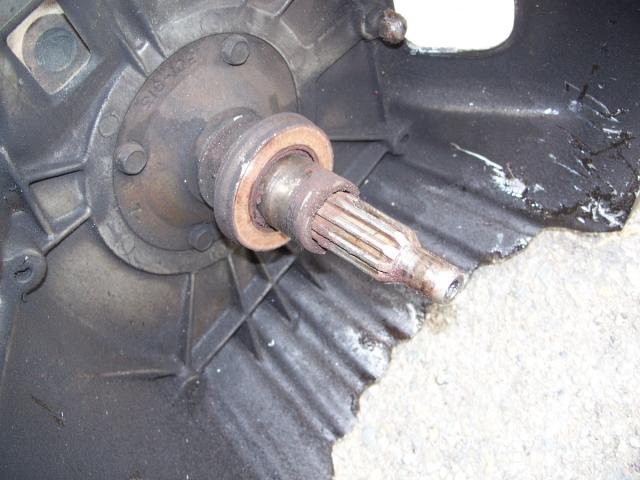
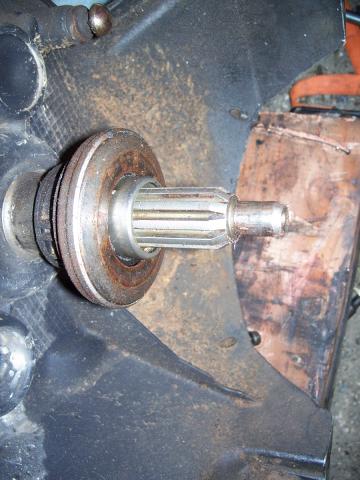
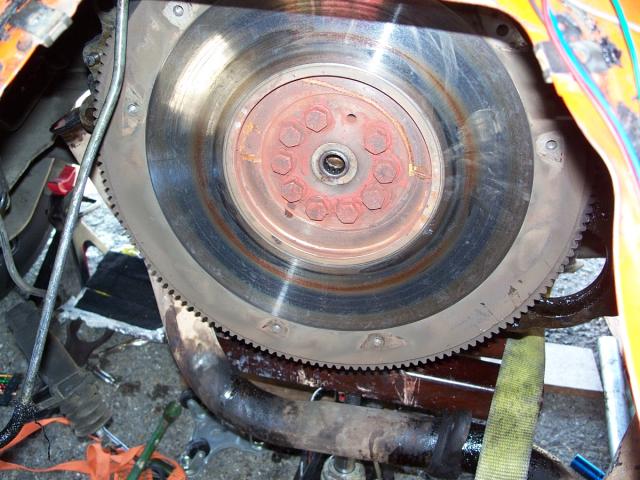
-The Clutch.  To the naked eye 10 splines with a 1 1/8” diameter input shaft (the part of the transmission which goes inside the clutch) looks pretty much identical to 10 splines with a 1 1/4” input shaft.  But when you get the new tranny half in, that small difference in diameter means it isn’t going in, no matter how you angle it.  You may have heard – repeatedly, from multiple sources – that it is challenging to get everything lined up perfectly and get the splines to engage.  Having heard it was tricky, you might be fooled into thinking that what you are experiencing is normal.  You might think it has something to do with not using a real transmission jack, or not having a helper or two, or just not having experience.  You might spend all morning trying to get it positioned just right; before finally realizing this can’t be right, going online, and finding out the hole in the middle of the clutch is 1/8thof an inch too small, and it wouldn’t have gone in no matter what you did.
Inline image 9     Inline image 10
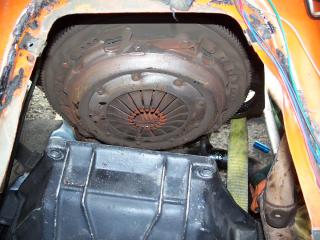
There are 4 possible clutches that will work: 11” or 12”, and with dampening springs or without.  If you go with a SMF (next step) you need springs, if you go DMF you need to not have them.  The simplest/cheapest option is 11”, with springs.  I used Sachs part # K0065-02, which I found at O’Reilys (same part #).  (I’m not endorsing O’Reily, they just happen to be nationwide, and fairly inexpensive, so it’s a simple example to use.  Cross reference the part numbers and shop wherever you like.  I encourage shopping at local/independent businesses)
Inline image 4
-The Flywheel.  You may or may not need to replace this.  It depends on what clutch you get (and what condition your old flywheel is in when you get the old tranny off and take a look at it).  If the clutch has springs in it, you need a single mass flywheel.  If it doesn’t, you need a dual mass.  The single mass flywheel may cause some ugly sounds when you are idling in neutral. Mine does. That’s ok, we’re ecomodders and hypermilers, we try to spend as little time idling as possible.  The engine/transmission can accept single (SMF) or dual mass flywheel (DMF) with either 11” or 12” clutch, so long as they are compatible with each other and have the correct diameter hole (1 ¼”)  and correct number of splines (10) to fit the transmission.
Inline image 12
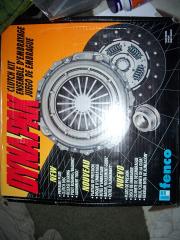
The pressure plate may or may not also need to be replaced.  If you are changing from single to dual mass (or vice versa) the bolt holes may not line up.  The clutch kit I got came with the pressure plate, throwout bearing, pilot bearing, and alignment tool, and I kept my original flywheel, so that made this step relatively simple.
Inline image 5
-The Drive Shaft.  The yoke at the end of the ZF is slightly bigger than the T-19, so it doesn’t mate up to the driveshaft using the same U-Joint.  A lot of people deal with this by changing out the entire driveshaft (or at least the first section of it.  However, you can also find hybrid adapter U-joints that make the existing driveshaft work with the ZF.
Inline image 8
-The Universal Joint (U-joint).  This is the +shaped thing with bearings that allows the driveshaft to transmit power to the transmission, while allowing them some freedom of angle relative to each other.  Just like with the clutch, in the newer generation truck, they changed the diameter of the part just a fraction of an inch, which is enough to make the old and new incompatible.  Fortunately, adapters with one size on one axis and another size on the other axis are actually pretty easy to find at regular auto stores.  You have to go from a ZF-5 (1350 / 1.188”) to a 6.9L IDI stock driveshaft (1330 / 1.063”).  At O’Reily the part number is 448.
Be careful not to let the caps fall off, or the tiny roller bearings will go all over the place, get lost or dirty, and you’ll need to buy a whole new U-joint.
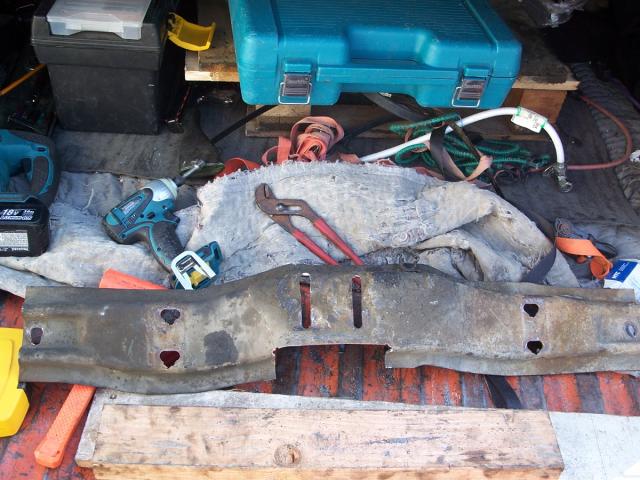
-The Crossmember.  This is the steel bar that rests on the frame, which holds up the back of the transmission.  The ZF is a couple inches longer than the BW.  The difference is small enough that you can use the same driveshaft, but the holes in the crossmemeber won’t line up.  If you can get one along with the transmission, it should fit in place of the old one.  Or you can just drill new holes in the original crossmember, and cut away a small section to fit around the back of the tranny (that’s what I did)
Inline image 7
-The Gearshift Lever.  There are several different shapes, sizes, and attachment methods.  Apparently the gas and diesel versions of the same transmission and the same year even used different attachment methods.  Plus some have straight shifter stubs (the part coming out of the tranny itself, that the lever attaches to) and some are curved.  Some levers are straight and others are curved.  If the new transmission didn’t come with the lever, you may have a fun time trying to improvise something that works.  That’s if it came with a shifter stub at all.  If it didn’t, well, I just don’t know what to tell you…
I melted the old one off of the BW shifter stub, and then drilled through it and the new shifter stub in order to bolt them together.  The old rubber was unusable after being melted off, so I used layers of bicycle inner tube and some random pipe I had lying around to fill the gap where the rubber used to be.  Because improvising is just how I roll.
-The Throwout Fork. The short arm which the clutch cable or hydraulic cylinder moves, which slides the throwout bearing back against the pressure plate.  The little mushroom looking knob thing that the fork pivots on inside the bellhousing is a slightly different diameter.  Hopefully the new transmission came with one.  If not, you could probably improvise a way to make the old one work (by trimming the attachment point that goes around the mushroom knob - it probably has an official name; I don’t know what it is)  Hopefully.  Mine came with its own.
-The Clutch Pedal / Linkage / Cylinder.  Most gas engines use a cable.  Most diesels use hydraulic.  Most automatics use neither (ok, ok, all of them).  If you are just changing with an otherwise compatible model, you probably won’t need to change any of this.  I didn’t.  But be aware it may change the release point and pedal feel.
-The Speedometer.  Some use a cable with 7 teeth.  Some use 8 teeth.  Some are electric.  I am currently using my GPS for speed.
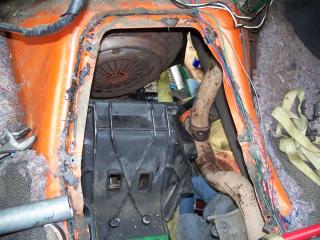
-The Floorpan.  The ZF sticks up a little bit higher.  If you can get the floorpan from the truck the tranny comes out of, you may as well take the matching floorpan.  I was able to get my original to work, just using a couple additional sheetmetal screws to hold it down in the places it wanted to pop up.


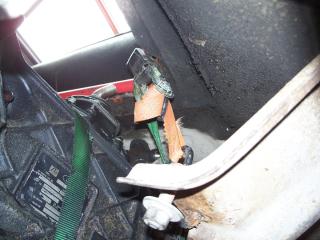
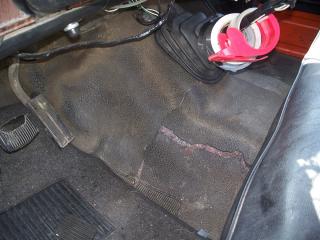
  • Speaking of the floorpan: if you’ve done transmission work before, you may think I am an idiot.  But I’ll bet I’m not the only person who didn’t know, so I’ll just go ahead and say it – the little metal plate under the rubber boot where the shift lever goes through the floor, that’s not the floor pan.  The entire metal plate that it attaches to is.  If you remove the carpet or vinyl floor covering, you can then clearly see the bolts for the whole thing.  Removing the vinyl floor covering is neither easy nor fun.  But having access from the top is worth it.
Inline image 1         Inline image 2
  • The Chilton manual for the 7th / 8th generation F-series (which supposedly covers both gas and diesel versions) explicitly says there are FOUR bolts holding transmission to engine.  Four.  It’s the manual.  It’s the freggin manual!  The whole point is that it is supposed to give you more information in order to make the job easier.  After removing those 4 bolts, no matter how you angle things, the transmission just won’t come out.  That would be because there are actually SIX bolts!!  Now you might say “but if the manual says one thing, and you are actually there on the ground and you see extra bolts, obviously you should take them out too” right?  Welllll….  Those last two bolts are in a place where there is literally no possible way to see them.  Unless you have very skinny and long fingers, you probably can’t feel them either.  And even if you could, there is absolutely no possibly way you are going to get a wrench or socket on them.
    The secret is that, after having removed the driveshaft, you loosen the engine mounting bolts, and hold the engine up with a jack, not a block or jackstand.  Then jack up the transmission just enough to remove the crossmember that holds up the transmission.  Finally, lower the engine (with the tranny still attached to it) and when it’s low enough the two hidden bolts on top become exposed.
Inline image 6
  • It looks like the part of the bellhousing which is flared out to accommodate the starter gear might just barely clear the exhaust pipe.
    It won’t.
    Before you ever start loosening the transmission to engine bolts, detach the exhaust from the headers on both sides.  Also remove the starter.  They say you should detach the battery first.  Officially, I’m recommending that.  Unofficially, I’d point out that this would make it impossible to listen to the car stereo while you work.Inline image 11
Don’t forget also to budget for transmission fluid, which should ideally be synthetic.  All the manual transmissions apparently will work with a pretty wide range of fluids, from ATF to motor oil to gear oil.  I’m using synthetic ATF, but I don’t know enough about the pros and cons to make any recommendations.  Supposedly 30w oil will make it quieter at idle, but make it harder to shift.

What a process.  I was expecting a 6-8 hour job.  It should have been.  Had I known everything then that I know now, it would have been.  In actuality, it took almost 36 hours (maybe twice that if you count internet research and shopping time) spread over 6 days.

------------------------------------------------------------------------

The Results:
My best ever miles per gallon between fill-ups with my original transmission was 31, with several tanks getting up to 30.
On my initial test run I ran into severe traffic due to an accident.  It was like a giant 6 lane parking lot.  I got off at the first exit I could and took surface streets for the next couple cities. That delayed me enough that I then hit regular rush hour traffic for the rest of the way back to the fuel station.  I did not feel optimistic about my mileage.
It took 3.5 gallons of biodiesel to fill up after 120 miles, so despite the traffic jam, I set a new record for the truck of 33mpg.
Of course I still wanted to know just how high it could go.  Next run was at night, so there was no commute traffic to contend with.  103 miles, 2.7 gallons = 38.16mpg.
That is better mileage than the average HYBRID (36.3 – average of all hybrid models available; not average of all hybrids actually on the road) In a 30 year old ¾-ton 5500lb V8 full-size truck.  8mpg gain, or  27%, or almost $200 a year fuel savings with current prices and my average amount of driving.
At this point its not so much about saving money anymore as just seeing how far I can take it, but its nice to know that as long as I keep the truck more than another 4 years, it will eventually pay off.

Therefore, my advice to anyone who has a vehicle old enough to not have an overdrive is: swap it out.  It’s a big job, but it’s worth it.

17 June 2012

Please ride your bike in the street.


My used bike buying guide has been way more popular than anything I have ever written.

Since it is geared towards new riders, I feel obligated to share some statistics I just learned - confirming what I have known for many years - about the best ways to stay safe in traffic.

                    ---------------------------------------------------------------------------

Riding among fast moving two-ton steel machines can be very nerve wracking when you first start out.

The number one fear of most new cyclists in traffic is getting hit from behind by a driver, but it is important to know that this is, statistically, actually the rarest type of accident. 

The most common are at intersections and driveways, when the driver didn't see the cyclist - usually because they weren't expecting the bike to be where it was.  That's why I (and the official League bike safety classes) recommend riding with the normal flow of traffic.

Riding with the normal flow of traffic means riding in the street, to the right (in America at least), and obeying basic traffic laws, such as stopping for red lights and going the correct way on one-way streets.  It means never riding against traffic (facing on-coming cars) and never riding on the sidewalk.

Although it feels much safer to be on the sidewalk, away from the cars, in reality most accidents happen at driveways and intersections, and a driver is less likely to see you if you are anywhere other than the street.

You reduce your statistical chance of being hit by a car by somewhere roughly on the order of 90% compared to the average rider just by riding predictably, following the law, and being extra visible, because, as it turns out, the vast majority of bike accidents are (at least partially) the cyclists' fault.

So what exactly does riding safely entail?


There are several ways a car and bike can make contact:


(If you are having trouble visualizing what I am describing, the following two websites have similar information, along with pictures of examples of each.  Note that they both come to the same ultimate conclusions:  
http://www.bikexprt.com/streetsmarts/usa/chapter2a.htm
  and/or  http://bicyclesafe.com/ )

  • Bike is at intersection (or driveway) going straight, car on cross street hits (or is hit by) bike.
    Much of the time, this is because the cyclist ran a stop sign or red light.
    Another common reason is because the cyclist was not riding with the normal flow of traffic.  Car drivers tend to naturally look only where they expect to find cars coming from, so they don't notice bikes coming from somewhere else.
    This can also happen because the cyclist did not have a headlight on in poor visibility. A car's headlights don't light up your reflectors from a 90 degree angle.
Solution 1: Do not run lights/signs. 
Solution 2: Never ride on the sidewalk, or against traffic. 

Solution 3: Use a bright headlight - even in daytime if visibility is poor (even cloudy / overcast) - see the next section, below, for more on being visible.

  • Bike is at intersection going straight, car comes up from behind, turns right in front of bike
Solution 1: Do not hug the shoulder.  Ride as far as a parked car away from the curb, even when there is no parked car there. 

Solution 2: Again, do not ride on the sidewalk, as a turning driver won't expect anything faster than a pedestrian to be coming into a crosswalk.

Solution 3: Do not ride in a right turn lane if you are going straight.  Cross over to the same lane cars going straight use.  Either ride the stripe between lanes, or take the forward lane, depending on the situation.

  • Bike is at intersection going straight, oncoming car turns left into bike
Solution: Combination of the two above: use bright flashing headlight, even in daytime, and ride out in the lane where you are more visible.  Also, pay attention, and be ready to brake at all times.  (In the event that this does happen, turning right, with the car, is your best bet to avoid a collision.)

  • Bike is riding too close to a parked car, driver of parked car opens the door and bike hits it
Solution: Ride several feet to the left of parked cars
Someone asked me the question, what do you do when there isn't enough room to stay far enough from parked cars without getting in the way of traffic?  That's certainly not an uncommon scenario.  One thing that can help is looking into the rear window of each parked car you pass, to see if it is occupied.  This doesn't work at night, or when the sun is behind you and glare is in the windows, or if the windows are tinted, but it works often enough.  If the section with limited space is small, and especially if it is either a 2 lane (each direction) road, or has only light traffic, check that no cars are right behind you, signal that you are moving left, and then ride in the center of the traffic lane.  Cars will either have to go around you, or wait.  This may annoy some drivers, but it is the safest option, and it is legal under those circumstances.  Move to the right as soon as it is practical and safe, and wave any cars that have been stuck behind you through.
In the case where there isn't enough room for a long stretch, just ride in the "door zone", but ride slower than normal.  This gives you more time to react, and in the unlucky case that you don't see the driver about to get out through the rear window, and the driver doesn't check before they open the door, and the timing works out that it opens immediately in front of you, an impact at 12mph is simply not that big a deal.  You might get some cuts and bruises, but running into a car door at 12mph won't break any bones and it certainly won't kill you.

  • Bike is just riding along, car comes up from behind and clips cyclist
Solution: Don't worry about it.  This almost never happens.  Seriously.  Of all the types of bike/car collisions, it is the least common.  For all practical purposes, it never happens.   (That being said, there are some things you can do to reduce the risk even further, which I will get to below)

Yet this last one, being hit by passing cars, is the one that ALL new cyclists worry about the most.

Unless a cyclist is riding at night with no lights and no reflectors, it is pretty easy as a driver to see when you are coming up behind one.  The one place even distracted drivers tend to be looking is the road straight ahead of them.  They have plenty of time to see that you are there.  Unlike with a side collision where the driver has very little time to see you and react, if a bike is going 15mph and a car is going 25, the relative speed is only 10mph because you are both going in the same direction.

Drivers rarely randomly swerve side-to-side when driving along a straight road.  If they did, they would be constantly clipping the mirrors of parked cars, side-swiping each other, and running up on the curb when there is no shoulder.  These things (almost) never happen, just like drivers don't run into cyclists from behind as they are passing them.

Even in the very unlikely case that a car did clip you from behind, it is most likely going to be their rear view mirror brushing your arm.  This may, or may not, cause you to fall.

That being said, there are definitely a few skills you should have before venturing into traffic on a bike. As I pointed out just above, car drivers almost never randomly swerve to the right when driving.  However, new and wobbly riders do sometimes swerve to the left.  Before you venture onto streets with no bike lane or wide shoulder, it is important that you are able to ride in a perfectly straight line.
Next, you need to be able to ride in a straight line, while taking one hand of the handlebars (in order to use it to signal your intentions to other road users).
And finally, you need to be able to turn your head and look back over your shoulder while riding in a straight line (so you can check for cars before changing lanes or going around obstacles).  This may sound silly to experienced riders, who don't remember how challenging that was to learn, and impossible to new riders.  It may not be automatic, but it is easier to learn than initially learning to ride a bike, so if you have gotten this far, you can do it.  Just spend some time practicing on an off street bike path or a big empty parking lot.  Pick a painted stripe on the ground, and try riding on it.  When you can ride along a 4" wide stripe without swerving off of it, try taking one hand off the bar and holding it out like you are signaling a left turn, and stay on the stripe, and when that's easy, look behind you and then check that you are still on the line.

I recommend NOT having a rear view mirror. If you are going to change lanes, it is important to actually turn your head and look. A mirror has a limited field of vision, and your own body/head blocks part of that field. Plus, like it says on the sticker, "objects are closer than they appear". If you are not planning to change position, there is no reason you need to know whether a car is approaching you from behind or not. If they are there, or not there, your actions should be exactly the same: don't suddenly swerve out into the traffic lane. Wanting to know if a car is approaching is just a manifestation of the fear of getting hit from behind, but that knowledge can not help you. There is no possible way to tell if the trajectory of a car behind you will have them pass you with 6" to spare, or with clip you with their mirror as they go by - the car is too big, the speeds are too fast, the clearance too small, and the driver could make a course correction at any moment. Therefore, regardless of if a car looks like it is going to pass close, you should simply keep riding in a straight line. You have a much better chance of injuring yourself by diving out of the way of a car that wasn't going to hit you anyway, than you do of successfully avoiding one that would have.
But if you need to turn and double check before changing lanes, and if it just makes you paranoid about something you can't do anything about anyway the rest of the time, what purpose does it serve? For the same reason, I find no reason not to wear stereo headphones - there is absolutely no way you can tell whether a car will hit you or not just by sound. Besides, you could be being passed by an electric car, or another faster cyclist, in which case hearing nothing doesn't mean you are safe. Therefore the habit of relying on sound to know if cars are around is a bad one - but I am not necessarily advocating riding with headphones either. In some places it is illegal, in which case you should probably avoid using them.

Because of the importance of not suddenly swerving into traffic, unless you have turned and checked and are sure nothing is coming, it is usually better to just ride over potholes, garbage, glass or other small obstacles in your path rather than going around. When there is an obstacle you can't go over (say, a delivery truck in the bikelane), or you need to cross the main traffic lane to reach the left turn lane, first turn and check if there is space to merge without getting hit, and put your left arm out to signal your intention. Then move over and ride in the center of the lane if you need to, to prevent cars from trying to force their way past you if there isn't room. Then get out of the way as soon as its safe, to avoid agitating drivers unnecessarily, and give them a sign to let them know they can pass.

A bike is considered a vehicle, and you have the same rights and responsibilities as a car driver. 
As long as you are 1) visible and 2) predictable, it is safe to flow with traffic - even on dense, crowded, or high speed roads.

Uneducated drivers may be annoyed that you are riding in the street in the way you are legally supposed to, they aren't going to hit you deliberately (well, it does happen occasionally - but very very rarely. Still, depending on where you live, it may be prudent to carry a camera...)

Accidents happen because cyclists do things that drivers weren't expecting.  That's why it isn't safe to ride the wrong way down the street, or to ride on the sidewalk (getting off and walking is of course always ok)

The best way to keep drivers from coming up way too close to you when there is no shoulder and barely enough room for both car and bike is, counter-intuitively, to move more to the left.  Make them change lanes to pass you.  If you hug the curb because you are afraid of cars, drivers will take advantage of that and squeeze past. Moving to the left - even if it means taking the entire lane, if you need to to be safe - is legal (but you will have to look it up yourself for your state).
Ride like you have as much right to the road as a car driver - because you do!

OK

So, you read all this, and you still aren't convinced.
How about some actual stats collected from real life bike crashes?

The following is from http://www.bicyclinglife.com/Library/TaleOfThree.htm

 At first, looking at the data, it doesn't look like this is true as the first two involve a car which should have stopped hitting a cyclist, but if you keep reading to "discussion" you find out that in the vast majority of those cases the cyclist was either riding the wrong way, or on the sidewalk (85%).  In the 3rd most common, the cyclist ran a light or sign:
"The three most frequent collisions in Gainesville comprising 82 (51.9%) crashes involve the motorist facing either a traffic control device or merging from a midblock location and the bicyclist on a crossing path. Of these bicyclists, 65 (79.3%) were riding on the sidewalk facing traffic. [emphasis mine]
"These crash types ["Drive Out At Stop Sign," "Right Turn On Red," and "Drive Out At Midblock"] are more likely to occur as a result of riding on the sidewalk."
In other words, the 3 types of common crashes which appear to be the fault of the driver, are all more likely from riding on the sidewalk (regardless of whether going with or against traffic).  The next most frequent accident types are clearly the fault of the rider (failure to yield).
"Conclusions/Recommendations... Due to the inherent conflicts at driveways and intersections, bicyclists should ride in the street and not on the sidewalk. "
So now you realize you should always ride in the street, with traffic, and follow the same traffic laws that apply to cars.  But as a new rider, its still freakin scary.
The only way to get over that is to just do it, and keep doing it until it feels normal.

Think of it like riding a bike for the first time, or just learning to drive.

-----------------------------------------------------------------------------------------

The second most common reason for bike car collisions, (after the bike rider doing something illegal and/or dangerous), is when a car driver fails to notice a bike - bikes tend to be less visible than cars.  They are not only smaller, but they don't have lights built in.
But you can fix that.

Legally (at least in CA, but probably similar everywhere) after sunset and until sunrise, you need, at a minimum:
Front, rear and side reflectors (all bikes come with them stock - if yours are missing, you can replace them with reflective tape)
AND
A white, front facing headlight.

A headlight is much more important than a taillight for the same reason you should ride on the street in the same direction of traffic.
At night a car's headlights light up your rear reflector, so they can see you with no taillight.
But as you approach an intersection, a car on the cross street has its headlight pointed straight ahead - not at you - so they don't see you.  You need a light facing them or they can't see you at all.

While any front facing white light is sufficient to meet the minimum legal standard, I strongly suggest that no one skimp on lights, even if you never ride at night.

Even in day light, if it is overcast and cloudy, foggy, shady (like under overpasses or tree lined streets), or the sun is low in the sky, you are much more noticeable to drivers if you have a flashing light on.
At a minimum, you should get a light with either 3 or more regular LEDs, or one "super" LED (luxeon or cree), which is powered by either AAA, AA, or a rechargeable battery pack, and which has a flashing mode.  These can be found for around $20 online or at any bikeshop, and are bright enough to be seen even in daytime.
Lights which run on button cell batteries are not powerful enough to be seen in daylight.  It never hurts to augment your main light - I have a little button cell single led on the top of my helmet - but I recommend against using one as your primary light.

In addition, its a very good idea to have a bright, flashing, rear light - again, 3 or more regular LEDs, and/or a luxeon or cree "super" led, running on triple A, double A, or built-in rechargeable batteries.

If you ride at night, even occasionally, it is worthwhile to augment your flashing headlight with something bright enough to actually see where you are going (this also adds very substantially to your night time visibility).  This means one or two super LEDs powered by a separate battery pack.  Very few self-contained units can match the light output of the battery pack lights. 
Look for a light rated for at least 200 lumens of output - the more the better.

These normally range from $100 to $300, and the brightest of them compete with a car's headlights in brightness.  This may be as much as you spent on your bike, but it also may save your life.  Considering that even if you buy the best bike components, you will never come close to the cost of a car, and that a bike can get you places gas-free, it is a reasonable investment. 

I got a 1200 lumen (according to the manufacturer) headlight from MagicShine for about $50 from dx.com
Absolutely worth it.  The difference is night and day (pun intended).  With a 1200 lumen light, you can ride on roads with no lighting, on a new moon, and see your path with total confidence.  The only problem is making sure not to shine it in the eyes of motorists and pedestrians.  The MagicShine has a terrible mounting system, but everything else about them is great.

A good idea for night riding is to mount one light on your handlebars, and another on your helmet.  This way one is always facing forward, no matter what you are looking at, so oncoming and cross traffic cars see you, and you can use the other to look in different directions, or to briefly flash directly at cars that appear to be on a collision path with you and aren't slowing down (like when a car on a cross street passes the crosswalk and stops sticking out in the intersection).  I have a red flashing light on the back of my helmet too, where it is up high and moves with the head. You can't have too much visibility.

In addition to your lights, I highly recommend one of those florescent safety green jackets (if the weather is cool) or vests (if its warm).

From personal observation, they are much more noticeable, night or day, then orange or yellow.  In day time especially, they stand out even more than reflective clothing.  At night color matters less than reflective stripes.  With a jacket or vest you can wear whatever clothes you want for when you get to your destination, even a suit, and still have maximum visibility.  When you get where you are going, the thin safety jacket or vest stuffs so small you can put it in a pocket.

Between bright lights and a high visibility jacket, (and, of course, riding in the street with traffic) your chances of getting hit by a driver who just didn't see you plummet.
At this point, if you want to add helmet lights, reflective tape on your bike and helmet, spoke lights, or a lazer beam bikelane (also available from dx.com) all that is just gravy.

I wear a pair of reflective gloves, (meant for cops directing traffic), so that drivers can see my hand signals at night. 
They just happen to be designed with a yellow triangle on the back - perfect for signaling turns;
and a red triangle on the palm - perfect for signaling stops.


--------------------------------------------------------------------------------------

So now you know.  Apply what you have learned, and your chances of getting hit by (or hitting) a car become far below the statistical average, and you will actually be much safer biking in traffic than you would be driving.  Add in the health benefits, and... well, its just obvious, isn't it?
Get out there and ride!

13 June 2012

“A poor person never gave me a job”


The latest meme created by the political Right in order to attempt to justify massive wealth inequality in America, a talking point for the middle class to use, but even more so a subtle reminder to them that they should be grateful towards their social superiors.

It is effective in its simplicity, as good memes and talking points should be. 
It takes so much for granted that it appears to be impossible to counter – it is in fact an accurate statement – so there is no equally simple one-liner that can refute it.  Each and everyone of the underlying concepts that it relies on are false, and so to show the irrelevance of the statement to the issue at hand requires actually delving into and dissecting the assumptions it makes.
That is generally not practical in casual conversation, nor on a heavily time restricted televised debate.

But I have as much space as I want here, so, since I have yet to see a thorough analysis of this –frankly – ridiculous statement, I will do so myself, right now:

1)      Rich vs. poor is a false dichotomy.  “Poor” means those living near or below the federal poverty level, which is roughly $10,000 per person in a household.  This is only about the bottom 10-20% of the population.

Above them is the middle class.  They include not only 9-5 workers, but most of the self-employed, and a large percentage of those who own small businesses.

Above them is the “rich” – the much talked about “1%” – who have 6-digit incomes, and a couple million in assets.  Some small businesses are also owned by the rich. 

Above them is the super rich.  They do not belong in the same category as the merely “rich”.  These are the billionaires. They have so much wealth in existing assets that they could go the rest of their lives without earning another dollar, live lavishly with limos, butlers, yachts, and private security, and still leave trust funds large enough that their children never need to work a day in their lives either.  These people are not the 1%.  They are the 0.01%.  There are only a few hundred of them.  As an interesting side-note, while a fairly large chunk of the rich actually got rich by working hard, living cheap, saving their excess income and investing it wisely, nearly half of the super rich got their money by inheriting it.

2)      The person who owns a business does not “create” the positions they hire for.  The only way that would be true is if people who had too much money started hiring people to dig holes in their back yards, and then hiring others to fill those holes in again.  That doesn’t happen.  The jobs they hire for are jobs that needed doing.  It is the economy – and ultimately consumers, who drive demand – that actually create the need for jobs to be filled.  Consumers consist primarily of the middle class.  They are creating their own jobs.
What form those jobs take can vary.  A century ago the vast majority of those jobs would have been in the form of individual family businesses, mostly with just one location, which grew bigger than the family could handle, so they began hiring a workforce.  Whether you have a mom & pop corner store, a family restaurant, and an independent coffee shop, or you have a WalMart, a McDonald’s, and a Starbucks, either way the exact same jobs exist.  The corporations didn’t “create” any of those jobs, nor did they “give” them to their employees.  They simply took over for the small businesses that existed before they arrived.  As times has gone on, more and more small businesses have closed as they have been unable to compete with (or bought out by) larger companies.

3)      Even with the massive growth of nation-wide and international corporations and the reduction in the small businesses they have displaced, it is still true that 50% of all jobs are created by small business.  As noted above, small business is owned by either the middle class or the merely “rich” (as opposed to the super-rich).  Small business, by definition, is not nation-wide, and is not a corporation.
In other words, not only are major corporations not creating new jobs, they aren’t even hosting ½ the jobs that do exist.

4)      In fact, one of the main reasons large business and corporations have a competitive advantage over small business is because of the fact that they are so good at eliminating jobs! 
There are three main forces that cause the need for American labor to shrink - and all three have become so common that they rarely get talked about any more, even though all three were recognized as problems for the American worker while they first began to develop.  They have become so wide-spread and common that we just take them for granted now, but they are bigger problems now than they used to be, and they are the root cause of our current unemployment.
a.       Outsourcing – obviously if a company moves its production to another country (almost always for cheaper labor) that means there is less need for workers here, and people get laid off.  This used to mean opening factories in other countries, but it now includes a lot of phone support and software development as well.
b.      Technology – whether its robots replacing factory workers, computers replacing accountants, RFID toll readers replacing human collectors, or self-check-out replacing cashiers, technology tends to have the affect of eliminating jobs.
c.       Consolidation – when one corporation buys out another, they frequently have multiple positions being filled by different people from each of the original companies.  One of them is now redundant, and so people get laid off.

5)      All three of the previous factors have a couple things in common.  One is that it reduces the necessary American workforce, which causes overall unemployment to rise.  Another is that all three benefit the company or corporation doing it – they have the same (or greater) output, but their labor costs are reduced, therefore their overall profits increase.  Far from assisting the American middle-class by providing jobs, they literally benefit directly from deliberately eliminating jobs.  As a bonus, as unemployment rises, competition for jobs increases, which allows employers to lower wages (or reduces cost-of-living increases, which amounts to the same thing) which pushes wages down for all jobs.  Again, benefiting the corporation at the expense of the workers.
There is one more important thing they have in common – they all require significant capital to undertake.  Building a brand new factory overseas is not something a one location family owned business with a handful of employees has the resources to do.  Buying state-of-the-art robots to run a factory in the US requires too much spare cash for a small business to make the switch.  Buying out all of ones competition, even if its at a loss, can be a very expensive undertaking.  There are obviously going to be individual exceptions, but in general these are all things which large companies are likely to do, and which small business is not likely to do.

6)      Giant companies are most likely either owned by the super-rich, or they are corporations.  Corporations are technically owned by all of their share-holders, which can include anyone with a stock portfolio (much of the middle class).  However, shareholders get minimal input into the company.  All the shareholders are doing is lending the company their money to use as capital. The decisions of what to do with that money are made by the “Preferred” Shareholders, the board of directors, and most of all by the CEO.  These are the people calling the shots, and they are the ones whose job it is to eliminate jobs, thereby increasing profits.
So while big business is hosting ½ the jobs purely because of their massive overwhelming size and influence, and having run most of the independents out of business, they are simultaneously responsible for eliminating all of the positions which used to exist, and would still if they weren’t around.

7)      As noted above, the thing that allows them to find cheaper ways to replace American workers is excess capital.  Tax breaks to big business and stock investment increases their excess capital.  And so, ironically, as the middle class votes for policies and politicians that benefit big business with the reasoning that it will come back to them in the form of employment, they are actually helping to eliminate their own jobs, while at the same time creating a government deficit, which ultimately they will pay for, in the form of higher taxes, reduced services (and “services” doesn’t just mean “welfare”; it means roads, highways and bridges, communication networks, clean water, police to combat crime, firefighters to combat fire, elections that aren’t fixed, mosquito abatement, corruption-free court systems, prisons… all that stuff that makes modern civilization work) – or both higher taxes AND reduced services. 
All to help out the very people in society who need the least help – the handful of incomprehensibly wealthy people who between them hold enough wealth to pay down the entire US debt – not just the deficit, the entire debt – while still leaving all of them millionaires.

Unfortunately, there is no easy way to condense all of that into a snappy one-liner come-back, and since American’s as a whole have shunned intellectuallyness and edumacation, one-liners is what sticks – “a poor person never gave me a job” will stick.  And we as a people will continue voting for politicians and policies that allow corporations to do whatever they want, not realizing that what they want is to give the people the ugly end of the shaft.  I guess maybe as long as we are going to turn to edutainment for news and talk radio commentators for political and economic analysis, we are just getting what we deserve.
Hopefully as our economy collapses around us it will shake the middle class to their senses, and we can start to build a new with a focus on benefiting US citizens as a people instead of profit for profits’ sake when we finally emerge from the rubble.