Blog.
What a funny word.
Hi, I'm Bakari Kafele.
You may remember me from such blogs as:
http://apps.biodieselhauling.org/blog/
http://neapolitanblog.blogspot.com/
and
http://www.myspace.com/pyrococcus_furiosus/blog
If so, you may have noticed that I have content scattered all over the place, none of which is well organized or easy to find or read.
Well that is all about to change.
For anyone who doesn't know who I am:
I'm Bakari Kafele. I already said that.
I often use the name Jacob Aziza when I am writing on the internet. I also sometimes use the name David Craig Hiser. And Lenard E. Simpleton (or sometimes just Lenard Simp)
We are all the same person, (like Tyler and his best friend, except that I have always been aware of it.)
I'm just a random ordinary guy.
I live in an RV which is partially solar powered, both for the environmental benefit and the major cost savings.
Living with me are girlfriend Jessica and non-human roommate Fushi, who also goes by the name Chairman Meow.
I run a small independantly-certified-green moving, hauling and handyman business BioDiesel Hauling, using my biodiesel powered truck. I've been doing this for over 5 years, beginning immediately after I finished 4 (simultaneous) associate degrees.
Before that I held over 30 jobs in my lifetime, including biology lab tech, bicycle messenger, private security officer, armored truck driver, carnie, factory worker, fundraiser, liquor store cashier, bicycle mechanic and gigs as a TV commercial actor, ditch digger, medical test subject, "adult" actor, and election polling place supervisor.
Currently, in addition to BioDiesel Hauling, I am in the Coast Guard Reserve, and I still take occasional shifts with the BikeStation where I used to work.
I am vegetarian, I drive a motorcycle with a very small engine, and I am very opinionated on just about everything. I also go through phases where I really enjoy writing, although I have been out of that phase for over a year now.
My old blogs have several years of content, some of which (at least in my own narcissistic opinion) is pretty good, so to begin with, I will be reposting old content which most likely no one has ever read (MySpace anyone?) to here where it will be more accessible.
I realize I will probably never get a huge following, since I have no real theme and no motivation to seek publicity, but if you happen to want to subscribe, I've made it easy with the top boxes in the right side bar.
Enjoy.
22 January 2012


17 January 2012
Buying a good used bike from Craigslist.
For my first post on this new blogger account, I'm going to write a guide to how to select a decent used bicycle.
My VERY first post.
Even before I introduce this new blog website of mine, which is taking the place of my old MySpace blog (remember MySpace?) and the free blog that came with my businesses web domain hosting (with its character limit). My second post here will introduce it a little more thoroughly than these three sentences, and after that I will start moving old existing content here.
But first I will take a break from my usual political ranting, personal stories, and posting of links I found fascinating, to fulfill a promise I made to a fellow reader of a different blog (one with actual readership, MMM) in the comment section to share some of my knowledge of bikes and of Craigslist for an audience that may not know a good bike from a bad one. Imagine that, something useful!
First, for anyone who came here via link or Google, and doesn't know me personally, my credentials on the subject:
I began riding regularly for fun and transportation in 1992, when I was 12. The next year I began riding to school every day, so that I could keep the bus money for other things. In high school, in addition to daily commuting (to school and internship) and weekend rides of 40-100 miles, I began annual 4 day trips down the CA coast with a group of teachers and friends. After college I went with the couple that had organized those annual rides from San Francisco to Puerto Vallarta Mexico, and went solo from there along the coast to Acapulco and then North to Mexico city (over an 8000ft pass) for a total of 2800 miles over 2 months. When I returned, I took a job as a bicycle messenger. I eventually ended up also working as a messenger in New York City.
In 20 years of serious riding, I have had a bmx bike, a steel touring bike, a British internal-hub drop-frame from the late 60s, a carbon fiber racing bike, an aluminum mountain bike, and two folding bikes, all of which together I paid a grand total of $450 for (of which $400 was the carbon fiber road bike).
Eventually I returned to CA where, for the past 6 years, my primary job has been as a hauler (mover, and handyman) which involves picking stuff up that people don't want anymore, and then finding new owners for those things. This involves either selling or giving away anything which is still useable (which is most of what I pick up), frequently on Craigslist.
My second job for the past 5 years has been as a mechanic in a tiny bike-shop of sorts, the Bike Station, whose primary service is FREE secure valet attended bicycle parking, but also offers relatively low-cost repairs. Because we don't sell new bikes, and because we never turn anyone away for lack of bike quality, I have been able to work on a great variety of bikes, of all types and ages and cost levels, which is rare in any one shop.
(My third job is a reserve for the Coast Guard, but that isn't relevant to this at all)
And now... on to the content!
1) This is the most important thing of all:
DO NOT BUY A DEPARTMENT STORE / TOY STORE BIKE!!!!!!!!!!!!!!!!!!!!!!
Ever. Don't even consider it. Seriously. Not even for your kid. They are absolute garbage. They shouldn't be legal to ride on public streets. They should be considered toys at best. This includes pretty much anything you can buy at WalMart, Target, or Toys'R'Us, or whatever local equivalent you may have where you live.
The most common brands are Magna and Next (both Dynacraft company), Pacific, Roadmaster, Huffy and Murray (all Dorel Company), . One of these bikes brand new is worth less than a real bike that is 30 years old. (Actually, my favorite bike, the one that I rode to Mexico and used a messenger is almost 40 years old).
Less common brands include Anza, Ozone, Rhino, Vertical, Malibu, Avigo and Sonoma (all owned by Dynacraft) Dyno, InStep and Powerlite (all Dorel/Pacific)
Only slightly better are most modern Mongoose, Schwinn, Ironhorse and GT. All of these made decent bikes in the 80s and 90s, but were then bought by Dorel and quality dropped. Not all of these bikes are department store quality - my own mountain bike is a GT - but if you aren't confident at telling the difference, it may be safer to avoid all of these brands (or find a friend who can).
The same company also owns Cannondale, but unlike with their other brands, Cannondale never made department store bikes.
Schwinn has recently begun producing decent entry level bikes again as of 2014, but they had about a ten year run of only making department store quality bikes.
I can not emphasize this enough. Having worked on department store bikes many years, I can say with absolute certainty that they are not worth the price if you are given one for free. They use the cheapest parts that can be found, parts which have been obsolete for decades in the rest of the bike world, and those parts are put together by people who know literally nothing about bike mechanics. I have rarely seen one, even brand new, that had everything adjusted properly. They are so cheaply made, and so poorly assembled, that they are dangerous.
The best clue that the bike you are looking at is a department store bike is if it has a one piece crank.
This is a one piece crank:

Notice how the crank arm bends where it meets the bike frame, and goes straight into the bottom bracket.
Here, in contrast, is a 3 piece crank:
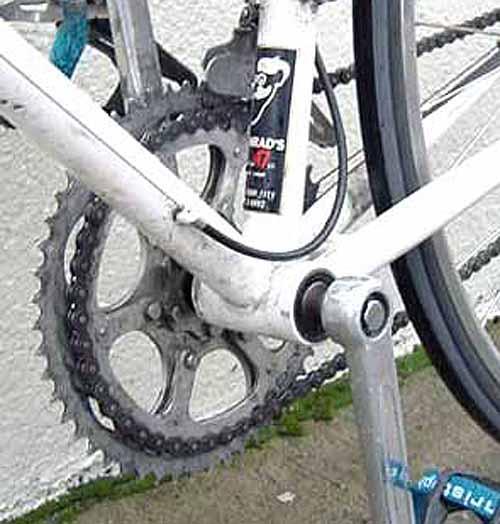
Notice that in this one, the crank arm is straight, and it is bolted to the axle.
Here are the two kinds, cut-away and side-by-side (one-piece on the left):

Another clue that the bike you are considering is a rolling pile of crap is brakes that look like this:
 or
or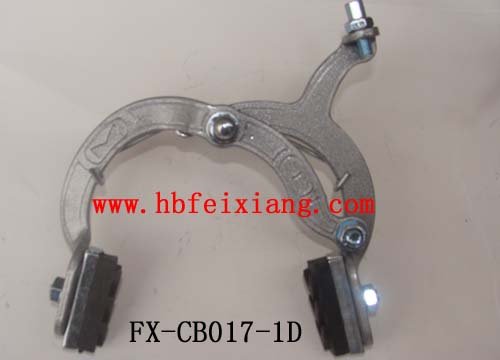
Called simple caliper brakes.
Note that most road bikes will have compound caliper brakes, which are similar in shape, but slightly more complex. The keys to the crappy brakes are the rectangle brake pads and the flat metal brake arms, with just one single pivot point in the center.
Note also that occasionally older bikes may have simple caliper brakes (though they won't have flat brake arms or square pads), and it doesn't necessarily mean the bike is crap. If a bike less than 30 years old has them, stay away.
Unfortunately, many department store bikes less than 5 years old often have slightly better components - 3 piece cranks and direct pull brakes - so it is slightly more challenging to recognize them at a glance, other than by brand.
Now that all that is out of the way, lets get into what you should look for.
But wait, no, before we get to that, you have to establish just what it is you are looking for.
2) Type of bike:
Like in everything else in life, every choice you make is a series of tradeoffs. There are a lot of different kinds of bikes, that are good for different kinds of things. You can use pretty much any bike for anything, but some will make the trip a lot easier.
Presumably most people reading this are looking for something practical to commute on, (and not a racing bike or a bike to do tricks on)
Some questions to ask yourself are:
Will I want to carry a lot of stuff with me?
Will I want to go fast sometimes? (I found I am often running late, and ended up using my racing bike to commute pretty often)
Are the local roads well paved, and/or will I ever want to venture on trails?
Will I have to climb any steep hills and/or pull a trailer?
Will I ever ride in rain/snow?
How important is comfort?
How important is efficiency?
Will I be working up to high mileage sometime in the future?
If you want to carry a lot, consider touring bikes or something meant specifically for commuting or hauling (of course, you can always retrofit any bike with a trailer, so that's another option)
If you want to go fast, and you don't need to carry much with you, a road-sport / racing bike will help you get there quicker with much less effort
A road-sport or racing bike, however, does poorly off-road, or with major potholes, gravel, glass, and curb-jumping
For steep hills, no matter what kind of bike, you will want not only gears, but low gears - generally that means 3 chainrings (the 3 big gears in the front, attached to the crank), like this:

Some bikes - especially ones specifically intended for casual riders or for commuting have the gears hidden inside the wheel. This has the advantage of being cleaner and simpler for the user, because all moving parts are hidden. They are also less prone to being broken and are more weather resistant for the same reason.
The trade off is that they are more expensive (to buy and to repair), heavier, and the lowest gear of an internal system will not be as low as with external gears. For this reason, if you have to ride up steep hills, go with external gears. If you ride mostly flat or only small hills, its a matter of preference.
For inclement weather, a mountain bike, hybrid, or purpose built commuting bike will outperform most road bikes - although you can put fenders and lights on anything, you can't put wide tires on a racer. This is especially true for snow.
Just like with a Cadillac and a Geo Metro, there is a trade off between comfort and efficiency. Beginners often get a bike with a wide saddle and tall handle bars, so they can sit up-right like a big rolling sofa, and then get discouraged when all the cool kids on real bikes pass them by at twice their speed everyday. Its not just that they are weak - there is a reason racers have low handlebars: the biggest factor in bicycle efficiency is wind resistance, and when you are upright, your torso is like a big parachute. So that comfort comes at the cost of twice as much effort to go the same speed. On the same note, a mid-range hybrid or mountain bike can weigh more than twice as much as a high-end road bike, which is a lot of extra pounds to lug with you up the hill to your house at the end of the day.
None of that is to say don't buy the hybrid, just understand that there are trade-offs. They are trying to be decent at everything at once, without costing much and making new riders comfortable, which means they excel at nothing.
The best compromise, in my opinion, between efficiency, bad road/trail worthiness, and bad weather capability, is a cyclo-cross bike, which is a road bike meant to be used off-road, however they are somewhat hard to find, and therefore usually expensive.
The next best all-around option, (again, in my personal opinion) which also includes cargo hauling capacity built in, is a road touring bike (which would be why that's been my primary bike for the last 2 decades).
But that isn't to say that you can't have a perfectly good long-term commuting experience with a mountain bike, racing bike, hybrid, cruiser, or a 60 year old bike from before special purpose bikes existed.
If it's possible, I'd recommend seeing if you have any friends with various types of bikes you can borrow for at least one ride, to see how they differ in riding position, gearing, handling, and so on.
If nothing else, maybe you can find a local bike shop and do a test ride on a couple of different bikes.
You may be taking advantage of them even more in the next step (since you will ultimately buy used directly from someone), but to make up for wasting their time, plan on buying all your accessories (minimum: helmet, lights, gloves, bell) from them, and/or having them do a basic check/tune of your new (used) bike once you get it.
3) Fit:
The only way to really get it exactly perfect in every way is to go to a bike shop and find someone who really knows all the variables, preferably with access to an adjustable bike fit machine (a stationary bike where you can change the lengths and angles of all the components and frame parts).
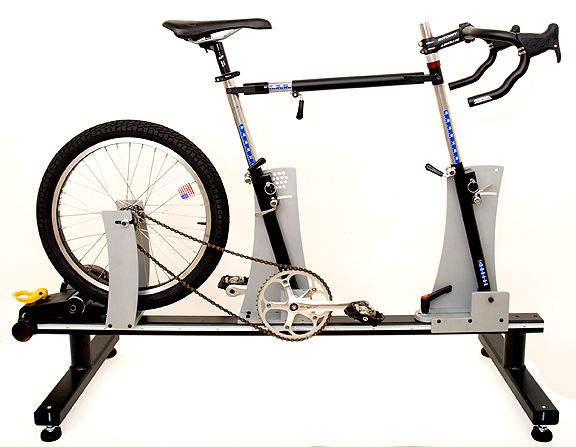
They often don't charge for this if you are planning to buy a bike from them, but again, if you go for a bike fitting, and don't buy a bike from that shop, you should really buy your accessories and/or service from them. Bike shops operate with a pretty small margin.
Given that you are looking to buy a bike used, and not get a frame custom built to your specifications, knowing your perfect fitment doesn't really matter anyway.
As a super quick and simple rule of thumb, when you stand over a bike frame (in front of the saddle) with your shoes on and feet flat on the ground, there should be at least 1 inch, preferably 3 or 4, between the top tube and the beginning of your... special parts. For one thing, if you were to be in a minor crash and fall forward off the saddle, you don't want to be impacting a big steel (or aluminum, or carbon) bar of bike frame. This is also an indication that the frame more or less fits you. If, when you straddle the bike, the top tube is actually touching you, that bike is much too big for you, and no matter how much you love it and no matter how good the price is, it just isn't the bike for you. I'm sorry.
On the opposite end, you can use the seatpost to judge if a bike is too big.
When you ride, your knees should be 99% of the way straight at the bottom of each pedal stroke (not 100%, or locked-out, but almost). If you don't extend your legs all the way, (imagine how it looks when an adult rides a tricycle meant for kids), you will end up hurting your knees.
In fact, if you have ever had hurting knees from riding a bike, this is the most likely reason. Your seat was too low.

(this bike is too small for him)
The seat post (the part that attaches the saddle to the frame) should have a line on it marking the maximum its meant to be extended (it may or may not say words to that effect). By loosing a screw, bolt, or quick release lever at the place where the frame clamps the post, you can raise or lower the seat height. If the post is at its highest (at the line) and when you ride the bike your legs are not extending fully, then the bike is probably too small for you. You can always buy a slightly longer seatpost if it's close, but if the seat needs to be higher than about 10 inches above the frame (assuming the top tube of the bike frame is horizontal, more on that soon), chances are the rest of the dimensions are too small for you anyway.
Of course, many bikes don't have a straight horizontal top tube running from the handlebars to the seat. The sloping top-tube or the drop-frame that used to indicate "girl's bike" (in order that the bike could be ridden in a skirt or dress) has become common on mountain bikes and commute oriented bikes and many hybrids for both genders, as well as continuing to be common for female specific road bikes. With a sloping top tube you can't just stand over it and measure the distance between your body and the frame to determine fit, and the seat-post will have to be extra long. In that case you just draw an imaginary line (or better yet, use a level and some string or a broomstick or something) where the top tube would be if it went straight across.

There is really a lot more to it than that, (such as the length of the top tube and the angle of the seat tube) but to keep things simple, 1-5 inches between you and the bike frame (or where the frame would be if it were straight) with your feet flat on the ground is about the best approximation there is.
Once you find one bike that fits, you can check the frame size (usually printed on the seat tube) and have a rough idea of what other bikes will also fit you - generally mountain bikes and hybrids will be measured in inches, road bikes in centimeters. But be aware that the numbers can vary between bike styles, brands, ages and depending on whether the top tube is horizontal or not.
So now you have some idea of what kind of bike you are looking for, and what size it needs to be.
4) Frame and components
There are hundreds of brands, with even more choices in components, so it is impossible to recommend any specifics, or break down all of the possible combinations. They all have high-end and low-end stuff, so never assume a bike is good or bad just based on the brand of the frame or the components.
Older bikes can be very good quality, just try to stay mostly on this side of the 80s, when most manufacturers switched from carbon steel or high-tensile (Hi-Ten) steel to chromoly (ChroMo) steel. The only modern bikes that still use carbon steel or hi-ten are the department store bikes, but pre-80s they were the standard for all but the most high-end bikes.
Some of the more high end older bikes did have good steel frames, particularly those made of Reynolds 531 or Columbus steel.
If you can find one, in good condition, you are looking at a good frame even though it is older.
However, unless the prior owner kept up with upgrades throughout the years, you should still consider a newer bike, as many advancements in components have been made since then.
Some brands which are in department stores today were once legitimate bike companies (most notable is Schwinn: a 10-20 year old Schwinn is likely a good bike, while a 2010 Schwinn is probably from a department store - better than a Murry or Huffy, but still not a good choice)
[UPDATE 2014]: Apparently Schwinn has started making real bikes again.
If it has a sticker (usually on the seat tube, near the frame size sticker) that tells frame material, avoid high tensile steel. Cromo steel, aluminum, titanium, and carbon fiber are all good frame materials, with their own pluses and minuses, but for practical commuting purposes, you should mostly be looking for steel.
Aluminum is also decent, and usually a little lighter. I prefer steel for a practical commute style bike, because it is the strongest of all frame materials, and it can be bent back after a crash and keep going. Any other frame type, once damaged or bent, is no longer safe to ride. However, if you find a bike that is perfect in every other way, don't necessarily shun it just because it is made of a more exotic material.
Suspension adds weight, complexity, and cost, and unless you ride off-road, doesn't serve much purpose, but if you do ride-off road, (or have giant and frequent pot-holes to contend with), it can make the ride more comfortable and give you better control. In general, for a commute bike, I would recommend skipping it.
Skinny, high pressure tires have less rolling resistance and less weight, therefore you can go faster / further with the same amount of effort. However they have less grip in bad conditions (esp mud or snow), give a bumpier ride, and are (in theory**) more prone to flats.
** In my personal experience, I have not had any more flats on my road bikes.
The curved style of handlebar found on road bikes gives you more possible hand positions, which can be nice on long rides once your hands get tired, but ultimately handlebar shape is a matter of personal preference. If possible, try a couple different styles out on the open road before becoming committed to any one type.
I would recommend an adjustable height and/or angle stem for any new cyclist, so you can choose whether to be more upright (more comfortable, but higher wind resistance) or more low and sleek, or anywhere between and change between them whenever you want, as you ride more and find what you like. Most older bikes (10 years or more) have an adjustable height stem standard. Most modern bikes have a "threadless headset" (commonly called "Ahead-set", which is actually a brand name) which are not adjustable in height, but you can attach an adjustable angle stem to it:
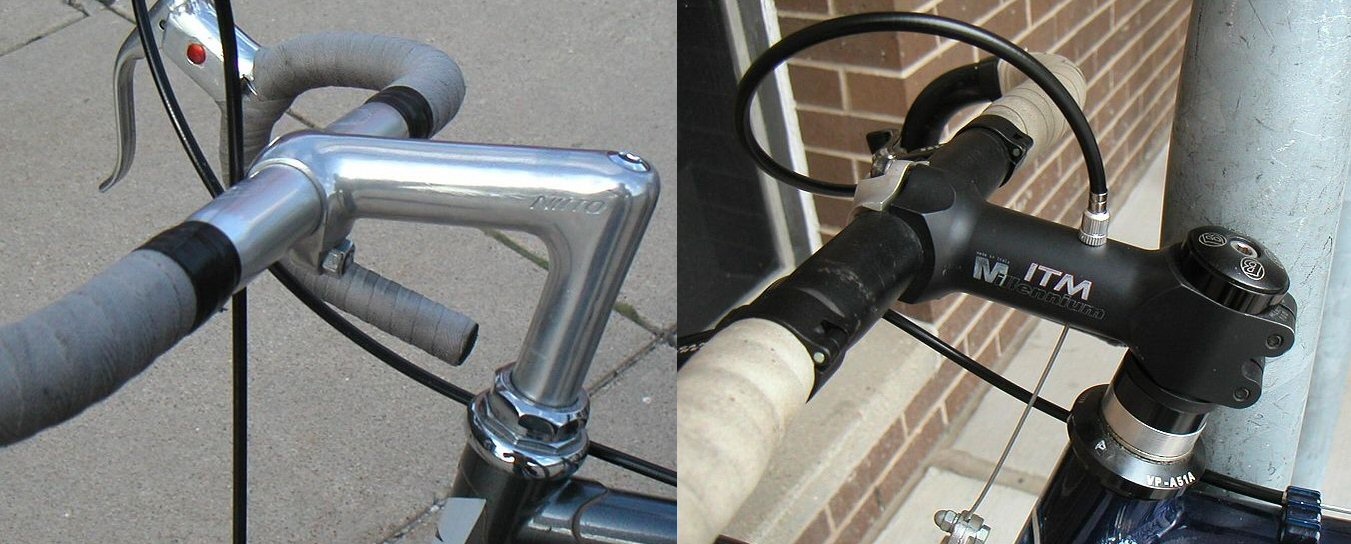
On the left is the traditional adjustable height stem. To change the height, you loosen the hex bolt in the center, twist the bars a little to break the connection, and pull them up. Don't go higher than the marked limit line.
On the right is the newer (threadless headset) which has limited to no height adjustability. Sometimes you can switch the position of the spacers to get a small height change.

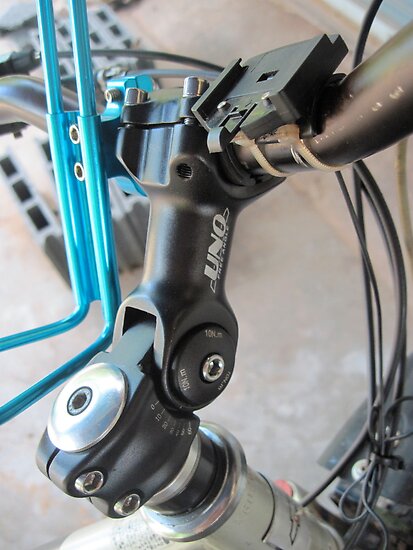
Adjustable angle stems.
As long as this already is, I am deliberately leaving out gobs of information, because this is a basic guide, and because you are buying something used and have limited choices. You aren't custom ordering a $3000 bike, so if you have a hard-core bike fanatic friend, you can safely ignore most of what she tells you about frame butting, spoke counts, gear ratios, or the superiority of Campy parts over Ultegra and Dura-Ace. Remind her that your goal is to get from one place to another, not to win a criterium. Tell her you don't even know what a criterium is.
5) Craigslist
In case you didn't already know, Craigslist is awesome. It is one of the most effective tools combating the worst aspects of the American consumerism cycle in which we are constantly throwing away things that still work in order to buy a slightly newer version, wasting our own money along with massive amounts of natural resources. Craigslist helps recirculate our money in our own communities instead of having it siphoned off by giant soulless corporations, keeps good stuff out of landfill, and prevents material extraction and energy consumption to create new stuff, all by the simple act of bringing together people who have stuff they don't want with people who want stuff they don't have.
If you are lucky enough to live in a reasonably large city, with at least a moderate amount of cyclists, than chances are good you can find a large selection of high quality bicycles on your local Craigslist page.
If not, though, the same principals apply to buying from a yard sale or flea market.
Another option is a used bikeshop. They will generally charge a bit more than buying directly from the previous owner, but you get the advantage of a bike that has been checked out by a mechanic, and a knowledgeable person to help you with the selection process.
Expect to spend at least $100, but unless you are lucky, probably $200, possibly more. Yep, that much, for a used bike. Even an old one, or a simple one. Less than that, and the chances are good you are buying a department store bike, a 40 year old bike which was low quality when it was new, or a bike that has been left out in the rain and generally not taken care of . Spending less will likely mean that you have to spend much more in parts and service in order to get it up to decent operating condition. If a bike is decent quality, well taken care of, and severely underpriced, it may well be stolen. Don't support bike thieves. They will end up stealing the bike back from you again. That's called Karma.
A decent new bike from a bike shop is generally $600 and up, so you are still saving plenty of cash by spending $200. Of course you can always get lucky and find someone who has no idea what they have is actually worth (like I did with my $400 carbon fiber racing bike), but don't expect it.
At the same time, be aware that there are a great many over-priced bikes on Craigslist. Depending on your market, it may take some patience to find a good one. Do a Google search of the make and model of any bike you are considering. In general, look for bikes no more than 20 years old, and of course, avoid department store bikes like the plague.
So say you have read this far, determined what you need, figured out the size, and browsed around and found a few ads that seem to have good quality bikes.
Keep in mind that someone is selling the bike for a reason. More often than not, the reason is because they just never ride it. Which usually means it hasn't had any maintenance in... ever. If its been stored indoors where it is dry, that may not be a problem, but in a damp basement or a back porch, there is likely internal rust that you can't see. If you see rust on the outside, unless the person is a bike enthusiast that you trust maintained the bike, assume there is internal rust as well. A bike bought by someone who never got around to riding it is more likely to have been cheap to begin with and to not have had much care taken in its purchase.
These are obviously not hard and fast rules, but if they are selling due to a move out of state, or due to having several other bikes, the chances are a little better the bike was taken care of.
Take hold of the wheels, and try to move them side to side (perpendicular to the way they turn). There shouldn't be any play in them side-to-side, against the axle. Do the same for the cranks (what the pedal attaches to) and the handlebars, trying to wobble them side-to-side, not the way they are supposed to turn. If they are loose and wobbly, that is a sign the bike hasn't been taken care of. Those things are easily tightened (although some require specialized bike tools) but if they have been ridden loose, they are likely to need more extensive repairs.
Spin the wheels while holding the bike off the ground, and watch how the rim moves relative to the brake pads. If the rim moves so much that it hits the brakes on every revolution, this is usually repairable (by "truing" the wheel - adjusting the tightness of each spoke) but it is another sign of a bike that wasn't maintained.
Avoid a bike with any obvious dents or cracks anywhere in the frame. If a bike has been in a severe crash, there may be more damage than meets the eye. I've had a frame suddenly break on me. It isn't pretty.
Tires and handlebar tape can be replaced, and a bad paint job can discourage theft, so try not to let the aesthetic elements overwhelm the mechanical ones.
Expect a test ride, but offer to leave something with the seller (like your ID) so they know you don't ride off with it, since it is essentially its own built-in getaway vehicle.
Once you have (FINALLY) found a good bike that fits your needs, its time to make the deal.
Because this is Craigslist, don't forget you can try to negotiate. But don't be a jerk about it. Don't show up and then at the last minute claim you "only have $100" as though you forgot the asking price.
Bring cash (it lets the seller know you aren't a scammer), and show up in person (but bring a friend who knows bikes if you have one)
Always make a receipt (preferably make it in advance with blanks for the bike and seller info). It should have the make and model of the bike (both are usually written somewhere on the frame), and as much descriptive information - color, frame type, size, age, any notable features - as possible. It should also say the purchase price, date, and the buyer and sellers names. And above all, it absolutely should have the bikes serial number, which will usually be stamped into the metal somewhere on the underside of the bike (you have to turn it over to see it), most often on the bottom bracket (the thing the crank axle goes through)

If the person refuses to provide their name, or seems hesitant to have you check the serial number, there is a good chance the bike is stolen, and you should politely move on.
Having a receipt will also be useful in recovering the bike should it ever get stolen from you, or in having insurance replace it if it isn't recovered.
6) Now that you have it... time to spend a little more money
It's a good idea to have it checked out by a qualified mechanic, or at least a friend who is a bike nut. This is a perfect opportunity to pay back the local bike shop that helped you out with advice while you were shopping.
If there isn't a local bike shop around that you owe a favor to, Bike Nashbar offers some of the lowest prices you can find anywhere on bike accessories.
While you are there, you need, at a bare minimum, a new helmet. Don't use a helmet that came with the bike, or any other used helmet. They get internal damage from absorbing the energy in a crash, which may not be visible from the outside (it is basically a bundle of microscopic bubble wrap, and in an impact, the little air bubbles pop). Therefor, a bike helmet is one-time use only. If it is used, there is no way to be sure it hasn't been in a crash already. Even if it hasn't been in a crash, repeated drops, even just from 4ft up to the ground, can gradually wear away its impact protection, as can UV exposure from the sun and ozone exposure from traffic.
If you ride at night, a headlight is absolutely essential, along with the reflectors that come standard (or reflective tape if someone removed the standard reflectors). Even better is an extra bright headlight, a tail light, the standard reflectors AND reflective tape. Run the headlight even when it is light out anytime there is reduced visibility, such as when there is sun glare at dusk and dawn, or on an overcast day. I've noticed I can see cyclists better when I am driving when they leave their headlights on in daytime, therefore I now run my lights ANY time I'm on the bike, day or night, even when its clear out.
Getting hit by cars is not fun.
(I go into much more depth on both lighting, and not getting hit by cars in general in my post on riding safely in traffic: http://biodieselhauling.blogspot.com/2012/06/please-ride-your-bike-in-street.html)
Other very good things to have are gloves, which absorb road bumps and protect your hands in a fall, and a bell to warn pedestrians without having to yell.
Some people swear by cycling shorts, which have a pad built in to supposedly make sitting more comfortable. I have never cared for them. More important is to get a saddle that fits you properly. It should be slightly wider than the distance between your "sit" bones - you can feel them protruding at the bottom of your pelvic bone when you squat. Measure that distance (preferably at home alone) and look for a saddle no more than an inch or two wider than that (and definitely no narrower than that). Having that distance correct will make more of a difference than any cut-outs or gel inserts or shock absorbers or any other gizmos and "features" you find on modern saddles.
The saddle should be firm. This will feel more uncomfortable at first, but as you get used to it, and you put more miles on the bike, it will be more comfortable (and do less potential damage to important body parts) than a squishy saddle. The reason is because you sink down into a soft saddle, and it puts pressure on all parts equally, while a hard saddle supports the sit bones only, keeping everything else above it, like it should. I know the big wide cushy gel seat seems like riding an easy chair. You just have to trust me.
The reason I put this under the accessories section, and not the components, is because saddle selection varies so widely, both by gender and among individuals, that you shouldn't expect to find a bike that has a comfortable saddle for you already in place. You might get lucky, but don't reject an otherwise good bike because the seat is uncomfortable. If possible, try to find a shop that will let you trade, if the one on your bike is in good shape, but just not right for you.
7) One last thing
A bicycle is considered a vehicle, and as such, they are required to follow the same traffic laws that cars do. Ride on the right side of the street. Stay off of the sidewalk (unless expressly allowed in a particular location). Stop at red lights. Stop at stop signs***. Ride predictably and signal your turns when warranted. The majority of bike/car collisions are partially or entirely the cyclists' fault. Two of the most common causes of crashes are bike riders riding on the sidewalk, and bike riders riding the wrong way (on the left side of the road). Another common cause is lack of visibility on the part of the cyclist. Eliminating these few (totally controllable) factors actually makes riding a bike statistically safer than driving a car. The thing most new cyclists worry about - getting clipped from the rear by passing cars - is actually relatively rare. Crashes happen primarily at driveways and intersections, and they happen because the cyclist was somewhere the driver didn't expect them to be.
If you are in the SF Bay Area, consider taking the FREE traffic safety course sponsored by the local Bicycle Coalitions: http://www.ebbc.org/safety
If not, check with your local shops, riding clubs, or bicycle coalition to see if anyone offers something similar.
UPDATE: I just wrote a new post specifically for new riders who aren't used to being in traffic, to help you avoid getting hit by a car.
This post has been way more popular than I ever expected, and since it is intended for new riders, I thought it would be pretty important to help y'all not only pick out a new bike, but not get run over while you are riding it!
Read this before you get on the road: http://biodieselhauling.blogspot.com/2012/06/please-ride-your-bike-in-street.html
*** I won't pretend I stop at stop signs, or even try to convince you to. But at least slow down for them, and look both ways before you cross. And always come to a full stop if there is cross traffic which has the legal right of way.
[Someone has written an article with counterpoints to this one. Personally, I disagree with him on a few points (1st off, that you should never buy a used bike!), but it is always worth getting 2nd opinions and different perspectives: http://hiawathacyclery.blogspot.com/2012/01/bike-buyers-guide-for-beginners.html]
My VERY first post.
Even before I introduce this new blog website of mine, which is taking the place of my old MySpace blog (remember MySpace?) and the free blog that came with my businesses web domain hosting (with its character limit). My second post here will introduce it a little more thoroughly than these three sentences, and after that I will start moving old existing content here.
But first I will take a break from my usual political ranting, personal stories, and posting of links I found fascinating, to fulfill a promise I made to a fellow reader of a different blog (one with actual readership, MMM) in the comment section to share some of my knowledge of bikes and of Craigslist for an audience that may not know a good bike from a bad one. Imagine that, something useful!
First, for anyone who came here via link or Google, and doesn't know me personally, my credentials on the subject:
I began riding regularly for fun and transportation in 1992, when I was 12. The next year I began riding to school every day, so that I could keep the bus money for other things. In high school, in addition to daily commuting (to school and internship) and weekend rides of 40-100 miles, I began annual 4 day trips down the CA coast with a group of teachers and friends. After college I went with the couple that had organized those annual rides from San Francisco to Puerto Vallarta Mexico, and went solo from there along the coast to Acapulco and then North to Mexico city (over an 8000ft pass) for a total of 2800 miles over 2 months. When I returned, I took a job as a bicycle messenger. I eventually ended up also working as a messenger in New York City.
In 20 years of serious riding, I have had a bmx bike, a steel touring bike, a British internal-hub drop-frame from the late 60s, a carbon fiber racing bike, an aluminum mountain bike, and two folding bikes, all of which together I paid a grand total of $450 for (of which $400 was the carbon fiber road bike).
Eventually I returned to CA where, for the past 6 years, my primary job has been as a hauler (mover, and handyman) which involves picking stuff up that people don't want anymore, and then finding new owners for those things. This involves either selling or giving away anything which is still useable (which is most of what I pick up), frequently on Craigslist.
My second job for the past 5 years has been as a mechanic in a tiny bike-shop of sorts, the Bike Station, whose primary service is FREE secure valet attended bicycle parking, but also offers relatively low-cost repairs. Because we don't sell new bikes, and because we never turn anyone away for lack of bike quality, I have been able to work on a great variety of bikes, of all types and ages and cost levels, which is rare in any one shop.
(My third job is a reserve for the Coast Guard, but that isn't relevant to this at all)
And now... on to the content!
1) This is the most important thing of all:
DO NOT BUY A DEPARTMENT STORE / TOY STORE BIKE!!!!!!!!!!!!!!!!!!!!!!
Ever. Don't even consider it. Seriously. Not even for your kid. They are absolute garbage. They shouldn't be legal to ride on public streets. They should be considered toys at best. This includes pretty much anything you can buy at WalMart, Target, or Toys'R'Us, or whatever local equivalent you may have where you live.
The most common brands are Magna and Next (both Dynacraft company), Pacific, Roadmaster, Huffy and Murray (all Dorel Company), . One of these bikes brand new is worth less than a real bike that is 30 years old. (Actually, my favorite bike, the one that I rode to Mexico and used a messenger is almost 40 years old).
Less common brands include Anza, Ozone, Rhino, Vertical, Malibu, Avigo and Sonoma (all owned by Dynacraft) Dyno, InStep and Powerlite (all Dorel/Pacific)
Only slightly better are most modern Mongoose, Schwinn, Ironhorse and GT. All of these made decent bikes in the 80s and 90s, but were then bought by Dorel and quality dropped. Not all of these bikes are department store quality - my own mountain bike is a GT - but if you aren't confident at telling the difference, it may be safer to avoid all of these brands (or find a friend who can).
The same company also owns Cannondale, but unlike with their other brands, Cannondale never made department store bikes.
Schwinn has recently begun producing decent entry level bikes again as of 2014, but they had about a ten year run of only making department store quality bikes.
I can not emphasize this enough. Having worked on department store bikes many years, I can say with absolute certainty that they are not worth the price if you are given one for free. They use the cheapest parts that can be found, parts which have been obsolete for decades in the rest of the bike world, and those parts are put together by people who know literally nothing about bike mechanics. I have rarely seen one, even brand new, that had everything adjusted properly. They are so cheaply made, and so poorly assembled, that they are dangerous.
The best clue that the bike you are looking at is a department store bike is if it has a one piece crank.
This is a one piece crank:
Notice how the crank arm bends where it meets the bike frame, and goes straight into the bottom bracket.
Here, in contrast, is a 3 piece crank:
Notice that in this one, the crank arm is straight, and it is bolted to the axle.
Here are the two kinds, cut-away and side-by-side (one-piece on the left):
Another clue that the bike you are considering is a rolling pile of crap is brakes that look like this:
orCalled simple caliper brakes.
Note that most road bikes will have compound caliper brakes, which are similar in shape, but slightly more complex. The keys to the crappy brakes are the rectangle brake pads and the flat metal brake arms, with just one single pivot point in the center.
Note also that occasionally older bikes may have simple caliper brakes (though they won't have flat brake arms or square pads), and it doesn't necessarily mean the bike is crap. If a bike less than 30 years old has them, stay away.
Unfortunately, many department store bikes less than 5 years old often have slightly better components - 3 piece cranks and direct pull brakes - so it is slightly more challenging to recognize them at a glance, other than by brand.
Now that all that is out of the way, lets get into what you should look for.
But wait, no, before we get to that, you have to establish just what it is you are looking for.
2) Type of bike:
Like in everything else in life, every choice you make is a series of tradeoffs. There are a lot of different kinds of bikes, that are good for different kinds of things. You can use pretty much any bike for anything, but some will make the trip a lot easier.
Presumably most people reading this are looking for something practical to commute on, (and not a racing bike or a bike to do tricks on)
Some questions to ask yourself are:
Will I want to carry a lot of stuff with me?
Will I want to go fast sometimes? (I found I am often running late, and ended up using my racing bike to commute pretty often)
Are the local roads well paved, and/or will I ever want to venture on trails?
Will I have to climb any steep hills and/or pull a trailer?
Will I ever ride in rain/snow?
How important is comfort?
How important is efficiency?
Will I be working up to high mileage sometime in the future?
If you want to carry a lot, consider touring bikes or something meant specifically for commuting or hauling (of course, you can always retrofit any bike with a trailer, so that's another option)
If you want to go fast, and you don't need to carry much with you, a road-sport / racing bike will help you get there quicker with much less effort
A road-sport or racing bike, however, does poorly off-road, or with major potholes, gravel, glass, and curb-jumping
For steep hills, no matter what kind of bike, you will want not only gears, but low gears - generally that means 3 chainrings (the 3 big gears in the front, attached to the crank), like this:
Some bikes - especially ones specifically intended for casual riders or for commuting have the gears hidden inside the wheel. This has the advantage of being cleaner and simpler for the user, because all moving parts are hidden. They are also less prone to being broken and are more weather resistant for the same reason.
The trade off is that they are more expensive (to buy and to repair), heavier, and the lowest gear of an internal system will not be as low as with external gears. For this reason, if you have to ride up steep hills, go with external gears. If you ride mostly flat or only small hills, its a matter of preference.
For inclement weather, a mountain bike, hybrid, or purpose built commuting bike will outperform most road bikes - although you can put fenders and lights on anything, you can't put wide tires on a racer. This is especially true for snow.
Just like with a Cadillac and a Geo Metro, there is a trade off between comfort and efficiency. Beginners often get a bike with a wide saddle and tall handle bars, so they can sit up-right like a big rolling sofa, and then get discouraged when all the cool kids on real bikes pass them by at twice their speed everyday. Its not just that they are weak - there is a reason racers have low handlebars: the biggest factor in bicycle efficiency is wind resistance, and when you are upright, your torso is like a big parachute. So that comfort comes at the cost of twice as much effort to go the same speed. On the same note, a mid-range hybrid or mountain bike can weigh more than twice as much as a high-end road bike, which is a lot of extra pounds to lug with you up the hill to your house at the end of the day.
None of that is to say don't buy the hybrid, just understand that there are trade-offs. They are trying to be decent at everything at once, without costing much and making new riders comfortable, which means they excel at nothing.
The best compromise, in my opinion, between efficiency, bad road/trail worthiness, and bad weather capability, is a cyclo-cross bike, which is a road bike meant to be used off-road, however they are somewhat hard to find, and therefore usually expensive.
The next best all-around option, (again, in my personal opinion) which also includes cargo hauling capacity built in, is a road touring bike (which would be why that's been my primary bike for the last 2 decades).
But that isn't to say that you can't have a perfectly good long-term commuting experience with a mountain bike, racing bike, hybrid, cruiser, or a 60 year old bike from before special purpose bikes existed.
If it's possible, I'd recommend seeing if you have any friends with various types of bikes you can borrow for at least one ride, to see how they differ in riding position, gearing, handling, and so on.
If nothing else, maybe you can find a local bike shop and do a test ride on a couple of different bikes.
You may be taking advantage of them even more in the next step (since you will ultimately buy used directly from someone), but to make up for wasting their time, plan on buying all your accessories (minimum: helmet, lights, gloves, bell) from them, and/or having them do a basic check/tune of your new (used) bike once you get it.
3) Fit:
The only way to really get it exactly perfect in every way is to go to a bike shop and find someone who really knows all the variables, preferably with access to an adjustable bike fit machine (a stationary bike where you can change the lengths and angles of all the components and frame parts).
They often don't charge for this if you are planning to buy a bike from them, but again, if you go for a bike fitting, and don't buy a bike from that shop, you should really buy your accessories and/or service from them. Bike shops operate with a pretty small margin.
Given that you are looking to buy a bike used, and not get a frame custom built to your specifications, knowing your perfect fitment doesn't really matter anyway.
As a super quick and simple rule of thumb, when you stand over a bike frame (in front of the saddle) with your shoes on and feet flat on the ground, there should be at least 1 inch, preferably 3 or 4, between the top tube and the beginning of your... special parts. For one thing, if you were to be in a minor crash and fall forward off the saddle, you don't want to be impacting a big steel (or aluminum, or carbon) bar of bike frame. This is also an indication that the frame more or less fits you. If, when you straddle the bike, the top tube is actually touching you, that bike is much too big for you, and no matter how much you love it and no matter how good the price is, it just isn't the bike for you. I'm sorry.
On the opposite end, you can use the seatpost to judge if a bike is too big.
When you ride, your knees should be 99% of the way straight at the bottom of each pedal stroke (not 100%, or locked-out, but almost). If you don't extend your legs all the way, (imagine how it looks when an adult rides a tricycle meant for kids), you will end up hurting your knees.
In fact, if you have ever had hurting knees from riding a bike, this is the most likely reason. Your seat was too low.
(this bike is too small for him)
The seat post (the part that attaches the saddle to the frame) should have a line on it marking the maximum its meant to be extended (it may or may not say words to that effect). By loosing a screw, bolt, or quick release lever at the place where the frame clamps the post, you can raise or lower the seat height. If the post is at its highest (at the line) and when you ride the bike your legs are not extending fully, then the bike is probably too small for you. You can always buy a slightly longer seatpost if it's close, but if the seat needs to be higher than about 10 inches above the frame (assuming the top tube of the bike frame is horizontal, more on that soon), chances are the rest of the dimensions are too small for you anyway.
Of course, many bikes don't have a straight horizontal top tube running from the handlebars to the seat. The sloping top-tube or the drop-frame that used to indicate "girl's bike" (in order that the bike could be ridden in a skirt or dress) has become common on mountain bikes and commute oriented bikes and many hybrids for both genders, as well as continuing to be common for female specific road bikes. With a sloping top tube you can't just stand over it and measure the distance between your body and the frame to determine fit, and the seat-post will have to be extra long. In that case you just draw an imaginary line (or better yet, use a level and some string or a broomstick or something) where the top tube would be if it went straight across.
There is really a lot more to it than that, (such as the length of the top tube and the angle of the seat tube) but to keep things simple, 1-5 inches between you and the bike frame (or where the frame would be if it were straight) with your feet flat on the ground is about the best approximation there is.
Once you find one bike that fits, you can check the frame size (usually printed on the seat tube) and have a rough idea of what other bikes will also fit you - generally mountain bikes and hybrids will be measured in inches, road bikes in centimeters. But be aware that the numbers can vary between bike styles, brands, ages and depending on whether the top tube is horizontal or not.
So now you have some idea of what kind of bike you are looking for, and what size it needs to be.
4) Frame and components
There are hundreds of brands, with even more choices in components, so it is impossible to recommend any specifics, or break down all of the possible combinations. They all have high-end and low-end stuff, so never assume a bike is good or bad just based on the brand of the frame or the components.
Older bikes can be very good quality, just try to stay mostly on this side of the 80s, when most manufacturers switched from carbon steel or high-tensile (Hi-Ten) steel to chromoly (ChroMo) steel. The only modern bikes that still use carbon steel or hi-ten are the department store bikes, but pre-80s they were the standard for all but the most high-end bikes.
Some of the more high end older bikes did have good steel frames, particularly those made of Reynolds 531 or Columbus steel.
If you can find one, in good condition, you are looking at a good frame even though it is older.
However, unless the prior owner kept up with upgrades throughout the years, you should still consider a newer bike, as many advancements in components have been made since then.
Some brands which are in department stores today were once legitimate bike companies (most notable is Schwinn: a 10-20 year old Schwinn is likely a good bike, while a 2010 Schwinn is probably from a department store - better than a Murry or Huffy, but still not a good choice)
[UPDATE 2014]: Apparently Schwinn has started making real bikes again.
If it has a sticker (usually on the seat tube, near the frame size sticker) that tells frame material, avoid high tensile steel. Cromo steel, aluminum, titanium, and carbon fiber are all good frame materials, with their own pluses and minuses, but for practical commuting purposes, you should mostly be looking for steel.
Aluminum is also decent, and usually a little lighter. I prefer steel for a practical commute style bike, because it is the strongest of all frame materials, and it can be bent back after a crash and keep going. Any other frame type, once damaged or bent, is no longer safe to ride. However, if you find a bike that is perfect in every other way, don't necessarily shun it just because it is made of a more exotic material.
Suspension adds weight, complexity, and cost, and unless you ride off-road, doesn't serve much purpose, but if you do ride-off road, (or have giant and frequent pot-holes to contend with), it can make the ride more comfortable and give you better control. In general, for a commute bike, I would recommend skipping it.
Skinny, high pressure tires have less rolling resistance and less weight, therefore you can go faster / further with the same amount of effort. However they have less grip in bad conditions (esp mud or snow), give a bumpier ride, and are (in theory**) more prone to flats.
** In my personal experience, I have not had any more flats on my road bikes.
The curved style of handlebar found on road bikes gives you more possible hand positions, which can be nice on long rides once your hands get tired, but ultimately handlebar shape is a matter of personal preference. If possible, try a couple different styles out on the open road before becoming committed to any one type.
I would recommend an adjustable height and/or angle stem for any new cyclist, so you can choose whether to be more upright (more comfortable, but higher wind resistance) or more low and sleek, or anywhere between and change between them whenever you want, as you ride more and find what you like. Most older bikes (10 years or more) have an adjustable height stem standard. Most modern bikes have a "threadless headset" (commonly called "Ahead-set", which is actually a brand name) which are not adjustable in height, but you can attach an adjustable angle stem to it:
On the left is the traditional adjustable height stem. To change the height, you loosen the hex bolt in the center, twist the bars a little to break the connection, and pull them up. Don't go higher than the marked limit line.
On the right is the newer (threadless headset) which has limited to no height adjustability. Sometimes you can switch the position of the spacers to get a small height change.
Adjustable angle stems.
As long as this already is, I am deliberately leaving out gobs of information, because this is a basic guide, and because you are buying something used and have limited choices. You aren't custom ordering a $3000 bike, so if you have a hard-core bike fanatic friend, you can safely ignore most of what she tells you about frame butting, spoke counts, gear ratios, or the superiority of Campy parts over Ultegra and Dura-Ace. Remind her that your goal is to get from one place to another, not to win a criterium. Tell her you don't even know what a criterium is.
5) Craigslist
In case you didn't already know, Craigslist is awesome. It is one of the most effective tools combating the worst aspects of the American consumerism cycle in which we are constantly throwing away things that still work in order to buy a slightly newer version, wasting our own money along with massive amounts of natural resources. Craigslist helps recirculate our money in our own communities instead of having it siphoned off by giant soulless corporations, keeps good stuff out of landfill, and prevents material extraction and energy consumption to create new stuff, all by the simple act of bringing together people who have stuff they don't want with people who want stuff they don't have.
If you are lucky enough to live in a reasonably large city, with at least a moderate amount of cyclists, than chances are good you can find a large selection of high quality bicycles on your local Craigslist page.
If not, though, the same principals apply to buying from a yard sale or flea market.
Another option is a used bikeshop. They will generally charge a bit more than buying directly from the previous owner, but you get the advantage of a bike that has been checked out by a mechanic, and a knowledgeable person to help you with the selection process.
Expect to spend at least $100, but unless you are lucky, probably $200, possibly more. Yep, that much, for a used bike. Even an old one, or a simple one. Less than that, and the chances are good you are buying a department store bike, a 40 year old bike which was low quality when it was new, or a bike that has been left out in the rain and generally not taken care of . Spending less will likely mean that you have to spend much more in parts and service in order to get it up to decent operating condition. If a bike is decent quality, well taken care of, and severely underpriced, it may well be stolen. Don't support bike thieves. They will end up stealing the bike back from you again. That's called Karma.
A decent new bike from a bike shop is generally $600 and up, so you are still saving plenty of cash by spending $200. Of course you can always get lucky and find someone who has no idea what they have is actually worth (like I did with my $400 carbon fiber racing bike), but don't expect it.
At the same time, be aware that there are a great many over-priced bikes on Craigslist. Depending on your market, it may take some patience to find a good one. Do a Google search of the make and model of any bike you are considering. In general, look for bikes no more than 20 years old, and of course, avoid department store bikes like the plague.
So say you have read this far, determined what you need, figured out the size, and browsed around and found a few ads that seem to have good quality bikes.
Keep in mind that someone is selling the bike for a reason. More often than not, the reason is because they just never ride it. Which usually means it hasn't had any maintenance in... ever. If its been stored indoors where it is dry, that may not be a problem, but in a damp basement or a back porch, there is likely internal rust that you can't see. If you see rust on the outside, unless the person is a bike enthusiast that you trust maintained the bike, assume there is internal rust as well. A bike bought by someone who never got around to riding it is more likely to have been cheap to begin with and to not have had much care taken in its purchase.
These are obviously not hard and fast rules, but if they are selling due to a move out of state, or due to having several other bikes, the chances are a little better the bike was taken care of.
Take hold of the wheels, and try to move them side to side (perpendicular to the way they turn). There shouldn't be any play in them side-to-side, against the axle. Do the same for the cranks (what the pedal attaches to) and the handlebars, trying to wobble them side-to-side, not the way they are supposed to turn. If they are loose and wobbly, that is a sign the bike hasn't been taken care of. Those things are easily tightened (although some require specialized bike tools) but if they have been ridden loose, they are likely to need more extensive repairs.
Spin the wheels while holding the bike off the ground, and watch how the rim moves relative to the brake pads. If the rim moves so much that it hits the brakes on every revolution, this is usually repairable (by "truing" the wheel - adjusting the tightness of each spoke) but it is another sign of a bike that wasn't maintained.
Avoid a bike with any obvious dents or cracks anywhere in the frame. If a bike has been in a severe crash, there may be more damage than meets the eye. I've had a frame suddenly break on me. It isn't pretty.
Tires and handlebar tape can be replaced, and a bad paint job can discourage theft, so try not to let the aesthetic elements overwhelm the mechanical ones.
Expect a test ride, but offer to leave something with the seller (like your ID) so they know you don't ride off with it, since it is essentially its own built-in getaway vehicle.
Once you have (FINALLY) found a good bike that fits your needs, its time to make the deal.
Because this is Craigslist, don't forget you can try to negotiate. But don't be a jerk about it. Don't show up and then at the last minute claim you "only have $100" as though you forgot the asking price.
Bring cash (it lets the seller know you aren't a scammer), and show up in person (but bring a friend who knows bikes if you have one)
Always make a receipt (preferably make it in advance with blanks for the bike and seller info). It should have the make and model of the bike (both are usually written somewhere on the frame), and as much descriptive information - color, frame type, size, age, any notable features - as possible. It should also say the purchase price, date, and the buyer and sellers names. And above all, it absolutely should have the bikes serial number, which will usually be stamped into the metal somewhere on the underside of the bike (you have to turn it over to see it), most often on the bottom bracket (the thing the crank axle goes through)

If the person refuses to provide their name, or seems hesitant to have you check the serial number, there is a good chance the bike is stolen, and you should politely move on.
Having a receipt will also be useful in recovering the bike should it ever get stolen from you, or in having insurance replace it if it isn't recovered.
6) Now that you have it... time to spend a little more money
It's a good idea to have it checked out by a qualified mechanic, or at least a friend who is a bike nut. This is a perfect opportunity to pay back the local bike shop that helped you out with advice while you were shopping.
If there isn't a local bike shop around that you owe a favor to, Bike Nashbar offers some of the lowest prices you can find anywhere on bike accessories.
While you are there, you need, at a bare minimum, a new helmet. Don't use a helmet that came with the bike, or any other used helmet. They get internal damage from absorbing the energy in a crash, which may not be visible from the outside (it is basically a bundle of microscopic bubble wrap, and in an impact, the little air bubbles pop). Therefor, a bike helmet is one-time use only. If it is used, there is no way to be sure it hasn't been in a crash already. Even if it hasn't been in a crash, repeated drops, even just from 4ft up to the ground, can gradually wear away its impact protection, as can UV exposure from the sun and ozone exposure from traffic.
If you ride at night, a headlight is absolutely essential, along with the reflectors that come standard (or reflective tape if someone removed the standard reflectors). Even better is an extra bright headlight, a tail light, the standard reflectors AND reflective tape. Run the headlight even when it is light out anytime there is reduced visibility, such as when there is sun glare at dusk and dawn, or on an overcast day. I've noticed I can see cyclists better when I am driving when they leave their headlights on in daytime, therefore I now run my lights ANY time I'm on the bike, day or night, even when its clear out.
Getting hit by cars is not fun.
(I go into much more depth on both lighting, and not getting hit by cars in general in my post on riding safely in traffic: http://biodieselhauling.blogspot.com/2012/06/please-ride-your-bike-in-street.html)
Other very good things to have are gloves, which absorb road bumps and protect your hands in a fall, and a bell to warn pedestrians without having to yell.
Some people swear by cycling shorts, which have a pad built in to supposedly make sitting more comfortable. I have never cared for them. More important is to get a saddle that fits you properly. It should be slightly wider than the distance between your "sit" bones - you can feel them protruding at the bottom of your pelvic bone when you squat. Measure that distance (preferably at home alone) and look for a saddle no more than an inch or two wider than that (and definitely no narrower than that). Having that distance correct will make more of a difference than any cut-outs or gel inserts or shock absorbers or any other gizmos and "features" you find on modern saddles.
The saddle should be firm. This will feel more uncomfortable at first, but as you get used to it, and you put more miles on the bike, it will be more comfortable (and do less potential damage to important body parts) than a squishy saddle. The reason is because you sink down into a soft saddle, and it puts pressure on all parts equally, while a hard saddle supports the sit bones only, keeping everything else above it, like it should. I know the big wide cushy gel seat seems like riding an easy chair. You just have to trust me.
The reason I put this under the accessories section, and not the components, is because saddle selection varies so widely, both by gender and among individuals, that you shouldn't expect to find a bike that has a comfortable saddle for you already in place. You might get lucky, but don't reject an otherwise good bike because the seat is uncomfortable. If possible, try to find a shop that will let you trade, if the one on your bike is in good shape, but just not right for you.
7) One last thing
A bicycle is considered a vehicle, and as such, they are required to follow the same traffic laws that cars do. Ride on the right side of the street. Stay off of the sidewalk (unless expressly allowed in a particular location). Stop at red lights. Stop at stop signs***. Ride predictably and signal your turns when warranted. The majority of bike/car collisions are partially or entirely the cyclists' fault. Two of the most common causes of crashes are bike riders riding on the sidewalk, and bike riders riding the wrong way (on the left side of the road). Another common cause is lack of visibility on the part of the cyclist. Eliminating these few (totally controllable) factors actually makes riding a bike statistically safer than driving a car. The thing most new cyclists worry about - getting clipped from the rear by passing cars - is actually relatively rare. Crashes happen primarily at driveways and intersections, and they happen because the cyclist was somewhere the driver didn't expect them to be.
If you are in the SF Bay Area, consider taking the FREE traffic safety course sponsored by the local Bicycle Coalitions: http://www.ebbc.org/safety
If not, check with your local shops, riding clubs, or bicycle coalition to see if anyone offers something similar.
UPDATE: I just wrote a new post specifically for new riders who aren't used to being in traffic, to help you avoid getting hit by a car.
This post has been way more popular than I ever expected, and since it is intended for new riders, I thought it would be pretty important to help y'all not only pick out a new bike, but not get run over while you are riding it!
Read this before you get on the road: http://biodieselhauling.blogspot.com/2012/06/please-ride-your-bike-in-street.html
*** I won't pretend I stop at stop signs, or even try to convince you to. But at least slow down for them, and look both ways before you cross. And always come to a full stop if there is cross traffic which has the legal right of way.
[Someone has written an article with counterpoints to this one. Personally, I disagree with him on a few points (1st off, that you should never buy a used bike!), but it is always worth getting 2nd opinions and different perspectives: http://hiawathacyclery.blogspot.com/2012/01/bike-buyers-guide-for-beginners.html]
Buying a good used bike from Craigslist.
For my first post on this new blogger account, I'm going to write a guide to how to select a decent used bicycle.
My VERY first post.
Even before I introduce this new blog website of mine, which is taking the place of my old MySpace blog (remember MySpace?) and the free blog that came with my businesses web domain hosting (with its character limit). My second post here will introduce it a little more thoroughly than these three sentences, and after that I will start moving old existing content here.
But first I will take a break from my usual political ranting, personal stories, and posting of links I found fascinating, to fulfill a promise I made to a fellow reader of a different blog (one with actual readership, MMM) in the comment section to share some of my knowledge of bikes and of Craigslist for an audience that may not know a good bike from a bad one. Imagine that, something useful!
First, for anyone who came here via link or Google, and doesn't know me personally, my credentials on the subject:
I began riding regularly for fun and transportation in 1992, when I was 12. The next year I began riding to school every day, so that I could keep the bus money for other things. In high school, in addition to daily commuting (to school and internship) and weekend rides of 40-100 miles, I began annual 4 day trips down the CA coast with a group of teachers and friends. After college I went with the couple that had organized those annual rides from San Francisco to Puerto Vallarta Mexico, and went solo from there along the coast to Acapulco and then North to Mexico city (over an 8000ft pass) for a total of 2800 miles over 2 months. When I returned, I took a job as a bicycle messenger. I eventually ended up also working as a messenger in New York City.
In 20 years of serious riding, I have had a bmx bike, a steel touring bike, a British internal-hub drop-frame from the late 60s, a carbon fiber racing bike, an aluminum mountain bike, and two folding bikes, all of which together I paid a grand total of $450 for (of which $400 was the carbon fiber road bike).
Eventually I returned to CA where, for the past 6 years, my primary job has been as a hauler (mover, and handyman) which involves picking stuff up that people don't want anymore, and then finding new owners for those things. This involves either selling or giving away anything which is still useable (which is most of what I pick up), frequently on Craigslist.
My second job for the past 5 years has been as a mechanic in a tiny bike-shop of sorts, the Bike Station, whose primary service is FREE secure valet attended bicycle parking, but also offers relatively low-cost repairs. Because we don't sell new bikes, and because we never turn anyone away for lack of bike quality, I have been able to work on a great variety of bikes, of all types and ages and cost levels, which is rare in any one shop.
(My third job is a reserve for the Coast Guard, but that isn't relevant to this at all)
And now... on to the content!
1) This is the most important thing of all:
DO NOT BUY A DEPARTMENT STORE / TOY STORE BIKE!!!!!!!!!!!!!!!!!!!!!!
Ever. Don't even consider it. Seriously. Not even for your kid. They are absolute garbage. They shouldn't be legal to ride on public streets. They should be considered toys at best. This includes pretty much anything you can buy at WalMart, Target, or Toys'R'Us, or whatever local equivalent you may have where you live. The most common brands are Huffy, Murry, Magna, Next and Roadmaster. Generally anything branded with a car/truck name (GMC) is one of these also. One of these bikes brand new is worth less than a real bike that is 30 years old. (Actually, my favorite bike, the one that I rode to Mexico and used a messenger is almost 40 years old).
I can not emphasize this enough. Having worked on these many many times, I can say with absolute certainty that they are not worth the price if you are given one for free. They use the cheapest parts that can be found, parts which have been obsolete for decades in the rest of the bike world, and those parts are put together by people who know literally nothing about bike mechanics. I have rarely seen one, even brand new, that had everything adjusted properly. They are so cheaply made, and so poorly assembled, that they are dangerous.
The best clue that the bike you are looking at is a department store bike is if it has a one piece crank.
This is a one piece crank:
Notice how the crank arm bends where it meets the bike frame, and goes straight into the bottom bracket.
Here, in contrast, is a 3 piece crank:
Notice that in this one, the crank arm is straight, and it is bolted to the axle.
Here are the two kinds, cut-away and side-by-side (one-piece on the left):
Another clue that the bike you are considering is a rolling pile of crap is brakes that look like this:
or
Called simple caliper brakes.
Note that most road bikes will have compound caliper brakes, which are similar in shape, but slightly more complex. The keys to the crappy brakes are the rectangle brake pads and the flat metal brake arms, with just one single pivot point in the center.
Note also that occasionally older bikes may have simple caliper brakes (though they won't have flat brake arms or square pads), and it doesn't necessarily mean the bike is crap. If a bike less than 30 years old has them, stay away.
Now that all that is out of the way, lets get into what you should look for.
But wait, no, before we get to that, you have to establish just what it is you are looking for.
2) Type of bike:
Like in everything else in life, every choice you make is a series of tradeoffs. There are a lot of different kinds of bikes, that are good for different kinds of things. You can use pretty much any bike for anything, but some will make the trip a lot easier.
Presumably most people reading this are looking for something practical to commute on, (and not a racing bike or a bike to do tricks on)
Some questions to ask yourself are:
Will I want to carry a lot of stuff with me?
Will I want to go fast sometimes? (I found I am often running late, and ended up using my racing bike to commute pretty often)
Are the local roads well paved, and/or will I ever want to venture on trails?
Will I have to climb any steep hills and/or pull a trailer?
Will I ever ride in rain/snow?
How important is comfort?
How important is efficiency?
Will I be working up to high mileage sometime in the future?
If you want to carry alot, consider touring bikes or something meant specifically for commuting or hauling (of course, you can always retrofit any bike with a trailer, so that's another option)
If you want to go fast, and you don't need to carry much with you, a road-sport / racing bike will help you get there quicker with much less effort
A road-sport or racing bike, however, does poorly off-road, or with major potholes, gravel, glass, and curb-jumping
For steep hills, no matter what kind of bike, you will want not only gears, but low gears - generally that means 3 chainrings (the 3 big gears in the front, attached to the crank), like this:
Some bikes - especially ones specifically intended for casual riders or for commuting have the gears hidden inside the wheel. This has the advantage of being cleaner and simpler for the user, because all moving parts are hidden. They are also less prone to being broken and are more weather resistant for the same reason.
The trade off is that they are more expensive (to buy and to repair), heavier, and the lowest gear of an internal system will not be as low as with external gears. For this reason, if you have to ride up steep hills, go with external gears. If you ride mostly flat or only small hills, its a matter of preference.
For inclement weather, a mountain bike, hybrid, or purpose built commuting bike will outperform most road bikes - although you can put fenders and lights on anything, you can't put wide tires on a racer. This is especially true for snow.
Just like with a Cadillac and a Geo Metro, there is a trade off between comfort and efficiency. Beginners often get a bike with a wide saddle and tall handle bars, so they can sit up-right like a big rolling sofa, and then get discouraged when all the cool kids on real bikes pass them by at twice their speed everyday. Its not just that they are weak - there is a reason racers have low handlebars: the biggest factor in bicycle efficiency is wind resistance, and when you are upright, your torso is like a big parachute. So that comfort comes at the cost of twice as much effort to go the same speed. On the same note, a mid-range hybrid or mountain bike can weigh literally twice as much as a high-end road bike, which is a lot of extra pounds to lug with you up the hill to your house at the end of the day.
None of that is to say don't buy the hybrid, just understand that there are trade-offs. They are trying to be decent at everything at once, without costing much and making new riders comfortable, which means they excel at nothing.
The best compromise, in my opinion, between efficiency, bad road/trail worthiness, and bad weather capability, is a cyclo-cross bike, which is a road bike meant to be used off-road, however they are somewhat hard to find, and therefor usually expensive.
The next best all-around option, (again, in my personal opinion) which also includes cargo hauling capacity built in, is a road touring bike (which would be why that's been my primary bike for the last 2 decades).
But that isn't to say that you can have a perfectly good long-term commuting experience with a mountain bike, racing bike, hybrid, cruiser, or a 60 year old bike from before special purpose bikes existed.
If its possible, I'd recommend seeing if you have any friends with various types of bikes you can borrow for at least one ride, to see how they differ in riding position, gearing, handling, and so on.
If nothing else, maybe you can find a local bike shop and do a test ride on a couple of different bikes.
You may be taking advantage of them even more in the next step (since you will ultimately buy used directly from someone), but to make up for wasting their time, plan on buying all your accessories (minimum: helmet, lights, gloves, bell) from them, and/or having them do a basic check/tune of your new (used) bike once you get it.
3) Fit:
The only way to really get it exactly perfect in every way is to go to a bike shop and find someone who really knows all the variables, preferably with access to an adjustable bike fit machine (a stationary bike where you can change the lengths and angles of all the components and frame parts).
They often don't charge for this if you are planning to buy a bike from them, but again, if you go for a bike fitting, and don't buy a bike from that shop, you should really buy your accessories and/or service from them. Bike shops operate with a pretty small margin.
Given that you are looking to buy a bike used, and not get a frame custom built to your specifications, knowing your perfect fitment doesn't really matter anyway.
As a super quick and simple rule of thumb, when you stand over a bike frame (in front of the saddle) with your shoes on and feet flat on the ground, there should be at least 1 inch, preferably 3 or 4, between the top tube and the beginning of your... special parts. For one thing, if you were to be in a minor crash and fall forward off the saddle, you don't want to be impacting a big steel (or aluminum, or carbon) bar of bike frame. This is also an indication that the frame more or less fits you. If, when you straddle the bike, the top tube is actually touching you, that bike is much too big for you, and no matter how much you love it and no matter how good the price is, it just isn't the bike for you. I'm sorry.
On the opposite end, you can use the seatpost to judge if a bike is too big.
When you ride, your knees should be 99% of the way straight at the bottom of each pedal stroke (not 100%, or locked-out, but almost). If you don't extend your legs all the way, (imagine how it looks when an adult rides a tricycle meant for kids), you will end up hurting your knees.
In fact, if you have ever had hurting knees from riding a bike, this is the most likely reason. Your seat was too low.
(this bike is too small for him)
The seat post (the part that attaches the saddle to the frame) should have a line on it marking the maximum its meant to be extended (it may or may not say words to that effect). By loosing a screw, bolt, or quick release lever at the place where the frame clamps the post, you can raise or lower the seat height. If the post is at its highest (at the line) and when you ride the bike your legs are not extending fully, then the bike is probably too small for you. You can always buy a slightly longer seatpost if it's close, but if the seat needs to be higher than about 10 inches above the frame (assuming the top tube of the bike frame is horizontal, more on that soon), chances are the rest of the dimensions are too small for you anyway.
Of course, many bikes don't have a straight horizontal top tube running from the handlebars to the seat. The sloping top-tube or the drop-frame that used to indicate "girl's bike" (in order that the bike could be ridden in a skirt or dress) has become common on mountain bikes and commute oriented bikes and many hybrids for both genders, as well as continuing to be common for female specific road bikes. With a sloping top tube you can't just stand over it and measure the distance between your body and the frame to determine fit, and the seat-post will have to be extra long. In that case you just draw an imaginary line (or better yet, use a level and some string or a broomstick or something) where the top tube would be if it went straight across.
There is really a lot more to it than that, (such as the length of the top tube and the angle of the seat tube) but to keep things simple, 1-5 inches between you and the bike frame (or where the frame would be if it were straight) with your feet flat on the ground is about the best approximation there is.
Once you find one bike that fits, you can check the frame size (usually printed on the seat tube) and have a rough idea of what other bikes will also fit you - generally mountain bikes and hybrids will be measured in inches, road bikes in centimeters. But be aware that the numbers can vary between bike styles, brands, ages and depending on whether the top tube is horizontal or not.
So now you have some idea of what kind of bike you are looking for, and what size it needs to be.
4) Frame and components
There are hundreds of brands, with even more choices in components, so it is impossible to recommend any specifics, or break down all of the possible combinations. They all have high-end and low-end stuff, so never assume a bike is good or bad just based on the brand of the frame or the components.
Older bikes can be very good quality, just try to stay mostly on this side of the 80s, when most manufacturers switched from carbon steel or high-tensile (Hi-Ten) steel to chromoly (ChroMo) steel. The only modern bikes that still use carbon steel or hi-ten are the department store bikes, but pre-80s they were the standard for all but the most high-end bikes.
Some of the more high end older bikes did have good steel frames, particularly those made of Reynolds 531 or Columbus steel.
If you can find one, in good condition, you are looking at a good frame even though it is older.
However, unless the prior owner kept up with upgrades throughout the years, you should still consider a newer bike, as many advancements in components have been made since then.
Some brands which are in department stores today were once legitimate bike companies (most notable is Schwinn: a 10-20 year old Schwinn is likely a good bike, while a 2010 Schwinn is probably from a department store - better than a Murry or Huffy, but still not a good choice)
If it has a sticker (usually on the seat tube, near the frame size sticker) that tells frame material, avoid high tensile steel. Cromo steel, aluminum, titanium, and carbon fiber are all good frame materials, with their own pluses and minuses, but for practical commuting purposes, you should mostly be looking for steel.
Aluminum is also decent, and usually a little lighter. I prefer steel for a practical commute style bike, because it is the strongest of all frame materials, and it can be bent back after a crash and keep going strong. Any other frame type, once damaged or bent, is no longer safe to ride. However, if you find a bike that is perfect in every other way, don't necessarily shun it just because it is made of a more exotic material.
Suspension adds weight, complexity, and cost, and unless you ride off-road, doesn't serve much purpose, but if you do ride-off road, (or have giant and frequent pot-holes to contend with), it can make the ride more comfortable and give you better control. In general, for a commute bike, I would recommend skipping it.
Skinny, high pressure tires have less rolling resistance and less weight, therefore you can go faster / further with the same amount of effort. However they have less grip in bad conditions (esp mud or snow), give a bumpier ride, and are (in theory**) more prone to flats.
** In my personal experience, I have not had any more flats on my road bikes.
The curved style of handlebar found on road bikes gives you more possible hand positions, which can be nice on long rides once your hands get tired, but ultimately handlebar shape is a matter of personal preference. If possible, try a couple different styles out on the open road before becoming committed to any one type.
I would recommend an adjustable height and/or angle stem for any new cyclist, so you can choose whether to be more upright (more comfortable, but higher wind resistance) or more low and sleek, or anywhere between and change between them whenever you want, as you ride more and find what you like. Most older bikes (10 years or more) have an adjustable height stem standard. Most modern bikes have a "threadless headset" (commonly called "Ahead-set", which is actually a brand name) which are not adjustable in height, but you can attach an adjustable angle stem to it:
On the left is the traditional adjustable height stem. To change the height, you loosen the hex bolt in the center, twist the bars a little to break the connection, and pull them up. Don't go higher than the marked limit line.
On the right is the newer (threadless headset) which has limited to no height adjustability. Sometimes you can switch the position of the spacers to get a small height change.
Adjustable angle stems.
As long as this already is, I am deliberately leaving out gobs of information, because this is a basic guide, and because you are buying something used and have limited choices. You aren't custom ordering a $3000 bike, so if you have a hard-core bike fanatic friend, you can safely ignore most of what she tells you about frame butting, spoke counts, gear ratios, or the superiority of Campy parts over Ultegra and Dura-Ace. Remind her that your goal is to get from one place to another, not to win a criterium. Tell her you don't even know what a criterium is.
5) Craigslist
In case you didn't already know, Craigslist is awesome. It is one of the most effective tools combating the worst aspects of the American consumerism cycle in which we are constantly throwing away things that still work in order to buy a slightly newer version, wasting our own money along with massive amounts of natural resources. Craigslist helps recirculate our money in our own communities instead of having it siphoned off by giant soulless corporations, keeps good stuff out of landfill, and prevents material extraction and energy consumption to create new stuff, all by the simple act of bringing together people who have stuff they don't want with people who want stuff they don't have.
If you are lucky enough to live in a reasonably large city, with at least a moderate amount of cyclists, than chances are good you can find a large selection of high quality bicycles on your local Craigslist page.
If not, though, the same principals apply to buying from a yard sale or flea market.
Another option is a used bikeshop. They will generally charge a bit more than buying directly from the previous owner, but you get the advantage of a bike that has been checked out by a mechanic, and a knowledgeable person to help you with the selection process.
Expect to spend at least $100, but unless you are lucky, probably $200, possibly more. Yep, that much, for a used bike. Even an old one, or a simple one. Less than that, and the chances are good you are buying a department store bike, a 40 year old bike which was low quality when it was new, or a bike that has been left out in the rain and generally not taken care of . Spending less will likely mean that you have to spend much more in parts and service in order to get it up to decent operating condition. If a bike is decent quality, well taken care of, and severely underpriced, it may well be stolen. Don't support bike thieves. They will end up stealing the bike back from you again. That's called Karma.
A decent new bike from a bike shop is generally $600 and up, so you are still saving plenty of cash by spending $200. Of course you can always get lucky and find someone who has no idea what they have is actually worth (like I did with my $400 carbon fiber racing bike), but don't expect it.
At the same time, be aware that there are a great many over-priced bikes on Craigslist. Depending on your market, it may take some patience to find a good one. Do a Google search of the make and model of any bike you are considering. In general, look for bikes no more than 20 years old, and of course, avoid department store bikes like the plague.
So say you have read this far, determined what you need, figured out the size, and browsed around and found a few ads that seem to have good quality bikes.
Keep in mind that someone is selling the bike for a reason. More often than not, the reason is because they just never ride it. Which usually means it hasn't had any maintenance in... ever. If its been stored indoors where it is dry, that may not be a problem, but in a damp basement or a back porch, there is likely internal rust that you can't see. If you see rust on the outside, unless the person is a bike enthusiast that you trust maintained the bike, assume there is internal rust as well. A bike bought by someone who never got around to riding it is more likely to have been cheap to begin with and to not have had much care taken in its purchase.
These are obviously not hard and fast rules, but if they are selling due to a move out of state, or due to having several other bikes, the chances are a little better the bike was taken care of.
Take hold of the wheels, and try to move them side to side (perpendicular to the way they turn). There shouldn't be any play in them side-to-side, against the axle. Do the same for the cranks (what the pedal attaches to) and the handlebars, trying to wobble them side-to-side, not the way they are supposed to turn. If they are loose and wobbly, that is a sign the bike hasn't been taken care of. Those things are easily tightened (although some require specialized bike tools) but if they have been ridden loose, they are likely to need more extensive repairs.
Spin the wheels while holding the bike off the ground, and watch how the rim moves relative to the brake pads. If the rim moves so much that it hits the brakes on every revolution, this is usually repairable (by "truing" the wheel - adjusting the tightness of each spoke) but it is another sign of a bike that wasn't maintained.
Avoid a bike with any obvious dents or cracks anywhere in the frame. If a bike has been in a severe crash, there may be more damage than meets the eye. I've had a frame suddenly break on me. It isn't pretty.
Tires and handlebar tape can be replaced, and a bad paint job can discourage theft, so try not to let the aesthetic elements overwhelm the mechanical ones.
Expect a test ride, but offer to leave something with the seller (like your ID) so they know you don't ride off with it, since it is essentially its own built-in getaway vehicle.
Once you have (FINALLY) found a good bike that fits your needs, its time to make the deal.
Because this is Craigslist, don't forget you can try to negotiate. But don't be a jerk about it. Don't show up and then at the last minute claim you "only have $100" as though you forgot the asking price.
Bring cash (it lets the seller know you aren't a scammer), and show up in person (but bring a friend who knows bikes if you have one)
Always make a receipt (preferably make it in advance with blanks for the bike and seller info). It should have the make and model of the bike (both are usually written somewhere on the frame), and as much descriptive information - color, frame type, size, age, any notable features - as possible. It should also say the purchase price, date, and the buyer and sellers names. And above all, it absolutely should have the bikes serial number, which will usually be stamped into the metal somewhere on the underside of the bike (you have to turn it over to see it), most often on the bottom bracket (the thing the crank axle goes through)
If the person refuses to provide their name, or seems hesitant to have you check the serial number, there is a good chance the bike is stolen, and you should politely move on.
Having a receipt will also be useful in recovering the bike should it ever get stolen from you, or in having insurance replace it if it isn't recovered.
6) Now that you have it... time to spend a little more money
It's a good idea to have it checked out by a qualified mechanic, or at least a friend who is a bike nut. This is a perfect opportunity to pay back the local bike shop that helped you out with advice while you were shopping.
If there isn't a local bike shop around that you owe a favor to, Bike Nashbar offers some of the lowest prices you can find anywhere on bike accessories.
While you are there, you need, at a bare minimum, a new helmet. Don't use a helmet that came with the bike, or any other used helmet. They get internal damage from absorbing the energy in a crash, which may not be visible from the outside (it is basically a bundle of microscopic bubble wrap, and in an impact, the little air bubbles pop). Therefor, a bike helmet is one-time use only. If it is used, there is no way to be sure it hasn't been in a crash already. Even if it hasn't been in a crash, repeated drops, even just from 4ft up to the ground, can gradually wear away its impact protection, as can UV exposure from the sun and ozone exposure from traffic.
If you ride at night, a headlight is absolutely essential, along with the reflectors that come standard (or reflective tape if someone removed the standard reflectors). Even better is an extra bright headlight, a tail light, the standard reflectors AND reflective tape. Run the headlight even when it is light out anytime there is reduced visibility, such as when there is sun glare at dusk and dawn, or on an overcast day. I've noticed I can see cyclists better when I am driving when they leave their headlights on in daytime, therefore I now run my lights ANY time I'm on the bike, day or night, even when its clear out.
Getting hit by cars is not fun.
(I go into much more depth on both lighting, and not getting hit by cars in general in my post on riding safely in traffic: http://biodieselhauling.blogspot.com/2012/06/please-ride-your-bike-in-street.html)
Other very good things to have are gloves, which absorb road bumps and protect your hands in a fall, and a bell to warn pedestrians without having to yell.
Some people swear by cycling shorts, which have a pad built in to supposedly make sitting more comfortable. I have never cared for them. More important is to get a saddle that fits you properly. It should be slightly wider than the distance between your "sit" bones - you can feel them protruding at the bottom of your pelvic bone when you squat. Measure that distance (preferably at home alone) and look for a saddle no more than an inch or two wider than that (and definitely no narrower than that). Having that distance correct will make more of a difference than any cut-outs or gel inserts or shock absorbers or any other gizmos and "features" you find on modern saddles.
The saddle should be firm. This will feel more uncomfortable at first, but as you get used to it, and you put more miles on the bike, it will be more comfortable (and do less potential damage to important body parts) than a squishy saddle. The reason is because you sink down into a soft saddle, and it puts pressure on all parts equally, while a hard saddle supports the sit bones only, keeping everything else above it, like it should. I know the big wide cushy gel seat seems like riding an easy chair. You just have to trust me.
The reason I put this under the accessories section, and not the components, is because saddle selection varies so widely, both by gender and among individuals, that you shouldn't expect to find a bike that has a comfortable saddle for you already in place. You might get lucky, but don't reject an otherwise good bike because the seat is uncomfortable. If possible, try to find a shop that will let you trade, if the one on your bike is in good shape, but just not right for you.
"Clipless" pedals - a system of a pedal and shoe combination which snap together - are much safer than the old "clip and strap" (cage) style pedal, and are much more efficient than simple flat pedals.
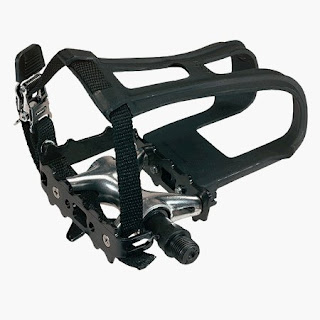
 On the left, the old clip 'n strap style pedal. On the right, an example of "clipless" pedals. The most common, by far, is called SPD. Your foot locks into the pedal, but it snaps off easily in a crash (unlike with the cages). Both types allow you to pull back, up, and forward on the pedal, so you are pedaling in circles, not just pushing down, which makes more efficient use of your muscles. They also give you greater control over the bike.
For maximum versatility on a commute bike, you can get a pedal which is clipless on one side, and flat on the other:
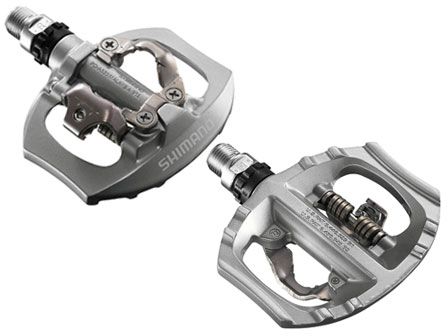
These have SPD on one side (left) and are flat on the other. There are many styles to choose from.
Having ridden many miles on flat pedals, cages, and clipless, I personally feel the clipless is worth it.
However, between the shoes and the pedals, the system can cost anywhere from $100 to $500, so just stick with whatever pedals happened to come with the bike at least until you have a well established relationship with cycling.
7) One last thing
A bicycle is considered a vehicle, and as such, they are required to follow the same traffic laws that cars do. Ride on the right side of the street. Stay off of the sidewalk (unless expressly allowed in a particular location). Stop at red lights. Stop at stop signs***. Ride predictably and signal your turns when warranted. The majority of bike/car collisions are partially or entirely the cyclists' fault. Two of the most common causes of crashes are bike riders riding on the sidewalk, and bike riders riding the wrong way (on the left side of the road). Another common cause is lack of visibility on the part of the cyclist. Eliminating these few (totally controllable) factors actually makes riding a bike statistically safer than driving a car. The thing most new cyclists worry about - getting clipped from the rear by passing cars - is actually relatively rare. Crashes happen primarily at driveways and intersections, and they happen because the cyclist was somewhere the driver didn't expect them to be.
If you are in the SF Bay Area, consider taking the FREE traffic safety course sponsored by the local Bicycle Coalitions: http://www.ebbc.org/safety
If not, check with your local shops, riding clubs, or bicycle coalition to see if anyone offers something similar.
UPDATE: I just wrote a new post specifically for new riders who aren't used to being in traffic, to help you avoid getting hit by a car.
This post has been way more popular than I ever expected, and since it is intended for new riders, I thought it would be pretty important to help y'all not only pick out a new bike, but not get run over while you are riding it!
Read this before you get on the road: http://biodieselhauling.blogspot.com/2012/06/please-ride-your-bike-in-street.html
*** I won't pretend I stop at stop signs, or even try to convince you to. But at least slow down for them, and look both ways before you cross. And always come to a full stop if there is cross traffic which has the legal right of way.
[Someone has written an article with counterpoints to this one. Personally, I disagree with him on a few points (1st off, that you should never buy a used bike!), but it is always worth getting 2nd opinions and different perspectives: http://hiawathacyclery.blogspot.com/2012/01/bike-buyers-guide-for-beginners.html]
My VERY first post.
Even before I introduce this new blog website of mine, which is taking the place of my old MySpace blog (remember MySpace?) and the free blog that came with my businesses web domain hosting (with its character limit). My second post here will introduce it a little more thoroughly than these three sentences, and after that I will start moving old existing content here.
But first I will take a break from my usual political ranting, personal stories, and posting of links I found fascinating, to fulfill a promise I made to a fellow reader of a different blog (one with actual readership, MMM) in the comment section to share some of my knowledge of bikes and of Craigslist for an audience that may not know a good bike from a bad one. Imagine that, something useful!
First, for anyone who came here via link or Google, and doesn't know me personally, my credentials on the subject:
I began riding regularly for fun and transportation in 1992, when I was 12. The next year I began riding to school every day, so that I could keep the bus money for other things. In high school, in addition to daily commuting (to school and internship) and weekend rides of 40-100 miles, I began annual 4 day trips down the CA coast with a group of teachers and friends. After college I went with the couple that had organized those annual rides from San Francisco to Puerto Vallarta Mexico, and went solo from there along the coast to Acapulco and then North to Mexico city (over an 8000ft pass) for a total of 2800 miles over 2 months. When I returned, I took a job as a bicycle messenger. I eventually ended up also working as a messenger in New York City.
In 20 years of serious riding, I have had a bmx bike, a steel touring bike, a British internal-hub drop-frame from the late 60s, a carbon fiber racing bike, an aluminum mountain bike, and two folding bikes, all of which together I paid a grand total of $450 for (of which $400 was the carbon fiber road bike).
Eventually I returned to CA where, for the past 6 years, my primary job has been as a hauler (mover, and handyman) which involves picking stuff up that people don't want anymore, and then finding new owners for those things. This involves either selling or giving away anything which is still useable (which is most of what I pick up), frequently on Craigslist.
My second job for the past 5 years has been as a mechanic in a tiny bike-shop of sorts, the Bike Station, whose primary service is FREE secure valet attended bicycle parking, but also offers relatively low-cost repairs. Because we don't sell new bikes, and because we never turn anyone away for lack of bike quality, I have been able to work on a great variety of bikes, of all types and ages and cost levels, which is rare in any one shop.
(My third job is a reserve for the Coast Guard, but that isn't relevant to this at all)
And now... on to the content!
1) This is the most important thing of all:
DO NOT BUY A DEPARTMENT STORE / TOY STORE BIKE!!!!!!!!!!!!!!!!!!!!!!
Ever. Don't even consider it. Seriously. Not even for your kid. They are absolute garbage. They shouldn't be legal to ride on public streets. They should be considered toys at best. This includes pretty much anything you can buy at WalMart, Target, or Toys'R'Us, or whatever local equivalent you may have where you live. The most common brands are Huffy, Murry, Magna, Next and Roadmaster. Generally anything branded with a car/truck name (GMC) is one of these also. One of these bikes brand new is worth less than a real bike that is 30 years old. (Actually, my favorite bike, the one that I rode to Mexico and used a messenger is almost 40 years old).
I can not emphasize this enough. Having worked on these many many times, I can say with absolute certainty that they are not worth the price if you are given one for free. They use the cheapest parts that can be found, parts which have been obsolete for decades in the rest of the bike world, and those parts are put together by people who know literally nothing about bike mechanics. I have rarely seen one, even brand new, that had everything adjusted properly. They are so cheaply made, and so poorly assembled, that they are dangerous.
The best clue that the bike you are looking at is a department store bike is if it has a one piece crank.
This is a one piece crank:
Notice how the crank arm bends where it meets the bike frame, and goes straight into the bottom bracket.
Here, in contrast, is a 3 piece crank:
Notice that in this one, the crank arm is straight, and it is bolted to the axle.
Here are the two kinds, cut-away and side-by-side (one-piece on the left):
Another clue that the bike you are considering is a rolling pile of crap is brakes that look like this:
orCalled simple caliper brakes.
Note that most road bikes will have compound caliper brakes, which are similar in shape, but slightly more complex. The keys to the crappy brakes are the rectangle brake pads and the flat metal brake arms, with just one single pivot point in the center.
Note also that occasionally older bikes may have simple caliper brakes (though they won't have flat brake arms or square pads), and it doesn't necessarily mean the bike is crap. If a bike less than 30 years old has them, stay away.
Now that all that is out of the way, lets get into what you should look for.
But wait, no, before we get to that, you have to establish just what it is you are looking for.
2) Type of bike:
Like in everything else in life, every choice you make is a series of tradeoffs. There are a lot of different kinds of bikes, that are good for different kinds of things. You can use pretty much any bike for anything, but some will make the trip a lot easier.
Presumably most people reading this are looking for something practical to commute on, (and not a racing bike or a bike to do tricks on)
Some questions to ask yourself are:
Will I want to carry a lot of stuff with me?
Will I want to go fast sometimes? (I found I am often running late, and ended up using my racing bike to commute pretty often)
Are the local roads well paved, and/or will I ever want to venture on trails?
Will I have to climb any steep hills and/or pull a trailer?
Will I ever ride in rain/snow?
How important is comfort?
How important is efficiency?
Will I be working up to high mileage sometime in the future?
If you want to carry alot, consider touring bikes or something meant specifically for commuting or hauling (of course, you can always retrofit any bike with a trailer, so that's another option)
If you want to go fast, and you don't need to carry much with you, a road-sport / racing bike will help you get there quicker with much less effort
A road-sport or racing bike, however, does poorly off-road, or with major potholes, gravel, glass, and curb-jumping
For steep hills, no matter what kind of bike, you will want not only gears, but low gears - generally that means 3 chainrings (the 3 big gears in the front, attached to the crank), like this:
Some bikes - especially ones specifically intended for casual riders or for commuting have the gears hidden inside the wheel. This has the advantage of being cleaner and simpler for the user, because all moving parts are hidden. They are also less prone to being broken and are more weather resistant for the same reason.
The trade off is that they are more expensive (to buy and to repair), heavier, and the lowest gear of an internal system will not be as low as with external gears. For this reason, if you have to ride up steep hills, go with external gears. If you ride mostly flat or only small hills, its a matter of preference.
For inclement weather, a mountain bike, hybrid, or purpose built commuting bike will outperform most road bikes - although you can put fenders and lights on anything, you can't put wide tires on a racer. This is especially true for snow.
Just like with a Cadillac and a Geo Metro, there is a trade off between comfort and efficiency. Beginners often get a bike with a wide saddle and tall handle bars, so they can sit up-right like a big rolling sofa, and then get discouraged when all the cool kids on real bikes pass them by at twice their speed everyday. Its not just that they are weak - there is a reason racers have low handlebars: the biggest factor in bicycle efficiency is wind resistance, and when you are upright, your torso is like a big parachute. So that comfort comes at the cost of twice as much effort to go the same speed. On the same note, a mid-range hybrid or mountain bike can weigh literally twice as much as a high-end road bike, which is a lot of extra pounds to lug with you up the hill to your house at the end of the day.
None of that is to say don't buy the hybrid, just understand that there are trade-offs. They are trying to be decent at everything at once, without costing much and making new riders comfortable, which means they excel at nothing.
The best compromise, in my opinion, between efficiency, bad road/trail worthiness, and bad weather capability, is a cyclo-cross bike, which is a road bike meant to be used off-road, however they are somewhat hard to find, and therefor usually expensive.
The next best all-around option, (again, in my personal opinion) which also includes cargo hauling capacity built in, is a road touring bike (which would be why that's been my primary bike for the last 2 decades).
But that isn't to say that you can have a perfectly good long-term commuting experience with a mountain bike, racing bike, hybrid, cruiser, or a 60 year old bike from before special purpose bikes existed.
If its possible, I'd recommend seeing if you have any friends with various types of bikes you can borrow for at least one ride, to see how they differ in riding position, gearing, handling, and so on.
If nothing else, maybe you can find a local bike shop and do a test ride on a couple of different bikes.
You may be taking advantage of them even more in the next step (since you will ultimately buy used directly from someone), but to make up for wasting their time, plan on buying all your accessories (minimum: helmet, lights, gloves, bell) from them, and/or having them do a basic check/tune of your new (used) bike once you get it.
3) Fit:
The only way to really get it exactly perfect in every way is to go to a bike shop and find someone who really knows all the variables, preferably with access to an adjustable bike fit machine (a stationary bike where you can change the lengths and angles of all the components and frame parts).
They often don't charge for this if you are planning to buy a bike from them, but again, if you go for a bike fitting, and don't buy a bike from that shop, you should really buy your accessories and/or service from them. Bike shops operate with a pretty small margin.
Given that you are looking to buy a bike used, and not get a frame custom built to your specifications, knowing your perfect fitment doesn't really matter anyway.
As a super quick and simple rule of thumb, when you stand over a bike frame (in front of the saddle) with your shoes on and feet flat on the ground, there should be at least 1 inch, preferably 3 or 4, between the top tube and the beginning of your... special parts. For one thing, if you were to be in a minor crash and fall forward off the saddle, you don't want to be impacting a big steel (or aluminum, or carbon) bar of bike frame. This is also an indication that the frame more or less fits you. If, when you straddle the bike, the top tube is actually touching you, that bike is much too big for you, and no matter how much you love it and no matter how good the price is, it just isn't the bike for you. I'm sorry.
On the opposite end, you can use the seatpost to judge if a bike is too big.
When you ride, your knees should be 99% of the way straight at the bottom of each pedal stroke (not 100%, or locked-out, but almost). If you don't extend your legs all the way, (imagine how it looks when an adult rides a tricycle meant for kids), you will end up hurting your knees.
In fact, if you have ever had hurting knees from riding a bike, this is the most likely reason. Your seat was too low.
(this bike is too small for him)
The seat post (the part that attaches the saddle to the frame) should have a line on it marking the maximum its meant to be extended (it may or may not say words to that effect). By loosing a screw, bolt, or quick release lever at the place where the frame clamps the post, you can raise or lower the seat height. If the post is at its highest (at the line) and when you ride the bike your legs are not extending fully, then the bike is probably too small for you. You can always buy a slightly longer seatpost if it's close, but if the seat needs to be higher than about 10 inches above the frame (assuming the top tube of the bike frame is horizontal, more on that soon), chances are the rest of the dimensions are too small for you anyway.
Of course, many bikes don't have a straight horizontal top tube running from the handlebars to the seat. The sloping top-tube or the drop-frame that used to indicate "girl's bike" (in order that the bike could be ridden in a skirt or dress) has become common on mountain bikes and commute oriented bikes and many hybrids for both genders, as well as continuing to be common for female specific road bikes. With a sloping top tube you can't just stand over it and measure the distance between your body and the frame to determine fit, and the seat-post will have to be extra long. In that case you just draw an imaginary line (or better yet, use a level and some string or a broomstick or something) where the top tube would be if it went straight across.
There is really a lot more to it than that, (such as the length of the top tube and the angle of the seat tube) but to keep things simple, 1-5 inches between you and the bike frame (or where the frame would be if it were straight) with your feet flat on the ground is about the best approximation there is.
Once you find one bike that fits, you can check the frame size (usually printed on the seat tube) and have a rough idea of what other bikes will also fit you - generally mountain bikes and hybrids will be measured in inches, road bikes in centimeters. But be aware that the numbers can vary between bike styles, brands, ages and depending on whether the top tube is horizontal or not.
So now you have some idea of what kind of bike you are looking for, and what size it needs to be.
4) Frame and components
There are hundreds of brands, with even more choices in components, so it is impossible to recommend any specifics, or break down all of the possible combinations. They all have high-end and low-end stuff, so never assume a bike is good or bad just based on the brand of the frame or the components.
Older bikes can be very good quality, just try to stay mostly on this side of the 80s, when most manufacturers switched from carbon steel or high-tensile (Hi-Ten) steel to chromoly (ChroMo) steel. The only modern bikes that still use carbon steel or hi-ten are the department store bikes, but pre-80s they were the standard for all but the most high-end bikes.
Some of the more high end older bikes did have good steel frames, particularly those made of Reynolds 531 or Columbus steel.
If you can find one, in good condition, you are looking at a good frame even though it is older.
However, unless the prior owner kept up with upgrades throughout the years, you should still consider a newer bike, as many advancements in components have been made since then.
Some brands which are in department stores today were once legitimate bike companies (most notable is Schwinn: a 10-20 year old Schwinn is likely a good bike, while a 2010 Schwinn is probably from a department store - better than a Murry or Huffy, but still not a good choice)
If it has a sticker (usually on the seat tube, near the frame size sticker) that tells frame material, avoid high tensile steel. Cromo steel, aluminum, titanium, and carbon fiber are all good frame materials, with their own pluses and minuses, but for practical commuting purposes, you should mostly be looking for steel.
Aluminum is also decent, and usually a little lighter. I prefer steel for a practical commute style bike, because it is the strongest of all frame materials, and it can be bent back after a crash and keep going strong. Any other frame type, once damaged or bent, is no longer safe to ride. However, if you find a bike that is perfect in every other way, don't necessarily shun it just because it is made of a more exotic material.
Suspension adds weight, complexity, and cost, and unless you ride off-road, doesn't serve much purpose, but if you do ride-off road, (or have giant and frequent pot-holes to contend with), it can make the ride more comfortable and give you better control. In general, for a commute bike, I would recommend skipping it.
Skinny, high pressure tires have less rolling resistance and less weight, therefore you can go faster / further with the same amount of effort. However they have less grip in bad conditions (esp mud or snow), give a bumpier ride, and are (in theory**) more prone to flats.
** In my personal experience, I have not had any more flats on my road bikes.
The curved style of handlebar found on road bikes gives you more possible hand positions, which can be nice on long rides once your hands get tired, but ultimately handlebar shape is a matter of personal preference. If possible, try a couple different styles out on the open road before becoming committed to any one type.
I would recommend an adjustable height and/or angle stem for any new cyclist, so you can choose whether to be more upright (more comfortable, but higher wind resistance) or more low and sleek, or anywhere between and change between them whenever you want, as you ride more and find what you like. Most older bikes (10 years or more) have an adjustable height stem standard. Most modern bikes have a "threadless headset" (commonly called "Ahead-set", which is actually a brand name) which are not adjustable in height, but you can attach an adjustable angle stem to it:
On the left is the traditional adjustable height stem. To change the height, you loosen the hex bolt in the center, twist the bars a little to break the connection, and pull them up. Don't go higher than the marked limit line.
On the right is the newer (threadless headset) which has limited to no height adjustability. Sometimes you can switch the position of the spacers to get a small height change.
Adjustable angle stems.
As long as this already is, I am deliberately leaving out gobs of information, because this is a basic guide, and because you are buying something used and have limited choices. You aren't custom ordering a $3000 bike, so if you have a hard-core bike fanatic friend, you can safely ignore most of what she tells you about frame butting, spoke counts, gear ratios, or the superiority of Campy parts over Ultegra and Dura-Ace. Remind her that your goal is to get from one place to another, not to win a criterium. Tell her you don't even know what a criterium is.
5) Craigslist
In case you didn't already know, Craigslist is awesome. It is one of the most effective tools combating the worst aspects of the American consumerism cycle in which we are constantly throwing away things that still work in order to buy a slightly newer version, wasting our own money along with massive amounts of natural resources. Craigslist helps recirculate our money in our own communities instead of having it siphoned off by giant soulless corporations, keeps good stuff out of landfill, and prevents material extraction and energy consumption to create new stuff, all by the simple act of bringing together people who have stuff they don't want with people who want stuff they don't have.
If you are lucky enough to live in a reasonably large city, with at least a moderate amount of cyclists, than chances are good you can find a large selection of high quality bicycles on your local Craigslist page.
If not, though, the same principals apply to buying from a yard sale or flea market.
Another option is a used bikeshop. They will generally charge a bit more than buying directly from the previous owner, but you get the advantage of a bike that has been checked out by a mechanic, and a knowledgeable person to help you with the selection process.
Expect to spend at least $100, but unless you are lucky, probably $200, possibly more. Yep, that much, for a used bike. Even an old one, or a simple one. Less than that, and the chances are good you are buying a department store bike, a 40 year old bike which was low quality when it was new, or a bike that has been left out in the rain and generally not taken care of . Spending less will likely mean that you have to spend much more in parts and service in order to get it up to decent operating condition. If a bike is decent quality, well taken care of, and severely underpriced, it may well be stolen. Don't support bike thieves. They will end up stealing the bike back from you again. That's called Karma.
A decent new bike from a bike shop is generally $600 and up, so you are still saving plenty of cash by spending $200. Of course you can always get lucky and find someone who has no idea what they have is actually worth (like I did with my $400 carbon fiber racing bike), but don't expect it.
At the same time, be aware that there are a great many over-priced bikes on Craigslist. Depending on your market, it may take some patience to find a good one. Do a Google search of the make and model of any bike you are considering. In general, look for bikes no more than 20 years old, and of course, avoid department store bikes like the plague.
So say you have read this far, determined what you need, figured out the size, and browsed around and found a few ads that seem to have good quality bikes.
Keep in mind that someone is selling the bike for a reason. More often than not, the reason is because they just never ride it. Which usually means it hasn't had any maintenance in... ever. If its been stored indoors where it is dry, that may not be a problem, but in a damp basement or a back porch, there is likely internal rust that you can't see. If you see rust on the outside, unless the person is a bike enthusiast that you trust maintained the bike, assume there is internal rust as well. A bike bought by someone who never got around to riding it is more likely to have been cheap to begin with and to not have had much care taken in its purchase.
These are obviously not hard and fast rules, but if they are selling due to a move out of state, or due to having several other bikes, the chances are a little better the bike was taken care of.
Take hold of the wheels, and try to move them side to side (perpendicular to the way they turn). There shouldn't be any play in them side-to-side, against the axle. Do the same for the cranks (what the pedal attaches to) and the handlebars, trying to wobble them side-to-side, not the way they are supposed to turn. If they are loose and wobbly, that is a sign the bike hasn't been taken care of. Those things are easily tightened (although some require specialized bike tools) but if they have been ridden loose, they are likely to need more extensive repairs.
Spin the wheels while holding the bike off the ground, and watch how the rim moves relative to the brake pads. If the rim moves so much that it hits the brakes on every revolution, this is usually repairable (by "truing" the wheel - adjusting the tightness of each spoke) but it is another sign of a bike that wasn't maintained.
Avoid a bike with any obvious dents or cracks anywhere in the frame. If a bike has been in a severe crash, there may be more damage than meets the eye. I've had a frame suddenly break on me. It isn't pretty.
Tires and handlebar tape can be replaced, and a bad paint job can discourage theft, so try not to let the aesthetic elements overwhelm the mechanical ones.
Expect a test ride, but offer to leave something with the seller (like your ID) so they know you don't ride off with it, since it is essentially its own built-in getaway vehicle.
Once you have (FINALLY) found a good bike that fits your needs, its time to make the deal.
Because this is Craigslist, don't forget you can try to negotiate. But don't be a jerk about it. Don't show up and then at the last minute claim you "only have $100" as though you forgot the asking price.
Bring cash (it lets the seller know you aren't a scammer), and show up in person (but bring a friend who knows bikes if you have one)
Always make a receipt (preferably make it in advance with blanks for the bike and seller info). It should have the make and model of the bike (both are usually written somewhere on the frame), and as much descriptive information - color, frame type, size, age, any notable features - as possible. It should also say the purchase price, date, and the buyer and sellers names. And above all, it absolutely should have the bikes serial number, which will usually be stamped into the metal somewhere on the underside of the bike (you have to turn it over to see it), most often on the bottom bracket (the thing the crank axle goes through)
If the person refuses to provide their name, or seems hesitant to have you check the serial number, there is a good chance the bike is stolen, and you should politely move on.
Having a receipt will also be useful in recovering the bike should it ever get stolen from you, or in having insurance replace it if it isn't recovered.
6) Now that you have it... time to spend a little more money
It's a good idea to have it checked out by a qualified mechanic, or at least a friend who is a bike nut. This is a perfect opportunity to pay back the local bike shop that helped you out with advice while you were shopping.
If there isn't a local bike shop around that you owe a favor to, Bike Nashbar offers some of the lowest prices you can find anywhere on bike accessories.
While you are there, you need, at a bare minimum, a new helmet. Don't use a helmet that came with the bike, or any other used helmet. They get internal damage from absorbing the energy in a crash, which may not be visible from the outside (it is basically a bundle of microscopic bubble wrap, and in an impact, the little air bubbles pop). Therefor, a bike helmet is one-time use only. If it is used, there is no way to be sure it hasn't been in a crash already. Even if it hasn't been in a crash, repeated drops, even just from 4ft up to the ground, can gradually wear away its impact protection, as can UV exposure from the sun and ozone exposure from traffic.
If you ride at night, a headlight is absolutely essential, along with the reflectors that come standard (or reflective tape if someone removed the standard reflectors). Even better is an extra bright headlight, a tail light, the standard reflectors AND reflective tape. Run the headlight even when it is light out anytime there is reduced visibility, such as when there is sun glare at dusk and dawn, or on an overcast day. I've noticed I can see cyclists better when I am driving when they leave their headlights on in daytime, therefore I now run my lights ANY time I'm on the bike, day or night, even when its clear out.
Getting hit by cars is not fun.
(I go into much more depth on both lighting, and not getting hit by cars in general in my post on riding safely in traffic: http://biodieselhauling.blogspot.com/2012/06/please-ride-your-bike-in-street.html)
Other very good things to have are gloves, which absorb road bumps and protect your hands in a fall, and a bell to warn pedestrians without having to yell.
Some people swear by cycling shorts, which have a pad built in to supposedly make sitting more comfortable. I have never cared for them. More important is to get a saddle that fits you properly. It should be slightly wider than the distance between your "sit" bones - you can feel them protruding at the bottom of your pelvic bone when you squat. Measure that distance (preferably at home alone) and look for a saddle no more than an inch or two wider than that (and definitely no narrower than that). Having that distance correct will make more of a difference than any cut-outs or gel inserts or shock absorbers or any other gizmos and "features" you find on modern saddles.
The saddle should be firm. This will feel more uncomfortable at first, but as you get used to it, and you put more miles on the bike, it will be more comfortable (and do less potential damage to important body parts) than a squishy saddle. The reason is because you sink down into a soft saddle, and it puts pressure on all parts equally, while a hard saddle supports the sit bones only, keeping everything else above it, like it should. I know the big wide cushy gel seat seems like riding an easy chair. You just have to trust me.
The reason I put this under the accessories section, and not the components, is because saddle selection varies so widely, both by gender and among individuals, that you shouldn't expect to find a bike that has a comfortable saddle for you already in place. You might get lucky, but don't reject an otherwise good bike because the seat is uncomfortable. If possible, try to find a shop that will let you trade, if the one on your bike is in good shape, but just not right for you.
"Clipless" pedals - a system of a pedal and shoe combination which snap together - are much safer than the old "clip and strap" (cage) style pedal, and are much more efficient than simple flat pedals.

For maximum versatility on a commute bike, you can get a pedal which is clipless on one side, and flat on the other:
These have SPD on one side (left) and are flat on the other. There are many styles to choose from.
Having ridden many miles on flat pedals, cages, and clipless, I personally feel the clipless is worth it.
However, between the shoes and the pedals, the system can cost anywhere from $100 to $500, so just stick with whatever pedals happened to come with the bike at least until you have a well established relationship with cycling.
7) One last thing
A bicycle is considered a vehicle, and as such, they are required to follow the same traffic laws that cars do. Ride on the right side of the street. Stay off of the sidewalk (unless expressly allowed in a particular location). Stop at red lights. Stop at stop signs***. Ride predictably and signal your turns when warranted. The majority of bike/car collisions are partially or entirely the cyclists' fault. Two of the most common causes of crashes are bike riders riding on the sidewalk, and bike riders riding the wrong way (on the left side of the road). Another common cause is lack of visibility on the part of the cyclist. Eliminating these few (totally controllable) factors actually makes riding a bike statistically safer than driving a car. The thing most new cyclists worry about - getting clipped from the rear by passing cars - is actually relatively rare. Crashes happen primarily at driveways and intersections, and they happen because the cyclist was somewhere the driver didn't expect them to be.
If you are in the SF Bay Area, consider taking the FREE traffic safety course sponsored by the local Bicycle Coalitions: http://www.ebbc.org/safety
If not, check with your local shops, riding clubs, or bicycle coalition to see if anyone offers something similar.
UPDATE: I just wrote a new post specifically for new riders who aren't used to being in traffic, to help you avoid getting hit by a car.
This post has been way more popular than I ever expected, and since it is intended for new riders, I thought it would be pretty important to help y'all not only pick out a new bike, but not get run over while you are riding it!
Read this before you get on the road: http://biodieselhauling.blogspot.com/2012/06/please-ride-your-bike-in-street.html
*** I won't pretend I stop at stop signs, or even try to convince you to. But at least slow down for them, and look both ways before you cross. And always come to a full stop if there is cross traffic which has the legal right of way.
[Someone has written an article with counterpoints to this one. Personally, I disagree with him on a few points (1st off, that you should never buy a used bike!), but it is always worth getting 2nd opinions and different perspectives: http://hiawathacyclery.blogspot.com/2012/01/bike-buyers-guide-for-beginners.html]
25 October 2011
Dramatically reduce unemployment - with no cost to government - by instituting a 35 hour work week
Tuesday, October 25, 2011 (UPDATED 15 SEPT 2013!; new petition currently active)
Dramatically reduce unemployment - with no cost to government - by instituting a 35 hour work week
Please sign my federal petition:
http://petitions.moveon.org/sign/a-35-hour-work-week-will
Whatever the response is, it will at least bring this issue to the attention of American politics which is the first step toward action.
It may never happen, but it will get people thinking about things they take for granted; like the purpose of the economy, production, employment, unemployment, distribution of wealth, etc.
It has become common practice when talking about the economy or the market to treat them as though they were an end in and of themselves, and inherent good regardless of their effects. We seem to have completely forgotten that the whole point of having an economy in the first place is to serve and better the lives of actual people. Over the past half century improvements to the economy have not translated to improvements in the lives of the majority of Americans. We all need to stop, step back a moment, and ask the question: in that case, what is the point?
When individual citizens are asked to make sacrifices for the sake of "the economy", that means citizens are here to serve the markets, instead of the markets being here to serve the citizens.
The petition website has a character limit; here the original text I wrote for it:
A 35 hour work week will create 22 MILLION jobs without costing the federal government or tax payers anything.
There are currently 14 million unemployed American's, so this will eliminate all unemployment, and then it will push wages up as employers are forced to compete for a limited labor force.
Literally ALL arguments against a 35 hour work week (that it would hurt business or make America less competitive, etc) can be countered by the simple fact that those same arguments were made against the 40 hour work week, and none of those things happened.
The 40 hour work week dates back to the early 1900s, with it becoming federal law in 1932.
Since that time productivity per worker has increased well over 1000%. This means each US Worker produces more than ten times as much in an hour of labor than when the current work week was created.
This has not manifested a corresponding 10 fold increase in average wages.
Productivity has increased over 400% since 1970 alone. In that same time, total GDP has increased even more dramatically, by 1400%.
And yet, since that time, wage income (adjusted for inflation) has been completely stagnant.
The reason for this disparity is that literally 100% of the additional profits made possible by new technology and globalization have gone to corporations and investors, while 0% have benefited the working and middle classes. The average worker produces approximately $100 thousand a year in output, yet receives less than $40 thousand in wages.
While many employers will object that they can not afford it, the enormous increases in productivity per worker and total GDP prove indisputably that they can. Income inequality is at an all-time high, and thanks to patent, tax, and labor laws there is no longer any correlation between income and how much an individual contributes to society or how hard they work. The unprecedented profits which have gone to corporations and investors between the time the 40 hour week was created and today are more than enough to cover the minor costs associated with taking the next step to a 35 hour work week.
The 35 hour work week must apply equally to hourly wage AND salaried workers, and even to commission based employees. In our current system millions of people are forced to work unpaid overtime hours because they are paid salary. These people should be entitled to overtime at a rate of 1.5 times their weekly pay (annual pay divided by 52) divided by 35 hours. This needs to be stated explicitly in the law to prevent abuse by employers. No industry should be exempt, the only exception being if an individual or union VOLUNTARILY chooses to waive their rights.
In order to protect the lowest paid workers, a 35 hour work week must be coupled with an increase in minimum wage so that full-time employment at minimum wage constitutes a living wage. A minimum wage of $11.50 would equal $20,000 a year (before taxes, assuming 10 days of holidays, vacation and/or sick days per year).
Finally, in order to protect American jobs from outsourcing (and reclaim jobs which have already been outsourced), the 35 hour work week could also be coupled with a tariff on any goods sold by a US based company, which was manufactured or assembled in another country, unless that other country has labor and environmental laws as strict or stricter than the US, or if the individual company voluntarily abide by US labor and environmental laws.
A 35 hour work week would give hard-working families a much needed and deserved break, while creating enough jobs to end unemployment completely.
--------------------------------------------------------------------------------------------------------
I have already received a number of very good questions and comments about this idea - but I have answers for them all:
Legitimate point:
"How could you prevent this from decreasing productivity?"My response:
I don't claim it won't drop total productivity, although it is possible that as a side effect of more free time people will become more productive.
My point is productivity per person has ALREADY increased 1000% since the 40 hour week was enacted. And that 1000% increase has not resulted in a 1000% increase in wages, nor a 1000% decrease in working hours, nor a 1000% decrease in CPI, nor any combination of the three.
We don't need as much productivity as we have.
That's why unemployment is so high.
If, in order to just maintain, you have to be growing at all times, then the system is obviously inherently unsustainable, and yet growth is the only solution normally proposed to absorb all of our excess labor capacity. Yet we all consume too much as it is.
If everyone were to, say, discover Mr Money Mustache and join in, there would be a lot less consumption, and a lot less needs to get done. But there will always be people in the accumulation phase who need work.
Even without that scenario, if consumption doesn't grow fast enough, there are more people who need work than there is work that needs to be done.
Our current "solution" is to have some people work full time, and pay others to look for a job.
We could just as easily have everyone work just a little less, and spread the effects out across the entire labor force - and not have to pay any unemployment.
The reason it creates job is because right now you have 130 million employed people doing 5.2 billion hours of work per week.
That means the current economy needs 5.2 billion hours worth of work done per week. If there was more or less than 5.2 billion hours worth of work to do, companies would be hiring or firing people accordingly.
But now say each person can only work 35 hours, or else the employer has to pay them time and a half. That's a pretty steep premium.
Now, in order to get 5.2 billion hours of work done, you need 148 million people to do it. Boom, instant 18 million jobs.
18 million is more than the total number of unemployed people. In other words, it becomes a employees market - which raises wages due to supply and demand.
If, as many suggest, it had the effect of creating more overtime hours instead of more jobs, I'd consider that a success too, it is still allowing employees to reclaim some portion of their own productivity that has been lost over time.
Legitimate point:
"I am payed for 40 hours, I actually work around 45 to 50 per week for the same pay. Sometimes I work even more, nights and weekends for the same pay... If we have a 35 hour work week, I loose 20 hours of pay/mo and still work 45-50 hours, nights and weekends. I am on a salary... Won't work for me"
My Response:
In California at least (except for a few specifically exempted professions) people on salary are still entitled to time and a half pay for hours over 40 in a week. If you are not being paid for working overtime, you should be looking for a good labor lawyer. See: http://www.dir.ca.gov/dlse/faq_overtime.htm
The fact that this law is almost never followed has more to do with the decline of unions than probably anything else.
Regardless of the length of the work week, there should be a similar law on the federal level that explicitly states that overtime laws apply to workers on salary and commission. Not only does it demean human dignity that money is put above everything else in life, but an overworked workforce is less productive per hour anyway. Forced overtime should also be illegal.
So, I also propose to explicitly include salaried and commissioned workers in the 35 hour week. Even on salary, anyone who went beyond 35 hours would be required to be paid time and a half based on what their weekly salary divided by 35 hours works out to, as it is in California. So a person in your situation would actually benefit even more than wage earners, as you would either get much more free time and/or a substantial boost in pay.
Legitimate point:
"The French tried that already, and it didn't accomplish what it was supposed to. They eventually gave it up"
My response:
First of all, it has not been given up yet.
Further, there were always some differences between France in 2000 and us today. One of the more significant ones is that French employers are not allowed to lay off workers when business is slow, which makes them even more reluctant to hire new ones than our fixed per worker costs.
Another difference is the size of our economy, and how much tangible goods we manufacture and export.
Overtime after 35 hours is as little as 1.1 times (+10%) regular pay in France (as opposed to our 1.5, +50%), so employers had less incentive to hire new workers rather than just pay existing ones slightly more for 4 hours a week.
Plus, apparently the way they set it up left a lot of big loopholes from the start, (for example, a 5 minute break could be considered off the clock even if it wasn't considered off the clock before the rule, so instead of actually reducing hours, employers could just redefine them). Apparently no one kept any records of how many hours workers actually worked before and after the law, but it is likely to have been a much smaller change in reality than on paper.
In 2003 (2 years after it went into affect) the law was changed so that overtime could be paid at regular wages (making the 35 hour standard meaningless in practice - yet still retaining the 35 hour as a standard)
Despite all these caveats, 300,000 new jobs were in fact created during the 3 years the law was fully active.
Unemployment dropped from 11.5% in 1997 (a year before the first, voluntary, phase of the law went into affect) to 8.5% in 2001 (a year after the mandatory provisions went into affect). After it was weakened in 2003 unemployment went up to about 9.3% for 3 years, dropped briefly, and then was essentially repealed completely in 2008, after which unemployment immediately climbed from its 7.6% low back up to 10% within one year.
http://www.google.com/publicdata/explore?ds=z8o7pt6rd5uqa6_&ctype=l&strail=false&bcs=d&nselm=h&met_y=unemployment_rate&fdim_y=seasonality:sa&scale_y=lin&ind_y=false&rdim=country_group&idim=country:fr&ifdim=country_group&tstart=859186800000&tend=1314169200000&hl=en&dl=en&uniSize=0.035&iconSize=0.5&icfg
How much these changes were due to the 35-hour work week and how much to other economic factors is debatable, but the data definitely doesn't support the idea that the 35 hour week hurt employment.
Legitimate point:
"It seems like the current unemployment is the result of an unusually large recession, and the fact that much of our previous boom was built on fake housing prices and borrowing, so the jobs related to that disappeared when the bubble popped. To fix it in a free-market sense, you need existing industries to keep growing ...and new industries to grow. "
and
"I too would like to see a more bell-shaped distribution with a smaller standard deviation. But if the "area under the curve" starts to decrease (GDP decrease), then everyone looses."
My Response:
One of the main reasons I hope to get this idea talked about is to get away from the traditional view of the economy.
Most specifically, I want to challenge the mind-set that "growing the economy" (mainly by increased consumerism) is inherently good and the primary goal of policy, as well as the only way to improve living standards.
The problem with expanding the economy in order to create jobs is that, as a society, we really have everything we need (and then some) already.
The flip side of consumption is production. The whole idea behind encouraging American's to buy more stuff is to "grow the economy". All the stuff that gets produced has to be bought by someone. The environmental impact of 300 million people working 40 hours a week at our current productivity levels is simply unsustainable, because it would necessarily mean an enormous amount of natural resource extraction for the purposes of production, and a corresponding increase in consumption. Therefor I believe it makes more sense to share the work we already have, rather than try to force there to be more work to do - especially since the marginal effect of additional wealth on the happiness of middle class Americans has consistently been shown to be zero
It is basically Jacob's (of Early Retirement Extreme) "Broken Window" theory of jobs. If someone throws a rock through your window, you have to hire a glassmaker to come and put in a new one. Now that glassmaker has a job and money just traded hands. So, technically, GDP has increased, and supposedly this is good for "the economy" and therefor society. However, nothing new of value has been created. In fact, resources were used up and wasted. This means that, while on paper, society is richer for the broken window, in reality we are poorer for it. The paper accounting and the reality are in direct opposition to each other.
The "service economy" is more or less just economic masturbation.
It reminds me of the story by Kurt Vonnegut where in the future automation had made work obsolete, so the government has people building multiple bridges over the same river, just in order to give people something to do since society is convinced it is morally irresponsible to just give everyone welfare checks even if society can afford to.
Growing the economy for its own sake, once a comfortable standard of living has been established, is actually counter-productive.
Legitimate point:
"1) Why not go further? Research shows part-time workers are more productive than full-time workers per hour, AND, they have better involvement in family and community...
2) Part-time workers need protection for basics like healthcare benefits"My Response:
1) I didn't go further because I know there would be enormous resistance as is, and it would be stronger the more extreme the change; both from employees (who would be losing 12% of their salary upfront) and employers (who have some fixed per/worker costs and therefor prefer the smallest possible workforce)
2) Healthcare should be provided by the government.
Legitimate point:
"How does the tariff relate to WTO and such? Is it even legally possible at this point?"
My response:
I don't know the details, but my idea is that you would bypass trade treaties by only applying tariffs to goods made by US companies. If it is a US based company already, then the "imports" aren't affecting the trade balance. The idea is just to de-incentivise employers building factories in 3rd world countries for cheap labor and then shipping products around the world back to US marketplaces.
- Incidentally, I have dropped this part of the proposal from my more recent petition -
"The downside of this is fat countries like the US will see a flattening of the wealth curve and regression to the mean which means a lowered standard of living for us while the rest of the world enjoys the benefits of world capitalism. I probably won't live to see the day when human capital will flow across borders as monetary capital has done for centuries. But you might and you won't like it when a desperate kid from the Mekong delta can do your job for $1/hour and be happy to get it. So much for a 35 hour workweek..."
My response:
Even though I personally stand to lose from a lowered standard of living overall in the US, I actually find that to be a perfectly reasonable outcome. We have way more than we need. We have so much that more has no affect on happiness. We are living way over the sustainable rate of natural resources regeneration. And we didn't earn that privileged, we got lucky by being born in the US. On top of all that, nearly all American's could easily maintain their current standard of living with 1/4 to 1/2 their current income, if they just stopped wasting so much of their money. If we didn't have so much excess, we would learn to stop throwing it away.
(I have become a big fan of Mr Money Mustache and Early Retirement Extreme of late)
If I were king of the world, the extreme wealth of the top 0.01% of the US would not be distributed to the American middle class. It would be distributed to the Third World.
However, all that said, this proposal has provisions to decrease outsourcing. There is nothing about it which would make "human capital" any more able to cross our boarders. The situation being described is the situation we have been facing for decades, which this proposal aims to amend. Outsourcing is one of the reasons for increased profits for wall street at the expense of employment and wages. Protecting those profits will not do anything to help the situation.
Legitimate point:
"for someone who's used to spending $X and desiring more money rather than more time, they wouldn't be happy to have to "sacrifice" their annual flat screen upgrade for an extra 5 hours per week.
A further problem in the US is that hiring extra workers comes with more fixed costs (benefits). It's in the interest of the way the system has been set up to have as few workers working as much as possible. Not a very smart way to do it, but that's the starting point."
My response:
I know that many many people will object - both the workers who lose hours and therefor pay, and employers who have fixed costs per employee. I don't expect it to happen (at least not anytime soon). But I do think it should be something people are talking about, if only to set the stage for the future, or even if only to challenge peoples assumptions about things they take for granted; like the purpose of the economy, production, employment, unemployment, distribution of wealth, etc.
Then again, the 40 hour week must have seemed just as impossible to the people who fought for it in the early 1900s - at a time when 80hour weeks were considered normal - and it eventually became an almost worldwide standard.
Legitimate point:
"I am more interested in changing the way business reward workers. It'll be nice to be rewarded as a function of economic output instead of the amount of time a person show up at a business.
It drives me nut to sit for 8 hours while doing 2 hours of real work for most of the year."
My response:
I'm with you in principal, but I can't think of any practical way to put that into practice universally. Can you?
Even if it were to be done, my original point - that wages have not kept up with productivity gains - would still be true. You generate more towards GDP in your 2 hours than a 1850 worker did in 12 hours.
Besides, there is good reason to believe that a shorter workweek would actually increase productivity. Note that in Europe, where the average work week is several hours lower than our own, productivity per worker per hour is actually higher.
For a likely explanation of that, see: http://www.mrmoneymustache.com/2011/10/25/the-joy-of-part-time-work/
Legitimate point:
"I am afraid this will be an automatic no-go. Wally*World will never let it fly. Wally hires people "under" a 40 hour week in order to consider them part time. This is why most of the WW people have no benefits."
My response:
Wally already hires people for 34 hours a week, which is still less than 35. They currently offer healthcare plans to anyone over 24 hours per week, so this change would not affect that threshold at all.
---------------------
The following questions were asked to me by someone who not only supports the principal, they are actually actively advocating an even shorter work week (20 hours, which I fully support in principle, but I am not sure it is as politically feasible at this time.)
1.- Why only 50 signatures? I was thinking maybe 100000 to really be take seriously. 50 is too low.
Because 50 is the threshold I have to generate before moveon makes the petition live on their site for the general public to see and sign. Then it can build it's own momentum.
2.- I really don't believe in writing politicians because they could care less if we have 100, 1000, or 1000000 signatures. All they see in those papers is something that can be used when they run out of toilette paper. If they see 1 million signatures on one side, from citizens requesting to do one thing or to vote one way, and on the other side they also see 1 million dollars in campaign contributions from corporations to do the opposite, the politicians are more likely to do what corporations ask, no question about it. However, I will still sign your petition because your goal is mostly to create momentum and awareness. I do have a similar petition, but for Sharan Burrows, head of the largest union in the world, ITUC, to call for a global strike to implement the 4 hour work-day. You can check it out by clicking on this link http://www.change.org/petitions/sharan-burrow- general-secretary-of-the-ituc- please-call-for-a-global- strike-to-implement-the-4- hour-work-day-worldwide
You answered your own question. My "goal is mostly to create momentum and awareness."
3.- 35 hours is not enough. If we do the math, 4 hours a day is not enough either. It should be 3, like Keynes predicted it (and I am not a Keynesian, but he was right about this). 35 is too short of a reduction. It could be easily reversed, like the French did. It would not be the same to tell people to work one more hour (from 7 to 8 hours) than to tell them to go from 4 back to 8 hours. It is harder to reverse a 4 hour work-day. The jump is higher and people will fight it. Also, a 4 hour workday request leaves room for negotiation, because corporations will fight against it for sure. We might not achieve the 4 hour work day but maybe the 5 or 6 hour work day. It's like selling a car. If you want to get $10000 for the car, list it for $12000 so you can have some room for negotiation and still get what you wanted. With 35 hours, you have nowhere else to go but back to the status quo of "40 hours" (And I put it on quotation marks because we work more than 40 hours a week) These are not the strongest reasons why we propose 4 hours (the strongest reasons are the economic reasons explained in my website) but I mention it just so you can have a different perspective.
I agree 100%. But, again, my goal is creating awareness. What 1 million signatures would do is potentially grab media attention. From conversations with people, I suspect 35 will be more palatable for larger numbers of people. The math works out that we should have 4 hour work WEEKS, given the rise in productivity since the 40 hour week began. But almost no one considers math or history when they form opinions. My primary intention is to just crack people's assumption that "40" is somehow a magical default number, the given standard. I want people to realize that WE (society) choose the number, it is not arbitrary, or handed down from the Gods, and that it can - and should - change proportionately with productivity. I want people to realize that the gains of productivity have gone disproportionately to the top 0.1%, and this is the primary reason for growing wealth inequality.
4.- There is nothing impossible in this world. Women did not think that fighting for her right to vote at the beginning of the 1900's was impossible. Martin Luther King did not think that his dream was impossible either. Relying on politicians to implement a 4 hour work day worldwide (yes, not just the US but worldwide. More on that later) is however highly unlikely. That's why we need to do it via a strike, a global strike, the same way we reduced the work day from 16 to 12 and then from 12 to 8.......with strikes. When you shut down the flow of money to the corporation's pockets, they will begin to listen.
That's not really a question! :P
As before, I agree with you 100%. The trick is getting a large enough portion of the general public involved. OWS is what started to make me think there was a chance in today's environment of making real progress on economic issues.
5.- why a reduction in income? That will not only gain opposition from the politicians and corporations but also opposition from the citizens, public in general. They would not support an idea that reduces their income, specially during a recession. With work-time reductions, income can remain the same. Business will have higher labor costs, yes, but also will have higher revenues due to the increase in aggregate demand, caused by full employment and a switch of bargaining power from the employer to the employee. That will allow them to cover the higher labor costs and still report profits. I explain that in more detail in my website.
Mainly because it would be very complicated to try to have everyone keep a fixed income with a change in hours when some are paid hourly, others on commission, still others on salary, and current work hours vary wildly. Could government effectively enforce a mandatory across the board 15% raise? I doubt it. Plus, there would already be many loud cries, on all sides of the political spectrum, that small and medium business could not afford to hire more workers to replace the lost hours.
Also, I believe the American middle class makes more money than anyone really needs. We, as a society, need to eventually start valuing life as much as we value consumption. We are extremely wasteful, and there are ecological consequences to that. Anyone who (for example) buys a new car is not hurting for money - though they may be making poor choices as a result of being used to excess wealth.
6.- I have issues with tariffs because it creates a distortion on the market. I am not a big fan of the market system either but that is what we have unfortunately. If I was the CEO of a US company and I am faced with tariffs on US products made overseas, I will bring the production plant back to the US but I will make it fully automated, which will be even cheaper that producing the goods in China. That will not generate the many jobs we want, unless of course we reduce the workday dramatically, like 3 or 4 hours a day. Another reason why I think 35 is not enough.
I think free trade causes distortions in the market. It is facilitated by a finite supply of artificiality cheap petroleum. It is used to circumvent labor, tax, and environmental laws. Any place we import from should be held to US labor and environmental laws, and if not, I see no distortion in evening things out with tariffs.
That said, I have dropped that portion of the idea from the current petition, to keep it simple and to the point.
7.- why just the US? If we reduce the work-day only here and the Canadians don't, then the Canadians will have more competitive advantage than the US. The reduction needs to be everywhere. You might be thinking that France implemented the 35 hour work-week alone and therefore it would be ok for the US to do it alone (and you might be right) but that brings me back to the point that 35 is not enough of a reduction.
Because no one people can force change on everyone else. I happen to be a US citizen, so this is where my focus is. At the same time, the US is the economic and cultural center of the world (for now), and places that are more politically liberal that might be more inclined to do something like this on their own are more likely to follow America's lead than the other way around. The US was the first country to adopt the 40 hour week (prior to which there was no maximum at all), and the majority of the developed world has followed suite since then.
8.- You seem to understand very well the concept of work-time reductions (you even seem to know more things that I do). You also seem very passionate about it too. Is there any reason? I am just curious. I hope we can work together on this endeavor.
I'm just an average ordinary guy. I have an associates degree in economics. I try to pay attention to how the world works. In this case, I saw a problem which (unlike most) actually has a clear solution, but very little of the general public, politicians, activists, or anyone else (present company excluded, of course), seems to have any awareness of it. If I could change that - from home, just using the internet(!) - I have to at least try.
==========================================================================
If you have actually read through all this, and haven't gotten bored of the topic yet, here are a few more articles I have written questioning the conventional wisdom - shared by both sides of the political spectrum, but completely wrong - regarding the economy:
http://biodieselhauling.blogspot.com/2012/06/poor-person-never-gave-me-job.html
http://biodieselhauling.blogspot.com/2013/04/spoiled-economic-downturn-luxury-as.html
http://biodieselhauling.blogspot.com/2013/01/SupplySideEconomics.html
http://biodieselhauling.blogspot.com/2012/06/free-market-vs-democracy-1-0.html
http://biodieselhauling.blogspot.com/2012/02/numero-ocho-in-which-i-point-out-that.html
http://biodieselhauling.blogspot.com/2012/04/22-wealth-should-be-taxed.html
http://biodieselhauling.blogspot.com/2012/03/heading-14-in-which-reparations-are.html
http://biodieselhauling.blogspot.com/2012/12/anarchy-vs-capitalism-anarchycapitalism.html
http://biodieselhauling.blogspot.com/2012/07/in-which-progressive-writes-article.html
http://biodieselhauling.blogspot.com/2013/06/flat-tax.html
http://biodieselhauling.blogspot.com/2012/03/article-11-in-which-inheritance-should.html
http://biodieselhauling.blogspot.com/2013/03/capitalists-libertarians-and-anarchists.html
http://biodieselhauling.blogspot.com/2013/06/response-to-turning-hustlers-into.html
http://biodieselhauling.blogspot.com/2012/12/comments-from-mmm-economics-philosophy.html
http://biodieselhauling.blogspot.com/2013/07/if-i-were-elected-king-of-country.html
http://biodieselhauling.blogspot.com/2013/04/spoiled-economic-downturn-luxury-as.html
http://biodieselhauling.blogspot.com/2013/01/SupplySideEconomics.html
http://biodieselhauling.blogspot.com/2012/06/free-market-vs-democracy-1-0.html
http://biodieselhauling.blogspot.com/2012/02/numero-ocho-in-which-i-point-out-that.html
http://biodieselhauling.blogspot.com/2012/04/22-wealth-should-be-taxed.html
http://biodieselhauling.blogspot.com/2012/03/heading-14-in-which-reparations-are.html
http://biodieselhauling.blogspot.com/2012/12/anarchy-vs-capitalism-anarchycapitalism.html
http://biodieselhauling.blogspot.com/2012/07/in-which-progressive-writes-article.html
http://biodieselhauling.blogspot.com/2013/06/flat-tax.html
http://biodieselhauling.blogspot.com/2012/03/article-11-in-which-inheritance-should.html
http://biodieselhauling.blogspot.com/2013/03/capitalists-libertarians-and-anarchists.html
http://biodieselhauling.blogspot.com/2013/06/response-to-turning-hustlers-into.html
http://biodieselhauling.blogspot.com/2012/12/comments-from-mmm-economics-philosophy.html
http://biodieselhauling.blogspot.com/2013/07/if-i-were-elected-king-of-country.html
Subscribe to:
Comments (Atom)